Core a cue?

I build all of my cues on a full 29" dowel and there is no A-Joint as far as a connection with an A-Joint bolt. This begs the question of the loss of the extra weight for that a-joint bolt within the cue. My answer to that was to engineer a weight and balance system whereby the fulcrum of the cue or balance is based on a weight bolt epoxy embedded behind the joint pin.


I may be wrong, but in the upper right of your picture it looks like a forearm that has an "A" joint tenon...JER

Jer,

Very observing eye.

That was a test piece of handle maple I used for setting the bed angle and depth of cut on my point groove machine. I was doing some tweaking of my point geometry at the time. The tenon you see was marked for specific insertion dimensions into the 5C collet chuck on my indexer as I hold my point geometry based on a 15.250 - X off my tail stock as 0 on the table to attain height and width repeatability while doing the points.

I still do an occasional A-Joint cue now and then because I have some point forearms in my shop that have been hanging around for some years.

Rick
 
Last edited:
I try to make a cue the requested weight by the woods that I use. I usually get pretty close. A few cues I have had to add weight after assembly. Lately I am weighing before final assembly of the butt so I can put some weight in the front if needed. I have a request for a 60 inch - 21 oz cue. I did a full core of PH with an 18 in piece of coco and the rest is CM. Add a pin, bumper, rings, and Juma ends and the butt weighs close to 17 oz. Ad a 4+ oz shaft and you have a 21 oz cue. I know that this cue will feel balanced and most likely lighter than 21 oz when shooting with it.

I have noticed that if a cue has weight added in the rear of the butt, it feels heavy and clumsy. If the cue is naturally weighted and balanced by the wood it is made from, it may weigh the same on a scale but it will feel lighter to the shooter. For my perception, a slightly front or nose heavy cue also feels lighter that it will show on a scale and feels better when playing.

but what do I know........ I am still learning

Kim

I think that depends on how the player holds and strokes his cue.
I know stroke slippers like heavy cues and like front heavy cues.
The big elbow droppers like light cues and like the weight in their grip hand ( from what I have gathered ).
Properly placed added weight ( up to a certain amount ) should actually make the cue hit better imo. Kenny Koo and I had this conversation with a pro player two weekends ago. He was begging for some 1/10th to 1/5th oz added to his cue. He said that extra weight will help when he throws the cue to the cueball.
As far as the A-joint, imo the A-joint is an opportunity to join two contrasting woods in compression mode ( threaded and epoxied ) . That combination of two contrasting woods makes it better than a single one long dowel. It'd be easy to prove as far as tone too. 15" + of maple threaded and glued to a 15" purpleheart will resonate better than a single 30" maple.
Balabushka even thought by adding a phenolic sleeve between two cylinders eliminated end grain to end grain contact, added more strength and improved the hit .
 
I think that depends on how the player holds and strokes his cue.
I know stroke slippers like heavy cues and like front heavy cues.
The big elbow droppers like light cues and like the weight in their grip hand ( from what I have gathered ).
Properly placed added weight ( up to a certain amount ) should actually make the cue hit better imo. Kenny Koo and I had this conversation with a pro player two weekends ago. He was begging for some 1/10th to 1/5th oz added to his cue. He said that extra weight will help when he throws the cue to the cueball.
As far as the A-joint, imo the A-joint is an opportunity to join two contrasting woods in compression mode ( threaded and epoxied ) . That combination of two contrasting woods makes it better than a single one long dowel. It'd be easy to prove as far as tone too. 15" + of maple threaded and glued to a 15" purpleheart will resonate better than a single 30" maple.
Balabushka even thought by adding a phenolic sleeve between two cylinders eliminated end grain to end grain contact, added more strength and improved the hit .

You are right.... I play with a very good player that has a cue that feels like he has a lb of lead in the ass end of it. He loves it and is an APA 7.

go figure.......... to each his own I guess

kim
 
Balabushka even thought by adding a phenolic sleeve between two cylinders eliminated end grain to end grain contact, added more strength and improved the hit .

Hi,

Omega DPK also used a large diameter threaded composite material sleeve as an A-Joint. I did not know why but after reading Joey's comment I think that fact has been revealed.

Rick
 
Last edited:
Hi,

Omega DPK also used a large diameter threaded composite material sleeve as an A-Joint. I did not know why but after reading Joey's comment I think that fact has been revealed.

Rick

Hi,

I had a lot of Omega DPK stuff at my shop last week and I thought I took a pic of that large fiber A-Joint. I will get a pic of it and post it later.

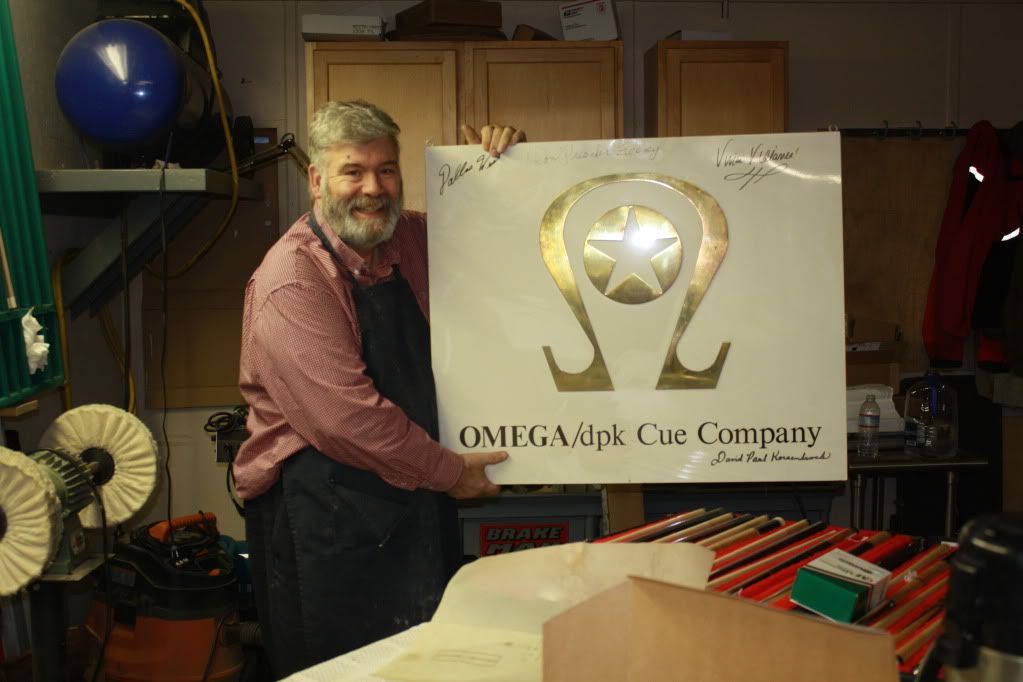
Here is the Omega Sign from the Waconda Shop that Todd Sold to an unidentified collector. Pretty Cool. Note the signature on the bottom right. DPK himself.

Rick

IMG_3922.jpg
 
Back
Top