Question for the palmer collector

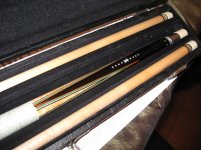
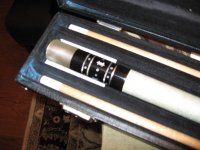
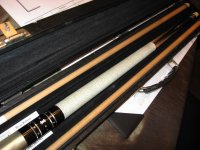
Here's a pic of my model M in the case that came with it. I'll never sell it...after all, that's my name under the clear plastic ring. ;)

Another pic of it might show the bumper...this cue is not refinished or restored. Shortly after buying it, I quit playing for a few decades.

Sweet. They didn't make 300 of those a week, I'll guarantee you that.

Kevin
 
i was friendly with gene and had him make me cues that i would sell after i played with them. a couple of his in the catalog were ones i had him make and then he put them in as he liked them and they were simple. i even would tke him old Brunswick titlest sticks to convert. and when i could get a bunch he bought them for 5 to eight dollars. they were eight new earlier.
also some plain ones that had nice wood. house cues that werent used so i got a good deal. i did the same with frank until i gave up on him.
 
Bump for the Palmer Collector

ken

Thanks for the PM. I've been really busy with work so I have neglected my pool cue time.

There were no hardcore records kept. Many years ago I interviewed Pter Balner, grilled him for months to get as much information as I could. Most of Palmer's higher production numbers were in the least expensive designs. For example, they may have turned out batches of 300 cues in a week, but they were the plain cues like the 3rd catalog Model 1, or special runs.

Most of Palmer's orders in the first and 2nd catalogs and the fancier cues of the 3rd catalog were made to order. They would make several hundred blanks, complete but unfinished handles with joints, then personalize them with inlays and name labels, wrap to order, fit the shafts and ship them off in a few weeks. Also, the designs had longevity. Most models were sold over as much as a 10 year period. Even in the 1980's you could order a design from the 1960's or 1970's.

The fancy designs like the Model M, the Model J, a lot of the 2nd and 3rd catalog cues spliced with ebony, were hard to produce in quantity because the blanks were made in small shops, Palmer's or Szamboti's.

Palmer bought huge lots of Titlist blanks in the 1960's from Brunswick, crates numbering in the thousands. This gave them the ability to produce Titlist based cues in decent quantity. Before reaching this volume, which enabled Palmer to buy directly from Brunswick, Palmer went to pool rooms and bought house cues for conversions. Palmer also sold blanks, shaft dowels, and wraps to cue makers like George Balabushka.

The fanciest designs and the most collectible Palmer's like the Model M, the J, the Model 11 first catalog, the Model 20 - even though these were popular cues, the numbers were in the 400 to 700 range total for the life of the design. Even in these cues there are a myraid of variations in the designs, customization, etc because they were made to order. Palmer had many one off customs which were based on one design or another.

During the 3rd catalog years, production of the affordable designs hit their peak. These are plain cues that were not made to order and weren't personalized, sold through dealers. The 3rd catalog Number 1, for example , had a total production of 10,000+.

I have never published production numbers because hard core numbers weren't kept and all I have is estimates. So I'll just say something like "about 500" and hope people get something from that. The survival rate is a lot lower than the production rates.

The Palmer PM and PB lines were made by Adam (to Palmer's designs) and distributed by Palmer - these production numbers are high, in the several thousand per design. The Palmer Margo "Bullets" were made in the Palmer shop and had very low production.

Anyway, hope that gives you an idea.

Chris

 
Last edited:
Chris, This a quote from Ken's post:

"The second Palmer catalog featured thirteen new cues with letters for model designations ranging from Model A to Model M. The most visible change in these cues was that the butt caps were twice as long, but they still were without bumpers."

Yet my model M, bought new, definitely has a bumper. Your thoughts on this?
 
Chris, This a quote from Ken's post:

"The second Palmer catalog featured thirteen new cues with letters for model designations ranging from Model A to Model M. The most visible change in these cues was that the butt caps were twice as long, but they still were without bumpers."

Yet my model M, bought new, definitely has a bumper. Your thoughts on this?

That's the late 1960's and they started coming with bumpers right after that - the 2nd catalog photo does not show bumpers - too many broken and chipped buttcaps I assume. Since they were push in style, it was no big deal to add or remove them.
 
Well how many of these bad boys were made?:thumbup:

This is my most recent pickup. This cue has an interesting story as it was ordered out of a pool room in Louisville and the owner played with it until he quit playing pool years later. Sold it to the owners son and I picked it up from him.

Scot Sherbine refinished it, and it still lays in its original case....It was born together and thought they should stay together.

Ken
 

Attachments

  • 006.jpg
    006.jpg
    98.5 KB · Views: 899
  • 007.jpg
    007.jpg
    89 KB · Views: 1,036
  • 008.jpg
    008.jpg
    97.8 KB · Views: 854
That's the late 1960's and they started coming with bumpers right after that - the 2nd catalog photo does not show bumpers - too many broken and chipped buttcaps I assume. Since they were push in style, it was no big deal to add or remove them.

Thanks for the clarification. :)
 
I had a question about the KPM blanks from Taiwan that were used in the 80's. I know Chris said these were of inferior quality. My question is what models were these blanks used on in the 80's? Were they used in the shop or in some of there overseas models? I have a Palmer from the early 80's that was made in the shop and I'm just curious.
 
Back
Top