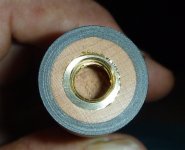
piloted joint question.

The intent of the pilot is to have intimate contact to keep the shaft and butt concentric. From an historical standpoint, today's precision machining and engineering tolerances of screw fits, pilots are not necessary to keep things concentric. However, in days where the fit of the screw to the fit of the female thread was not so precise (please look up Machinist's Handbook for scrw fits), then a pilot that seated into a counterbore was a necessary item.

The Schuler and the Lambros joints were developed to keep that intimate contact over time. Many of the old-school pilot designs seem to wear down to the point of non-contact. But the intent was to have contact, according to those that know (not me).

I think newer pilots that don't have that contact are there for show.

Freddie <~~~ my own background and opinion.
In some old cues like Brunswick Hoppie's they had a large pilot that may have worked like that. In fact on most I guess the shaft collar was installed before the shaft was fitted to the cue. When you look at the face of the shaft the collar may be half as thick on one side as the other. It was concentric as it was made but when the shaft it's self was made concentric with the butt it is not way off center.
 
Some piloted joints (i.e., just brass inserts) don't mate up and don't seem to have any mechanical purpose other than provide a longer thread count. Other piloted joints provide a compression fit and it does add some structural integrity and improved feel.

As shown below, many cue makers built 5/16X14 piloted joints with just a brass insert. IMO, I would try to find those that have 1/4" or so of wood for the pilot, with just a brass cap. For example, Mottey, Black, Old Scruggs, etc have these types of piloted joints. The wood in the pilot gives a compression fit and (some say) better feel/feedback.

Here are some examples of the different pilots I've come across:

On this shaft, the insert is rounded, but there isn't alot of brass showing (but there is some wood showing)
Pin2.jpg


On this shaft, the insert is rounded, but there is MORE brass showing (but there is still some wood showing)
Pin4.jpg


On this shaft, there is almost NO wood showing, and only the insert is showing (but it's not rounded)
Pin1.jpg


brass inserts only
joints.jpg


An example of piloted joint:
Pin3.jpg


Again (just the butt)
pin5.jpg


-td
 
I have owned my Tascarella for four years, and when assembling the cue, in the last 3/4 turn, you can feel the pilot grab the SS joint. It has not changed or wore down at all since I have owned it, and I believe it is intentional for what some describe as a compression fit.

I also owned a Black Boar and the fit was the same, Tony told me it was supposed to be this way, the last turn the pilot grabs the inside of the joint.

I have also owned other SS jointed cues in which this was not the case.

-dj

Thanks. Just what I'm talking about. I think this system would, in theory, be more stable. Making for a nice solid hit.

I know none of this is necessary with today's precision tech, but seems like a good system to create a long, long lasting cue.

Sent from my Nexus 4 using Tapatalk
 
I've handled a Schon cue in the past that had two shafts, one that you could definitely feel when the pilot contact the joint and it got nice and firm for the final turn and then the other just screwed right down with no additional force, I don't think that pilot made contact at all (though it was very very close). Honestly, couldn't feel a bit of difference myself. That being said, mentally I still preferred the tighter fit.

I think the piloting has some merit when we're talking ss joints, 5/16x14 pins, and threaded metal inserts in the shaft. If you had a SS flat faced joint with a shaft that had a threaded metal insert you could have an issue with wood either expanding or contracting a little such that the center of the shaft/butt joint would make contact but the outside would not. Obviously that wouldn't be ideal. So piloting the joint helps remove this issue by making sure the shaft and butt connect along their outer edges. It's not so much the extension down from the shaft that helps in this case but just having that recess in the butt so the insert in the shaft isn't making direct contact with the butt joint face.
 
Now here's another idea. If the the diameter of the pilot was, say .001 or so smaller than the pocket diameter would this cause a vacuum effect keeping it from seating properly? With that said, could I flute the side of the pilot on shaft to fix this?

The nickel sliver ferrules on bamboo fly rods are hand-lapped to a lot tighter clearance than .001" and there is no problem pushing the sections together, even though the metal-to-metal contact area is over a full inch long.

You know you have the correct fit when they go together with a little nose oil, and when you pull the sections apart you hear a distinct "pop" as they separate. Yet, even with all that metal and such a tight fit, they eventually wear to the point where you can hear the joint click while casting.

My gut feeling is that a piloted joint on a cue would do zero to make the joint more stable or to improve the hit. It's just too short relative to the diameter of the joint. It may help keep a poorly machined joint aligned as qbilder pointed out, but the screwing and unscrewing of the cue would eventually create wear that would allow the sloppy workmanship to show its face sometime down the road.
 
Some piloted joints (i.e., just brass inserts) don't mate up and don't seem to have any mechanical purpose other than provide a longer thread count. Other piloted joints provide a compression fit and it does add some structural integrity and improved feel.

As shown below, many cue makers built 5/16X14 piloted joints with just a brass insert. IMO, I would try to find those that have 1/4" or so of wood for the pilot, with just a brass cap. For example, Mottey, Black, Old Scruggs, etc have these types of piloted joints. The wood in the pilot gives a compression fit and (some say) better feel/feedback.

Here are some examples of the different pilots I've come across:

On this shaft, the insert is rounded, but there isn't alot of brass showing (but there is some wood showing)
Pin2.jpg


On this shaft, the insert is rounded, but there is MORE brass showing (but there is still some wood showing)
Pin4.jpg


On this shaft, there is almost NO wood showing, and only the insert is showing (but it's not rounded)
Pin1.jpg


brass inserts only
joints.jpg


An example of piloted joint:
Pin3.jpg


Again (just the butt)
pin5.jpg


-td
In your brass inserts only example that part you see at the end that make like a nipple is wider then the threaded part of the insert. In general it serves two purposes. One being it makes a finished look. If that lip was not there the threading would be visible as it enters the wood like you see on some old cues and that looks terrible,
The second and most important is the wider lip at the top provides a stop point as the insert in installed and tightened. If you look at say a Meucci, they also have it, you don't see any wood threading because it has been countersunk and machined off for finished look for the flat faced design they use.

http://cached.muellers.com/RS/SR/Product/15/stji_R_176bb0f4.jpg
 
Last edited:
In your brass inserts only example that part you see at the end that make like a nipple is wider then the threaded part of the insert. In general it serves two purposes. One being it makes a finished look. If that lip was not there the threading would be visible as it enters the wood like you see on some old cues and that looks terrible,
The second and most important is the wider lip at the top provides a stop point as the insert in installed and tightened. If you look at say a Meucci, they also have it, you don't see any wood threading because it has been countersunk and machined off for finished look for the flat faced design they use.

http://cached.muellers.com/RS/SR/Product/15/stji_R_176bb0f4.jpg
As I see things, on the recessed part of the cue, the extended brass insert doesn't touch anything, so there is no stop point. It's the wood of the shaft touching the joint that stops things. If you have ever made a shaft, all you do is face off the top of the brass insert to get it flat. Because there is no recess on the joint, the wood touches wood.

As for the aesthetic part, there are many cues that don't even have inserts, so there's the same ugly or pretty aspect there. [e.g., 3/8 X 10 and radial].

Here are some examples of some different joints:

An example of radial flat faced joint:
radial_pin.jpg


radial_flat.jpg


An example of 5/16X14 flat faced joint:
5_16_14_flat.jpg


An example of 3/8X10 flat faced joint:
3_10_butt.jpg


3_8_10.jpg


-td
 
Last edited:
As I see things, on the recessed part of the cue, the extended brass insert doesn't touch anything, so there is no stop point. It's the wood of the shaft touching the joint that stops things. If you have ever made a shaft, all you do is face off the top of the brass insert to get it flat. Because there is no recess on the joint, the wood touches wood.

As for the aesthetic part, there are many cues that don't even have inserts, so there's the same ugly or pretty aspect there. [e.g., 3/8 X 10 and radial].

Here are some examples of some different joints:

An example of radial flat faced joint:
radial_pin.jpg


radial_flat.jpg


An example of 5/16X14 flat faced joint:
5_16_14_flat.jpg


An example of 3/8X10 flat faced joint:
3_10_butt.jpg


3_8_10.jpg


-td
You misunderstood what I meant. When you are building the shaft you drill a hole and tap it for the insert. When you install the insert you thread it in with some glue and tighten it to the shaft. The lip or flange on the insert creates a finished look as well as allowing you to tighten it to the shaft. I am not referring to anything that has to do with screwing the shaft to the butt, just how that design of insert aids in building the shaft.

If you machine off the piece sticking out as you say to make it flat it exposes the threading. There is nothing you can do about it but try to hide it. The way something threads in one side is going to look bad because some of the thread is spiraling in exposing some of the wood thread.

I ran out to the shop and made one that way as an example. I could not find an old shaft made like that, I have some but they are around somewhere and it was easier to make a joint myself in a couple of minutes. I did not make it look that bad on purpose that is how it comes out without the flange at the top.
If you want a nice flat faced finish look you have to countersink some of the top lip or flange is a better term, then machine off what is sticking out and it looks very nice. I used a piece of an old insert to make the example I didn't waste a good one.
 

Attachments

  • insert ex.jpg
    insert ex.jpg
    96.5 KB · Views: 242
Last edited:
definite benefit to the pilot being snug against the inner wall of the joint... I even like it to bottom out also... more contact with the surface area the better the feedback...
 
definite benefit to the pilot being snug against the inner wall of the joint... I even like it to bottom out also... more contact with the surface area the better the feedback...

Bottoming out is risky. Any swelling of the wood and it could bottom out and the joint may still not be screwed down all the way. If you could achieve that kind of precision then go all the way and make a conical joint. Then you would really have something that is solid precision.
 
I'm not really a fan of piloted joints or steel joints as is, but I would believe that more surface area contact would create a more solid hit. I always thought the whole reason for a piloted joint would be to create a snug fit of complete or almost complete contact area of the shaft into the butt end of the cue... I could be wrong but thats just what I've read and heard, also just makes sense either way, otherwise why not just have a flat faced joint with complete surface area contact?

-Drew
 
Bottoming out is risky. Any swelling of the wood and it could bottom out and the joint may still not be screwed down all the way. If you could achieve that kind of precision then go all the way and make a conical joint. Then you would really have something that is solid precision.

First off Mac, I'm jealous. I wish I shop with materials to go experiment with. Next, I didn't think about a conical joint. Very precise, but must make one hell of solid cue.

Back to the pilot. If it was a brass pilot going into a SS joint, I could bypass the wood expanding, right? Then you could go super precise?, touching the bottom.

Also I never got any thoughts on the soft gasket in bottom of pocket to allow some forgiveness. Is this just a silly idea?


Sent from my Nexus 4 using Tapatalk
 
I'm not really a fan of piloted joints or steel joints as is, but I would believe that more surface area contact would create a more solid hit. I always thought the whole reason for a piloted joint would be to create a snug fit of complete or almost complete contact area of the shaft into the butt end of the cue... I could be wrong but thats just what I've read and heard, also just makes sense either way, otherwise why not just have a flat faced joint with complete surface area contact?

-Drew

:smile:


Flat face joint is just as good as piloted joint, super joint, or whatever joint Lambros decides to use.

Don't believe all the hype....:wink: or bull.


If solid was better then all shafts would be solid at the end.:grin:
Now that's another funny subject.
 
You don't want your pilot bottoming. It will compete with the joint face. Having something soft in the bottom will add nothing but can become an obstruction. It's best to have enough space that bottoming will never be a threat. Also the reason pilots are generally made of brass is because brass has an oily characteristic that lubricates itself. That's why bushings are most often brass. A brass insert will never wear out from being screwed into a steel joint collar.

And anybody who thinks cue makers don't use tolerances as tight as machinists, doesn't know much about cue making. Many of us used to be machinists, or still are. Try fitting an "A" joint where the forearm has points & expect the points to remain even if you don't follow tight tolerance in the machining. Or think about lining up rings the full length of the cue, even when the shaft is screwed down. The machining has to be absolute or else it doesn't work out. Very few times as a machinist did I have to perform more precise work than I do as a cue maker, and my cues are relatively simplistic. Try doing the things Thomas Wayne does without having an ultra high standard for tolerance. Granted not all cue makers do precise work, but anybody who's anybody in the cue world holds standards at least on par with typical machine shops.
 
:sorry:


LOL...well a good machinist has never used glue and other fillers to fill a gap.

Maybe some gap filling lock-tite for a press fit once in a while.:thumbup:
 
IMO, a pilot is intended to locate/align the outer diameters of each component. With sloppy v-threads the shaft will settle off to one side or the other as it seats. A pilot prevents this. If the pilot is as sloppy fitting as the threads, then it's a pointless aspect of the joint design. If the joint pin isn't installed on center or straight, a good fitting pilot will still pull the shaft to center. There are many ways a pilot 'could' mask or negate issues associated with sloppy machining and ill fitting parts, but with good machining practices a pilot is unnecessary, IMO.

All that said, some cue makers use piloted joints for nostalgic purposes, with a few even believing a good fitting pilot enhances solidarity of the joint as well as enhancing playability. Kinda like bigfoot, I'm not convinced but then again wouldn't be surprised to find out it's true. At least there's some food for thought with that situation. With sloppy fitting pilots, there's no purpose.

As I said before - a pilot WAS - once upon a time, used for alignment.

The fact that, with improved equipment, the alignment part is moot, is not any
particular reason to change the basic design of the joint.

I am sure you have heard of 'if it ain't broke...

George, Gus, Ernie, and many more seem to be(have been) perfectly happy
with piloted SS joints - I doubt nostalgia has any bearing, It certainly doesn't
with me.

Now using the 5/16 - 14 pin instead of the standard x 18, that I could be convinced
has more to do with tradition than any real advantage.

Dale
 
:sorry:


LOL...well a good machinist has never used glue and other fillers to fill a gap.

Maybe some gap filling lock-tite for a press fit once in a while.:thumbup:

Yes they do. It's called brazing & welding & filling & molding, etc. A good machinist knows how to do it and make it look good as well as retain accuracy & utility. An inexperienced machinist dose not.

For perspective, my joint pin has a .3115" minor diameter, and fits a .312" bore in the shaft. It has to be lubed with Teflon or else it won't fit. That .0005" difference gives .00025" of slop either side of the pin. When finished with arbors, the completed cue assumes the same tolerance so the joint is flush to within .00025". When I was machining for an actuator & valve contractor, I would cut faces on valves to within .0025" in order to prevent steam from escaping the seal. My cue joint is literally 10x more accurate than a high pressure steam valve in nuclear power plants. The kicker is that I'm not even known for my precision. I'm an OK cue maker with pretty typical standards. Imagine how precise the machining is on cues known for their tight tolerances, such as Searing, Showman, Mobley, Lambros, DZ, etc. Their work is as close to perfection as a machine is capable of producing.

I assume the comment about using fillers is directed at inlay work. For inlays, it's a completely different subject & completely different standard of tolerance. But in the realm of joint work, to think a cue maker doesn't work as precisely as a machinist is simply false. Very few machining applications require the accuracy of modern day cue joints. At what point is good enough, "good enough"? A Schon hits great & its joint work is accurate to within .005". A Joss is even sloppier. But it's accepted & ok because those are production cues. I don't think folks really understand the expertise & skill it takes to create a competent custom cue in today's market. It's insane & completely impractical, IMO.
 
Yes they do. It's called brazing & welding & filling & molding, etc. A good machinist knows how to do it and make it look good as well as retain accuracy & utility. An inexperienced machinist dose not.

For perspective, my joint pin has a .3115" minor diameter, and fits a .312" bore in the shaft. It has to be lubed with Teflon or else it won't fit. That .0005" difference gives .00025" of slop either side of the pin. When finished with arbors, the completed cue assumes the same tolerance so the joint is flush to within .00025". When I was machining for an actuator & valve contractor, I would cut faces on valves to within .0025" in order to prevent steam from escaping the seal. My cue joint is literally 10x more accurate than a high pressure steam valve in nuclear power plants. The kicker is that I'm not even known for my precision. I'm an OK cue maker with pretty typical standards. Imagine how precise the machining is on cues known for their tight tolerances, such as Searing, Showman, Mobley, Lambros, DZ, etc. Their work is as close to perfection as a machine is capable of producing.

I assume the comment about using fillers is directed at inlay work. For inlays, it's a completely different subject & completely different standard of tolerance. But in the realm of joint work, to think a cue maker doesn't work as precisely as a machinist is simply false. Very few machining applications require the accuracy of modern day cue joints. At what point is good enough, "good enough"? A Schon hits great & its joint work is accurate to within .005". A Joss is even sloppier. But it's accepted & ok because those are production cues. I don't think folks really understand the expertise & skill it takes to create a competent custom cue in today's market. It's insane & completely impractical, IMO.

:p


Sorry...I'm not going to agree with you. I know better unlike others on these forums.:thumbup:
 
Thanks Qbilder, pdcue, mac...... Seems I've took a simple thing and over thought it once again. I do realize if it isn't broke dont fix it, I have always been that way though when I get an idea in my head. I'm always looking for a way to ,better, not fix something. Just my nature I guess. If you stop thinking you can't learn anything new.

I'm glad that some builders agree with me on tolerances though. Precision is a requirement to me in any craft. Knife making, cue making, hell even in turning a pen you have to be precise.

Thanks for every body chiming in. I dont plan on making cues anytime soon. Couldn't afford it. But this has turned into an informative and interesting conversation.

Sent from my Nexus 4 using Tapatalk
 
Back
Top