
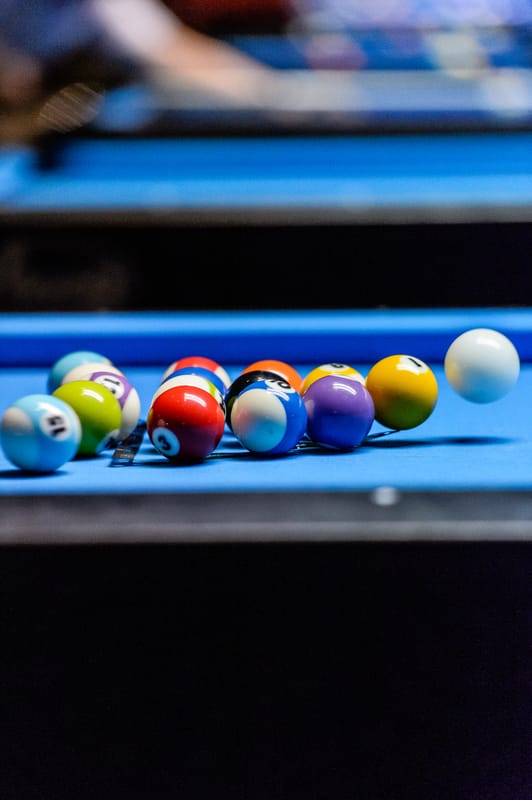
8 Ball break, just after impact

hang-the-9

AzB Silver Member
Silver Member
Found this image on the CSI page while checking out info on league stuff.

Note how the back row of balls separated as almost a single unit. I heard from people that in games like 8 ball and straight pool it's important to keep the back row tight.

Who wants to estimate how soon after impact this picture was taken?
jp22558_51_orig.jpg
 
8 Ball break, just after impact

Found this image on the CSI page while checking out info on league stuff.

Note how the back row of balls separated as almost a single unit. I heard from people that in games like 8 ball and straight pool it's important to keep the back row tight.

Who wants to estimate how soon after impact this picture was taken?

My estimate = Just.
 
I don’t like the way the template rises...like it’s stuck to the bottom of the one ball.
 
Found this image on the CSI page while checking out info on league stuff.

Note how the back row of balls separated as almost a single unit. I heard from people that in games like 8 ball and straight pool it's important to keep the back row tight.

Who wants to estimate how soon after impact this picture was taken?

jp22558_51_orig.jpg
Wonder why I can't see the pic...?

In the quoted post I can see this:

http://www.playcsipool.com/uploads/7/3/5/9/7359673/jp22558_51_orig.jpg

...with IMG tags surrounding it, but the IMG tags and everything between them (and whatever the link refers to) is invisible when posted - like in the quoted post above.

pj
chgo
 
Last edited:
I don’t like the way the template rises...like it’s stuck to the bottom of the one ball.

I think what is happening, is that the force of the hit is pushing the template backwards, but since the mass of the balls behind the 1 is holding it down, it's going in the only place it can, up.
 
I think you might be missing a zero (or two).

.003 seconds is three times longer than tip/ball contact.

pj
chgo

I have a feeling Dr Dave is out there somewhere with a ruler and calculator not sleeping till he figures it out. Looks like the 15 moved exactly one ball width away from the rack, so all one would need to do is figure out the time of force traveling through the balls, and how long it would take for the 15 to move 2 1/4 inches given an average break speed (since that must affect things but we don't know how fast the break was, so best guess will have to do).
 
Last edited:
I suspect it's bouncing up like the 1 ball after being driven downward by the CB hitting it above center.

pj
chgo

I think what is happening, is that the force of the hit is pushing the template backwards, but since the mass of the balls behind the 1 is holding it down, it's going in the only place it can, up.

The explanations are reasonable...
...but I don’t like the fact that the template has so much effect on the break.

pt...dusting off his Sardo
 
Well...

We all know that repeated breaks on a table will leave a divot on the spot.
We also know the template sits above the surface.
Therefore, it is obvious that the one ball is driven down into the cloth, through the template.
Combined with the forward motion imposed by the cue ball... It makes sense that you end up with tinea pedis.
 
Last edited:
As for how long after = instantly ( the faster the break the more instant)

I practice and analyze my breaks with cameras all the time.

As for the back row being even. They are close but not even.

The breaker either miss hit or intentionally hit 1 ball a tad off center.

Also, we have to assume the rack was tight and straight.

Rake
 
As for the back row being even. They are close but not even.

The breaker either miss hit or intentionally hit 1 ball a tad off center.
The back corner balls are even and the two balls just inside those are even but haven't moved as far. I think that means the 1 ball was hit dead center but more force was transmitted to the outside balls (and/or it was transmitted quicker) because of how they line up in the rack.

pj
chgo
 
Who wants to estimate how soon after impact this picture was taken?

It all depends on break speed. Let's assume that it is a fast break speed of 24 mph or 10 m/s (which is equal to 10 mm/ms).

The wing balls will travel at approximately half the speed of the break, adjusted by the cosine of the 30 degree offset angle (cos 30 = .866). So that means that the wing ball is traveling at approximately 10 mm/ms x 0.5 x 0.866 = 4.33 mm/ms.

Now to get time we need distance traveled, and by eyeballing the wing ball it looks like it has traveled approximately one ball diameter (2.25 in or 57.15 mm).

Distance = Speed x Time ==> Time = Distance / Speed

Time = 57.15 mm / 4.33 mm/ms = 13.12 ms or 0.01312 sec.
 
The back corner balls are even and the two balls just inside those are even but haven't moved as far. I think that means the 1 ball was hit dead center but more force was transmitted to the outside balls (and/or it was transmitted quicker) because of how they line up in the rack.

pj
chgo

To me, it looks like it was hit off center a bit or the rack was twisted just enough.

Either way, on my table, balls, racks I've recorded literally hundreds of breaks and most all look identical to that one. Other than the "very few" hit dead nuts. Even then, there is very little difference in what we see.

As for how the balls reacted, off center or dead center will cause "almost" same.......as long as it was "close" to full ball from "close" to center table.

Either way, very interesting to me. I've been working tirelessly on my American Rotation break.


Rake
 
Back
Top