Drills to correct your alignment

You won't EVER see pros slow rolling balls unless absolutely necessary

As usual another thread full of bad advice
If you expect high accuracy with fast shots without even verifying to see if you have accuracy with slow shots (and at the expense of not looking “cool” to your friends for a while) then you should dig out a foundation and build a nice comfortable house on your plateau.
 
If you expect high accuracy with fast shots without even verifying to see if you have accuracy with slow shots (and at the expense of not looking “cool” to your friends for a while) then you should dig out a foundation and build a nice comfortable house on your plateau.
Lol. Plateau

I play for me and thats it, keep hitting shots by slow rolling them, I don't care
 
Lol. Plateau

I play for me and thats it, keep hitting shots by slow rolling them, I don't care
Then why comment at all about advice in a thread if you only play for yourself and don’t care? Just to troll I suppose.

George Fels has useless advice… I think not.
 
Are there drills you can do to get your body ideally aligned to the shotline, so that only micro strokes are needed to send the object ball to the pocket?
Most of the aiming was done standing up.
Watched a recent video from Niels Feijen about aiming.
He mentioned ''aim from the hip''.
Realizing this, that's where your cue stick is, above your r/s hip bone. (right handed players)
By doing this repetitively.... it creates your baseline of body movement when approaching your chosen shot line.
If I'm consistently missing a shot to the left or the right that's a good thing.
Then.... all I do is walk up a little more left or a little more right before I get down on my shot.
 
I do not interpret Fels’ advice as “slow roll” every shot. He’s saying stop hitting the balls too hard, if you are, which many do. They’re called “bangers” for a reason. There is a speed not so slow as to risk roll off and not too fast as to rattle the ball.
 
I do not interpret Fels’ advice as “slow roll” every shot. He’s saying stop hitting the balls too hard, if you are, which many do. They’re called “bangers” for a reason. There is a speed not so slow as to risk roll off and not too fast as to rattle the ball.
This is correct.

There is an optimal speed to hit object balls to maximize pocket acceptance.

This is something that I rediscovered many times and kept forgetting, even though I knew about this advice from many sources. The thing that really made it stick for good was when I decided to choose to think about perfect object ball and cue ball speed "as a complete solution" during my practice strokes, rather than anything else (like only cue ball position, or aiming for example). This ended up gluing everything together and the result was an excellent stroke with perfect tip position. It also allowed me to hit object balls much softer. I ran over 70 balls.

I think it takes much more mental energy to think about perfect ball speed, as compared to tip position and aiming, which may be why it is so elusive for players. I think that it is the missing "glue" that brings everything together.

This thread is about "Drills to correct your alignment"... and I think the drill should be to practice thinking about perfect speed during your practice strokes which will indirectly fix your alignment as a consequence.
 
I do not interpret Fels’ advice as “slow roll” every shot. He’s saying stop hitting the balls too hard, if you are, which many do. They’re called “bangers” for a reason. There is a speed not so slow as to risk roll off and not too fast as to rattle the ball.
Once a player starts playing specific position on every shot, there is only one right speed for the position they are playing. I think George's advice was not for those players; he was speaking to the players who tend to use four-length speed on many shots.

There are a few exceptions to this, such as straight shots that can be played with an entire range of speeds to achieve a precise position. The main exception for pro players is the game ball, and often they play that shot with their most comfortable speed, which is not pocket speed.
 
Once a player starts playing specific position on every shot, there is only one right speed for the position they are playing. I think George's advice was not for those players; he was speaking to the players who tend to use four-length speed on many shots.

There are a few exceptions to this, such as straight shots that can be played with an entire range of speeds to achieve a precise position. The main exception for pro players is the game ball, and often they play that shot with their most comfortable speed, which is not pocket speed.
I played snooker for so long and could get into the zone and produce big break after big break. When I switched over to pool thinking I could make everything in sight was my detriment. I finally started giving it my all and it's working. I walk up to the table,look at the layout then put my cue at the CB aiming at the OB then get into my stance. As far as I'm concerned and said over and over the cue/alignment is the composer. The subconscious is the speed and position player
 
What is a 'micro-stroke'? Why would you want to use a micro stroke?

When I'm playing my best, I don't even look at the cueball after setting my to on the table. I take 0-2 practice strokes generally.

So much of the recommended psr stuff is just noise that interfers with playing well. Minimize the psr to the only things you need. See shot, align cue, relax, shoot. That is all you need. It isn't helping to chalk exactly six times, inspect the cueball, shake your left leg, shrug your shoulders, bob your head, etc.. See shot, aim shot, shoot shot.

 
What is a 'micro-stroke'? Why would you want to use a micro stroke?

When I'm playing my best, I don't even look at the cueball after setting my to on the table. I take 0-2 practice strokes generally.

So much of the recommended psr stuff is just noise that interfers with playing well. Minimize the psr to the only things you need. See shot, align cue, relax, shoot. That is all you need. It isn't helping to chalk exactly six times, inspect the cueball, shake your left leg, shrug your shoulders, bob your head, etc.. See shot, aim shot, shoot shot.
The title of the thread is “drills”. What drills can we do that help improve alignment.

Just because you don’t need drills anymore doesn’t mean other people can’t benefit from them.
 
  • Like
Reactions: bbb
The title of the thread is “drills”. What drills can we do that help improve alignment.

Just because you don’t need drills anymore doesn’t mean other people can’t benefit from them.

The very definition of 'drill' in a practice context precludes needing to tell anyone how to do it. If you have problems with alignment, you shoot balls straight until you don't have that problem. If you have problems with straight in shots, shot those into they aren't a problem.

Everybody wants some form of game or challenge to practice things. That isn't a drill, that is a game or challenge. Have a problem, work directly on that problem. This is the only information that is useful to anyone without more information. Maybe a video would show a problem.
 
The very definition of 'drill' in a practice context precludes needing to tell anyone how to do it. If you have problems with alignment, you shoot balls straight until you don't have that problem. If you have problems with straight in shots, shot those into they aren't a problem.

Everybody wants some form of game or challenge to practice things. That isn't a drill, that is a game or challenge. Have a problem, work directly on that problem. This is the only information that is useful to anyone without more information. Maybe a video would show a problem.
I see what you mean.
 
The title of the thread is “drills”. What drills can we do that help improve alignment.

Just because you don’t need drills anymore doesn’t mean other people can’t benefit from them.
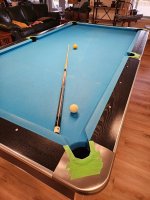
Stun,follow and draw shots also 1-handed potting
 

Attachments

  • 20250105_154604.jpg
    20250105_154604.jpg
    228.6 KB · Views: 16
There was a guy in the pool room a few nights ago that brought in a contraption. It sat on the table vertically. It was made of plexiglass or possibly glass, about the size of 2 pieces of typing paper, one on top of the other. It had lines drawn into it, and I think might have been a mirror surface, I'm not sure. I was half the room away in an action match so only paid it slight attention. I think it was meant for the player to stroke into it and it would show him the flaws.
 
There was a guy in the pool room a few nights ago that brought in a contraption. It sat on the table vertically. It was made of plexiglass or possibly glass, about the size of 2 pieces of typing paper, one on top of the other. It had lines drawn into it, and I think might have been a mirror surface, I'm not sure. I was half the room away in an action match so only paid it slight attention. I think it was meant for the player to stroke into it and it would show him the flaws.
One device like that is a mirror that sits above the cue ball. If you cue straight at the mirror, the reflection of the stick will be in the same line as the stick. If you are off a little, the stick will look broken.
 
I know a guy who shoots nothing else. He never plays anyone. He never shoots any other shot. He doesn't even change ends.

There are several reasons why the X is a bad drill, especially the way some people end up playing it.
It's good for getting your stroke straight that's it.
 
Back
Top