
Yeah, but I bet it would still really be cool designing and building it.
Please post a video when you are done.


Yeah, but I bet it would still really be cool designing and building it.

I bet even a well designed machine would have a tough time achieving and repeating simultaneous hits. The balls still need to be set up absolutely perfectly every time, and the machine would need to be aligned (and stay aligned) perfectly relative to the balls, and the cloth in between the balls can’t change at all in between shots (no fiber changes, no dirt or chalk dust), and the CB needs to be absolutely perfect so things don’t change with CB orientation. The machine would also need to be built with extremely tight tolerances, and it would need to be very stiff and mounted very firmly to the table. That’s a long list of things that can go wrong (and I’m probably not considering everything).

The most irritating to me was the guy on YouTube who said I said you should not use any physics knowledge, just go with the order of the contacts you can actually see. He said that after I objected to:Even worse, people will comment on the video post who OBVIOUSLY never watched it, and say the dumbest things! I had to refrain from blasting some of the people on facebook.
...


I think this is the “exception,” rather than the “rule.”They are also using video to get the call wrong.

The most irritating to me was the guy on YouTube who said I said you should not use any physics knowledge, just go with the order of the contacts you can actually see. He said that after I objected to:
[BeginGarbage] BCA/WPA referee guidelines (which are different from the rulebook available to players) specify that the referee must see the foul itself in these situations. Watching for after-the-fact "evidence", such as the direction the cue ball travels after contact, is not the correct way to referee. You must actually SEE the wrong ball be hit first, to call it a foul shot .And as we all know, it's very difficult to see, especially when the shot is played with speed. Benefit of the doubt goes to the shooter. [EndGarbage]
The guy who claimed they exist did not respond to my request for more info. My guess is that if there are such guidelines, they were created by someone who doesn't follow the WSR (World Standardized Rules).Bob,
Are you aware of any such unpublished guidelines? I mean obviously if they exist I’m presuming they don’t say that, but what DO they say?
I dispute your assertion that use of an overhead close up slow motion video of the contact would ever result in a errored call.They are also using video to get the call wrong.

This guy did it also.You and Mark Rober could do a collab. I bet you could do it.
It’s already happened several times, well documented.I dispute your assertion that use of an overhead close up slow motion video of the contact would ever result in a errored call.

There was one or a couple where the cue ball rocked left but if the ref missed that movement, no foul.Interesting that in your frozen ball/simultaneous hit scenario, whichever ball was hit first raced out of frame first, without exception. And the sibgle hit where you pretty much managed the nearly impossible actual simultaneous hit, the balls left the frame as a tie.
So it’s possible that distance traveled can be another indicator assuming the area after the hit affords room on the table to determine speed and distance.
That's true for a perfectly broadside shot as in the video or close to that, but usually the cue ball is coming in at an angle and that can make object ball speed more complicated.... So it’s possible that distance traveled can be another indicator assuming the area after the hit affords room on the table to determine speed and distance.
Can you refer me to the video that would show it?It’s already happened several times, well documented.

Why would that even be interesting? Mark has a very dedicated specialized fan base and is engaging.You and Mark Rober could do a collab. I bet you could do it.
FYI, I just posted a new video that presents a master class on everything you need to know to understand how to judge if a split hit, where the cue ball hits two balls at nearly the same time, is a foul or not. Check it out:
Contents:
Supporting Resources:
- 0:00 - Intro
- 0:22 - Pro Match Examples
- 1:40 - Tangent Lines
- 3:17 - Simultaneous Hit
- 6:48 - Angled Hit
- 7:42 - Larger Gap
- 9:51 - Thin Hit
- 12:03 - Perpendicular Contact
- 13:54 - Right Calls
- 17:05 - Wrap Up
As always, I look forward to your feedback, comments, questions, complaints, and requests.
- split hit resource page
- example bad calls in pro matches
- fouls resource page
- rules resource page
- Yapp shot analysis video
- Capito shot analysis video
Enjoy!
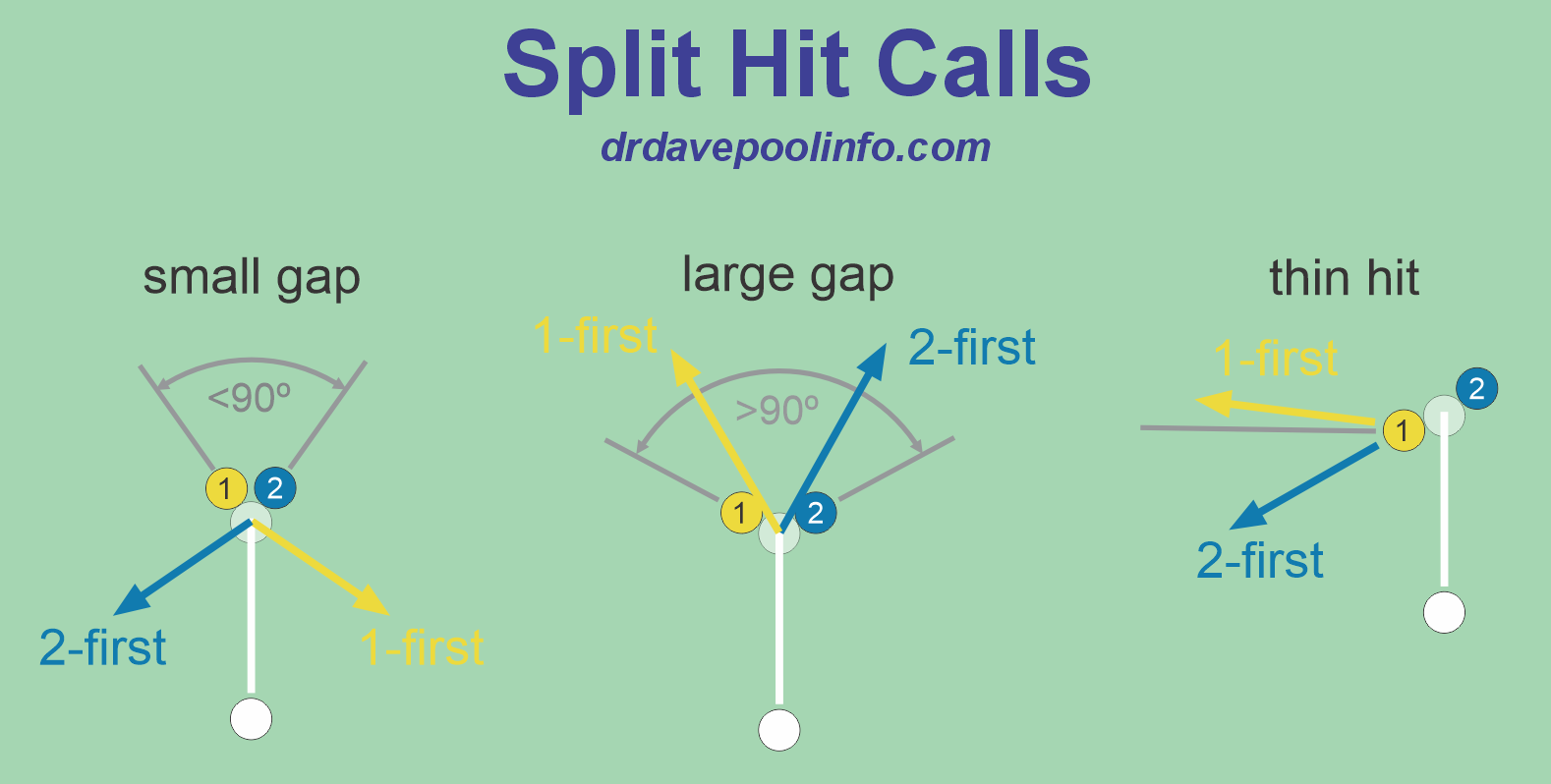

Very interesting as usual, Doc. Referees should have things like this available in a "Close Call Guide" on their phones.FYI, I just added this image to the split hit resource page, providing a concise summary of almost everything in the video:
FYI, I just added this image to the split hit resource page, providing a concise summary of almost everything in the video:
