

Though not the intended purpose of the DigiBall, Dr. Dave's recent post, which included a high speed video of a ball rebounding off of a rail, gave me the idea to try to measure it directly. Here is his video:
Dr. Dave measured the incoming velocity and rebound velocity of the ball by counting the number of pixels traversed per number of frames. Since the camera is stationary relative to the ball, this method works. The DigiBall has no reference to the outside world, and therefore has no idea what its linear speed is relative to the table, except under one condition: the ball is rolling without slipping. When the ball is rolling, the linear velocity of the ball is directly proportional to the inertia and diameter of the ball, which never change. Therefore we can divide the rotations per second a purely rolling rolling ball after rail contact by what is was before contact, to obtain the COF directly, without a high speed camera.
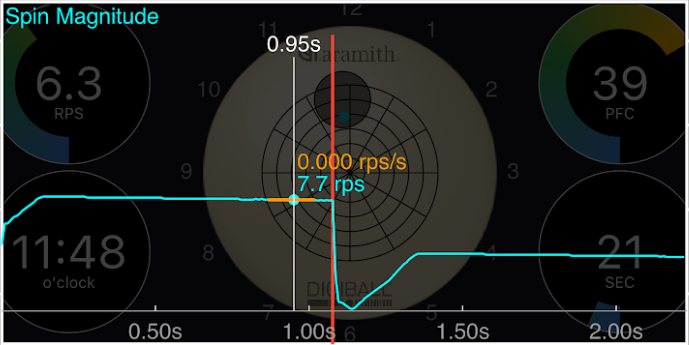
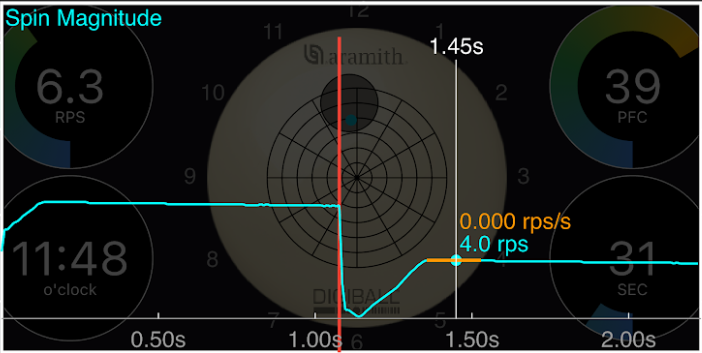
Below is a plot of the DigiBall spin after hit softly with pure top, so that the ball is rolling. The horizontal axis is time in seconds, and the blue line is the spin magnitude. RPS is rotations per second. When the ball hits the rail, the ball briefly stops spinning, then drags for a short time and picks up rolling speed, and then starts rolling again (almost flat lines). The angular rolling speeds before and after the rail are 7.7 rps and 4.0 rps. The ratio is 51.9%, which is the COR of this part of the rail.
I did this at six places on my table:
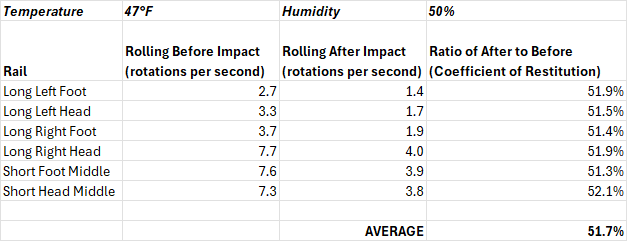
The results were pretty consistent even with using only one decimal of precision. Heated tables (especially the rails) are at least 60% and probably more.
I am waiting for a hot dry day this summer to repeat the experiment again to see how much the COF increases, and also compare it to a heated table when I have time to go to Amazin' Billiards next.
The advantage of using the DigiBall to do this is that small variations in shot speed do not matter, and it is very portable and easy to do quickly, and most importantly you don't need an expensive high speed camera.
Dr. Dave measured the incoming velocity and rebound velocity of the ball by counting the number of pixels traversed per number of frames. Since the camera is stationary relative to the ball, this method works. The DigiBall has no reference to the outside world, and therefore has no idea what its linear speed is relative to the table, except under one condition: the ball is rolling without slipping. When the ball is rolling, the linear velocity of the ball is directly proportional to the inertia and diameter of the ball, which never change. Therefore we can divide the rotations per second a purely rolling rolling ball after rail contact by what is was before contact, to obtain the COF directly, without a high speed camera.
Below is a plot of the DigiBall spin after hit softly with pure top, so that the ball is rolling. The horizontal axis is time in seconds, and the blue line is the spin magnitude. RPS is rotations per second. When the ball hits the rail, the ball briefly stops spinning, then drags for a short time and picks up rolling speed, and then starts rolling again (almost flat lines). The angular rolling speeds before and after the rail are 7.7 rps and 4.0 rps. The ratio is 51.9%, which is the COR of this part of the rail.
I did this at six places on my table:
The results were pretty consistent even with using only one decimal of precision. Heated tables (especially the rails) are at least 60% and probably more.
I am waiting for a hot dry day this summer to repeat the experiment again to see how much the COF increases, and also compare it to a heated table when I have time to go to Amazin' Billiards next.
The advantage of using the DigiBall to do this is that small variations in shot speed do not matter, and it is very portable and easy to do quickly, and most importantly you don't need an expensive high speed camera.
Last edited:


