cue ID help

People that think Kao does not make well finished cues with even points and well done inlays are mistaken. As was said before, they collaborated with Adam. You can find identical points, butt sleeves, and inlays on Adam and Kao branded cues.
 
People that think Kao does not make well finished cues with even points and well done inlays are mistaken. As was said before, they collaborated with Adam. You can find identical points, butt sleeves, and inlays on Adam and Kao branded cues.

Hi, I wonder, is Kao the company who built Lucasi cues back in the 90's? The reason I ask is I have seen a lot of Adam cues that looked like Lucasi cues, and even had the same Roman Numeral numbers on the opposite side of the logo, just like I have seen on Players cues. I know, I should just ask Google AI these days, and they might give me a good answer, lol.

I do wonder what Adam cues, specifically, Kao made.

Also, do you know of the Helmstetter cues that were made back in the late 90's? Like, 97, 98 series, iirc. Those cues had lop sided inlays, and uneven points, in my experience with many of them. Maybe they were made by Kao. I do not believe they were made in Japan. Helmstetter cues, made after the mid 90's, like the 97 and 98 series, if I have that right. I always thought the quality of those looked kind of poor.
 
Hi, I wonder, is Kao the company who built Lucasi cues back in the 90's? The reason I ask is I have seen a lot of Adam cues that looked like Lucasi cues, and even had the same Roman Numeral numbers on the opposite side of the logo, just like I have seen on Players cues. I know, I should just ask Google AI these days, and they might give me a good answer, lol.

I do wonder what Adam cues, specifically, Kao made.

Also, do you know of the Helmstetter cues that were made back in the late 90's? Like, 97, 98 series, iirc. Those cues had lop sided inlays, and uneven points, in my experience with many of them. Maybe they were made by Kao. I do not believe they were made in Japan. Helmstetter cues, made after the mid 90's, like the 97 and 98 series, if I have that right. I always thought the quality of those looked kind of poor.
The numbered Helmstetter cues were made in Japan by Adam.

I'll have to check my notes. I think I have something about when the collaboration with Kao was a thing. Year range at least.

These factories are all extremely capable. I think garzar can speak firsthand more specifically. Cue makers like Helmstetter and even Stroud dealt with them as far as business. No, I am not saying any JW was ever made by anyone but him. But he did design the Smart Shaft.

Much of what has been produced in the East just isn't commonly known here. That's both production and custom.
 
The numbered Helmstetter cues were made in Japan by Adam.

I'll have to check my notes. I think I have something about when the collaboration with Kao was a thing. Year range at least.

These factories are all extremely capable. I think garzar can speak firsthand more specifically. Cue makers like Helmstetter and even Stroud dealt with them as far as business. No, I am not saying any JW was ever made by anyone but him. But he did design the Smart Shaft.

Much of what has been produced in the East just isn't commonly known here. That's both production and custom.

I find it very hard to believe that these 97 Series Helmstetter cues, for example, were made in Japan.


The quality just looked horrible, to me. Lop sided inlays, uneven points. The Japanese Helmstetter cues, like the 86 and 87 series, along with the VIP lines, and others, like the Balabushka line, just looked so much nicer, and higher quality.

Kind of makes me sick, thinking about the 97 series Helmstetter cues, for example, lol. They were kind of garbage quality, I thought. Well, not garbage, but just not that great.
 
I find it very hard to believe that these 97 Series Helmstetter cues, for example, were made in Japan.


The quality just looked horrible, to me. Lop sided inlays, uneven points. The Japanese Helmstetter cues, like the 86 and 87 series, along with the VIP lines, and others, like the Balabushka line, just looked so much nicer, and higher quality.

Kind of makes me sick, thinking about the 97 series Helmstetter cues, for example, lol. They were kind of garbage quality, I thought. Well, not garbage, but just not that great.
Regardless of their numbered status, or whatever name or brand is on the decal, they are mass produced.

If you are really that fussy, why are you looking at mass produced cues?

If you are really that fussy, stop bargain hunting and step up with a few thousand for a proper custom cue.

If you look close enough, even they are not perfect.

You want close to perfection? Get a Searing. There are others.

If you find a perfect cue, I will eat my socks.

If it is made of wood, I will eat my shoes as well.

I have good cues, but I have a more fun dabbling with the productions cues. Why? I dunno. Cheap. Variety. Lots' of "unknowns" to research.

I am not looking to replace my Joss or flip cues, so maybe I am different than most.
 
Regardless of their numbered status, or whatever name or brand is on the decal, they are mass produced.

If you are really that fussy, why are you looking at mass produced cues?

If you are really that fussy, stop bargain hunting and step up with a few thousand for a proper custom cue.

If you look close enough, even they are not perfect.

You want close to perfection? Get a Searing. There are others.

If you find a perfect cue, I will eat my socks.

If it is made of wood, I will eat my shoes as well.

I have good cues, but I have a more fun dabbling with the productions cues. Why? I dunno. Cheap. Variety. Lots' of "unknowns" to research.

I am not looking to replace my Joss or flip cues, so maybe I am different than most.
I am on the same boat. I have more cues than I can point a pool stick at, the only customs are the cues I have made myself.
I love collecting odds and ends. Still looking for a PBR cue like the two you have. :geek:
 
Regardless of their numbered status, or whatever name or brand is on the decal, they are mass produced.

If you are really that fussy, why are you looking at mass produced cues?

If you are really that fussy, stop bargain hunting and step up with a few thousand for a proper custom cue.

If you look close enough, even they are not perfect.

You want close to perfection? Get a Searing. There are others.

If you find a perfect cue, I will eat my socks.

If it is made of wood, I will eat my shoes as well.

I have good cues, but I have a more fun dabbling with the productions cues. Why? I dunno. Cheap. Variety. Lots' of "unknowns" to research.

I am not looking to replace my Joss or flip cues, so maybe I am different than most.

I was just comparing those later / late 90's era Helmstetter cues, to other Adam and Helmstetter cues, that were made in the 80's, and early 90's. The quality difference is like night and day, in my opinion. I am just of the belief that the Adam cues that were made in Japan were a lot higher quality then the Adam cues that were made in China, back in the late 90's, I believe.

I just think the Adam cues from Japan were made a lot better, with better quality control. They did not have lop sided inlays, or very uneven points.

But, I understand that in more recent years, the cues from China are far higher quality then they were back in the late 90's, and you will not see very uneven points, or lop sided inlays on them. Like on the Balabushka cues that are now made in China.

I was always under the impression that Miki of Mezz cues built cues for Adam, up until around 95, when they came out with their own brand (Mezz), and that the Helmstetter cues made after the mid 90's, were made in China, because production was moved to China, for the most part.

In more recent years, I believe that the only Adam cues still made in Japan, are the high end lines, like Musashi, and maybe Mugen, but maybe not even Mugen, because they are only like in the $1k price range. The Adam Musashi cues retail in the 2-3k price range, I believe.

Oh, here is a really high end one, with their Square Core. I can't even imagine how much this cue probably retailed for.


Musashi is like the Custom shop, at Adam cues. They are not Mass Produced. Kind of like what Exceed is to Mezz.

 
Last edited:
I was just comparing those later / late 90's era Helmstetter cues, to other Adam and Helmstetter cues, that were made in the 80's, and early 90's. The quality difference is like night and day, in my opinion. I am just of the belief that the Adam cues that were made in Japan were a lot higher quality then the Adam cues that were made in China, back in the late 90's, I believe. Like the ones with those Roman Numeral numbers on them. I think they may have been made in the same factory that made the Lucasi cues, from the same time period.

I just think the Adam cues from Japan were made a lot better, with better quality control. They did not have lop sided inlays, or very uneven points.
That depends on the level. Millions of lower level cues were made in Japan, even of ramin wood.

It was partly the low end cue market that made raminwood endangered, along with the furniture market. The mass production of low-end pool cues had a noticeable and highly concentrated impact on the depletion of ramin wood. Ramin wood in Japan is a highly regulated now, because of heavy over-exploitation, it is strictly controlled under CITES regulations, and direct imports to Japan have significantly declined

Both Adam and other Taiwan and China makers like Kao produced a wide spectrum of quality cues.

What has happened now is that when people see a better made Asian cue they say it is Adam, and if it is less well made they say it's not, probably Kao. It's not accurate, it's a more or less hit and miss assessment. Add to that fact that there have been millions made with no logo or branding.

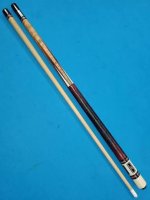
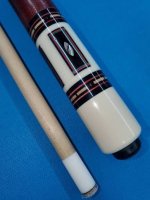
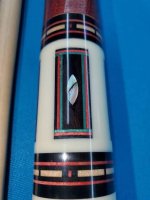
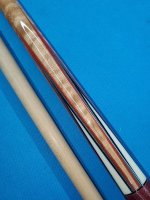
We have been down this road before. I have a number of examples, but this is the one I repeatedly use.

This is a Kao made cue that was MSRP $500 in 1992. That is $1,454 today.

20160211_225424.jpg

20160211_225556.jpg

20160211_225619.jpg

20160211_225654.jpg

20160212_201744.jpg
 

Attachments

  • tasc.jpg
    tasc.jpg
    19.9 KB · Views: 3
That depends on the level. Millions of lower level cues were made in Japan, even of ramin wood.

It was partly the low end cue market that made raminwood endangered, along with the furniture market. The mass production of low-end pool cues had a noticeable and highly concentrated impact on the depletion of ramin wood. Ramin wood in Japan is a highly regulated now, because of heavy over-exploitation, it is strictly controlled under CITES regulations, and direct imports to Japan have significantly declined

Both Adam and other Taiwan and China makers like Kao produced a wide spectrum of quality cues.

What has happened now is that when people see a better made Asian cue they say it is Adam, and if it is less well made they say it's not, probably Kao. It's not accurate, it's a more or less hit and miss assessment. Add to that fact that there have been millions made with no logo or branding.

We have been down this road before. I have a number of examples, but this is the one I repeatedly use.

This is a Kao made cue that was MSRP $500 in 1992. That is $1,454 today.

View attachment 913279
View attachment 913280
View attachment 913281
View attachment 913282
View attachment 913283

I see. Very nice cue. The point I was trying to make is that, with Adam cues, the quality seemed to go down hill, after the mid 90's, at least for awhile. Not sure. But those 97, and 98 Series Helmstetter cues just did not look that good Uneven points and lop sided inlays. Here is a 86-16 Helmstetter that I had. The 86 series were very nice. Fairly even points, and really good inlay work, I think. The 97 series just looked like garbage, in comparison. Playing with both, I could really notice a big difference too. I felt that the older Helmstetter cues played far nicer.
 

Attachments

  • images.jpeg
    images.jpeg
    14.6 KB · Views: 6
  • images1.jpeg
    images1.jpeg
    24.4 KB · Views: 5
  • images2.jpeg
    images2.jpeg
    21.9 KB · Views: 6
  • s-l400.jpg
    s-l400.jpg
    29.4 KB · Views: 6
I see. Very nice cue. The point I was trying to make is that, with Adam cues, the quality seemed to go down hill, after the mid 90's, at least for awhile. Not sure. But those 97, and 98 Series Helmstetter cues just did not look that good Uneven points and lop sided inlays. Here is a 86-16 Helmstetter that I had. The 86 series were very nice. Fairly even points, and really good inlay work, I think. The 97 series just looked like garbage, in comparison. Playing with both, I could really notice a big difference too. I felt that the older Helmstetter cues played far nicer.
Adam Cues subcontracted production out of Japan starting in the mid-1990s, and the licensed Balabushka replica cues were shifted to off-shore manufacturing.

1995 – 1998 (The Move to China & Taiwan): Due to rising Japanese labor costs, Adam began outsourcing the majority of its mid-tier production. Standard Adam cues and the lower-end Balabushka models shifted production to China and Taiwan. The mid-90s to mid-2000s outsourcing contract was not given to the Kao Factory. Instead, the bulk of Adam's outsourced production was sent to the Taican (Universal) factory. I said Kao, my mistake.

After 2007 the original Japanese factory scaled down to strictly producing Adam's ultra-premium, high-end boutique Musashi cues, while 100% of standard production permanently moved to China.

1969 – 1995 was sort of the golden era for the original Adam many of us remember and love. The early first catalog cues are legendary with pointed pins and aluminum shaft inserts.

My Kao confusion is due to remembering Harold Miller, the former sales manager for Adam Cues. He later used the Kao Kao factory to manufacture high-end "Cobra Professional" import cues. The Mizerak Professional Series cues were made at that same factory under a deal with Mizerak. These lines directly rivaled the construction of Adam cues.
 
There are two Kao co's, KaoKao, the one you're referring to, and KaoFa. I've seen both and KaoFa's stuff is nicer. Their Awens custom line is really nice.
Yes, I know. That's why I often just say Kao, because I mix them up so easily.

You know more about that than me.
 
Adam Cues subcontracted production out of Japan starting in the mid-1990s, and the licensed Balabushka replica cues were shifted to off-shore manufacturing.

1995 – 1998 (The Move to China & Taiwan): Due to rising Japanese labor costs, Adam began outsourcing the majority of its mid-tier production. Standard Adam cues and the lower-end Balabushka models shifted production to China and Taiwan. The mid-90s to mid-2000s outsourcing contract was not given to the Kao Factory. Instead, the bulk of Adam's outsourced production was sent to the Taican (Universal) factory. I said Kao, my mistake.

After 2007 the original Japanese factory scaled down to strictly producing Adam's ultra-premium, high-end boutique Musashi cues, while 100% of standard production permanently moved to China.

1969 – 1995 was sort of the golden era for the original Adam many of us remember and love. The early first catalog cues are legendary with pointed pins and aluminum shaft inserts.

My Kao confusion is due to remembering Harold Miller, the former sales manager for Adam Cues. He later used the Kao Kao factory to manufacture high-end "Cobra Professional" import cues. The Mizerak Professional Series cues were made at that same factory under a deal with Mizerak. These lines directly rivaled the construction of Adam cues.
ADAM-Japan makes more than just Musashi. The Kenbu line( as well as the Hayakawa line) is Japanese too and super nice: https://adam-ny.com/product/kenbu/ This outfit in NYC is the official dealer in the US for Japan ADAM stuff.
 
Back
Top