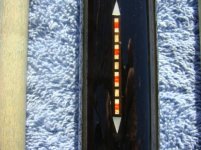
Lenny e-mailed me about this and I'm exploring it further, but here are my own thoughts.
Assuming it is a Balabushka, like Dave Sutton said, it does look like a Szamboti blanked Bushka. That would put the year at 1973 - 1975 or so. I like the design a lot too. Considering the potential value, I would definitely get the cue to Pete to have it authenticated ASAP, because that letter is worth more than gold. I had asked John Davis if he ever made a birdseye blank for George and he said "not that I recall". George didn't trust birdseye, but he must have changed his mind after he saw all those old Harvey Martin cues hold up just fine.
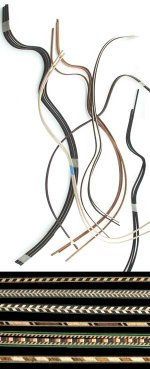
As far as the inlays go, both George Balabushka and Palmer got a lot of ideas from the shop of H.L. Wild & Co., a musical instrument parts supplier which was located in the East Village, New York City. The inlays are guitar "purfling", which are wood bandings glued up and re-sawn to form complex repeating shapes (see the pic below). These purflings are used as inlays, but what they are mainly designed to do is decorate the edges, veneer seams, and sound holes of guitars. Wild also sold mother of pearl shapes, including these arrow-head inlays.
The Palmer Margo Bullet series came out later, early 1980's - so they might have seen this Balabushka and thought it was a good design idea. By the way, Gus Szamboti also made the blanks for some of the upscale Margo Cues, particularly the Margo #10.
If I find out any more, I'll post it or pm Lenny.
Chris
Assuming it is a Balabushka, like Dave Sutton said, it does look like a Szamboti blanked Bushka. That would put the year at 1973 - 1975 or so. I like the design a lot too. Considering the potential value, I would definitely get the cue to Pete to have it authenticated ASAP, because that letter is worth more than gold. I had asked John Davis if he ever made a birdseye blank for George and he said "not that I recall". George didn't trust birdseye, but he must have changed his mind after he saw all those old Harvey Martin cues hold up just fine.
As far as the inlays go, both George Balabushka and Palmer got a lot of ideas from the shop of H.L. Wild & Co., a musical instrument parts supplier which was located in the East Village, New York City. The inlays are guitar "purfling", which are wood bandings glued up and re-sawn to form complex repeating shapes (see the pic below). These purflings are used as inlays, but what they are mainly designed to do is decorate the edges, veneer seams, and sound holes of guitars. Wild also sold mother of pearl shapes, including these arrow-head inlays.
The Palmer Margo Bullet series came out later, early 1980's - so they might have seen this Balabushka and thought it was a good design idea. By the way, Gus Szamboti also made the blanks for some of the upscale Margo Cues, particularly the Margo #10.
If I find out any more, I'll post it or pm Lenny.
Chris
Attachments
Last edited: