Has anyone ever sent a cue back to have inlays added after they have played with the cue foe a few years? Seemed like an alternative to buying a new cue.

You are using an out of date browser. It may not display this or other websites correctly.
You should upgrade or use an alternative browser.
You should upgrade or use an alternative browser.
Changes to your cue
- Thread starter scot n Texas
- Start date

Well, Scott, I've got a long answer and a short answer. Noooooooo. And no.
Seriously though, it could be done but doing it to a cue that is already at finished dimensions would be a real pain in the butt (pun intended). Back in the day, if I would have been asked to do it I would have passed.
Seriously though, it could be done but doing it to a cue that is already at finished dimensions would be a real pain in the butt (pun intended). Back in the day, if I would have been asked to do it I would have passed.
Last edited:

My first Tim Scruggs cue was a plain 4 point cocobola player, with a steel joint and 5/16 pin.
After a few years, I had Tim change out the joint to Ivory with a 3/8 10 pin, new shafts and some simple ivory inlays in the cue.
To me this was a more affordable option then buying a cue.
BTW I still have the cue.
After a few years, I had Tim change out the joint to Ivory with a 3/8 10 pin, new shafts and some simple ivory inlays in the cue.
To me this was a more affordable option then buying a cue.
BTW I still have the cue.

jdxprs
Banned
My first Tim Scruggs cue was a plain 4 point cocobola player, with a steel joint and 5/16 pin.
After a few years, I had Tim change out the joint to Ivory with a 3/8 10 pin, new shafts and some simple ivory inlays in the cue.
To me this was a more affordable option then buying a cue.
BTW I still have the cue.
got pictures?

got pictures?
It can be done, But pick a real cue maker to do the job..

RBC
Deceased
Don't they do this with Titlists?
I have seen a Judd cue that was a plain jane. The cue was picked up for a reasonable price and the new owner sent it to Judd and had some inlays and other changes. Cue looked great.
Adding inlays to an existing cue is a little different than building a cue from a titleist.
When adding inlays, the cue is already at the finish dimensions so you have to be careful to cut the inlays down to the existing cue without making it any smaller. It's not that hard, but it is different.
When you build a cue from a titleist, you would typically still have to turn the cue down to your finish size once all the inlays are in place. It's easier this way, but it can still be done very effectively after the cue has been made.

My first Tim Scruggs cue was a plain 4 point cocobola player, with a steel joint and 5/16 pin.
After a few years, I had Tim change out the joint to Ivory with a 3/8 10 pin, new shafts and some simple ivory inlays in the cue.
To me this was a more affordable option then buying a cue.
BTW I still have the cue.
I have a friend who had Paul Mottey and Mike Cochran add more inlays to finished cues and they both looked great after the inlays were added to the cues. You couldn't tell that the cues didn't come that way to begin with......
James
It can be done, But pick a real cue maker to do the job..
I sent it back to Paul Drexler to do the work since he built the cue.

Seems to me that doing that will get you the same cue with pretty pictures. Someone else in the thread had a different joint installed and some other major work done on an existing stick, that would be worth being done IMHO, otherwise you are not really getting a "new cue".
To me, the whole point of getting a new cue is to play with different constructions. Different shafts, woods, joints, etc... Unless you are trying to just add resale value.
To me, the whole point of getting a new cue is to play with different constructions. Different shafts, woods, joints, etc... Unless you are trying to just add resale value.
Has anyone ever sent a cue back to have inlays added after they have played with the cue foe a few years? Seemed like an alternative to buying a new cue.

My first Tim Scruggs cue was a plain 4 point cocobola player, with a steel joint and 5/16 pin.
After a few years, I had Tim change out the joint to Ivory with a 3/8 10 pin, new shafts and some simple ivory inlays in the cue.
To me this was a more affordable option then buying a cue.
BTW I still have the cue.
Changing the joint is a good option, though very different than putting inlays into a finished cue.
Adding inlays to an existing cue is a little different than building a cue from a titleist.
When adding inlays, the cue is already at the finish dimensions so you have to be careful to cut the inlays down to the existing cue without making it any smaller. It's not that hard, but it is different.
When you build a cue from a titleist, you would typically still have to turn the cue down to your finish size once all the inlays are in place. It's easier this way, but it can still be done very effectively after the cue has been made.
Plus, a titlist blank is usually thicker than what the finished dimensions would be. There is still enough meat on the titlist to turn it down. That is not the case with a cue that is already finished.
This is the scruggs cocobolo I described
http://tony.homedns.org/photos/Home/My%20Cues/slides/DSC_0014.html
More pics of it and the rest of my cues are on this site.
http://tony.homedns.org/photos/Home/My%20Cues/slides/DSC_0014.html
More pics of it and the rest of my cues are on this site.
got pictures?
I also have a Tim Scruggs Titlist that Mike C. did some additional inlays, a hoppe butt and a refinish with new leather wrap.
This titlist is a bit thinner than normal as I like a thinner cue. He had no problems and did excellent work.
It pays when you use a competent cuemaker to make changes to a cue.
This titlist is a bit thinner than normal as I like a thinner cue. He had no problems and did excellent work.
It pays when you use a competent cuemaker to make changes to a cue.
Changing the joint is a good option, though very different than putting inlays into a finished cue.
Plus, a titlist blank is usually thicker than what the finished dimensions would be. There is still enough meat on the titlist to turn it down. That is not the case with a cue that is already finished.
Yes, new inlays were put into the cue too. The original cue had none.
Changing the joint is a good option, though very different than putting inlays into a finished cue.
Plus, a titlist blank is usually thicker than what the finished dimensions would be. There is still enough meat on the titlist to turn it down. That is not the case with a cue that is already finished.
i spoke to Paul yesterday and he did not see an issue with adding a few inlays. The cue is an ebony titlist and i love the way it plays but i wanted to dress it up a little so i am just having some MOP dots and diamonds added. i did find it interesting that he is doing the inlay work with the clear on the cue then sanding it down to the wood to reapply the clear coat.
I am sure that when it is finished you will not see a single problem with it. He is a well respected cuemaker that has been doing this work for a long time.
That is exactly what I had done to my titlist too. BTW what kind of butt do you have on the cue, if you don't have a bumperless rambo butt you may want to consider having him do that too. It will complete the old school look.
That is exactly what I had done to my titlist too. BTW what kind of butt do you have on the cue, if you don't have a bumperless rambo butt you may want to consider having him do that too. It will complete the old school look.
i spoke to Paul yesterday and he did not see an issue with adding a few inlays. The cue is an ebony titlist and i love the way it plays but i wanted to dress it up a little so i am just having some MOP dots and diamonds added. i did find it interesting that he is doing the inlay work with the clear on the cue then sanding it down to the wood to reapply the clear coat.
it is an ebony titlist unturned blank converted to a cue with an ivory joint and a MOP wedge on the bottom but it seemed like a lot of black so i want to dress it up some.
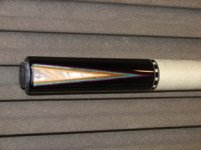

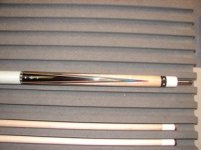

Great looking cue. That's a Brunswick 26 1/2, not a titlist. I think they were made earlier, like in the 20's/30's.
There are many more knowledgeable people here, I'm sure they would know. My "expertise" doesn't scratch the surface of most here.
There are many more knowledgeable people here, I'm sure they would know. My "expertise" doesn't scratch the surface of most here.
My first Tim Scruggs cue was a plain 4 point cocobola player, with a steel joint and 5/16 pin.
After a few years, I had Tim change out the joint to Ivory with a 3/8 10 pin, new shafts and some simple ivory inlays in the cue.
To me this was a more affordable option then buying a cue.
BTW I still have the cue.
After reading this thread again and this post it reminded me of a TV ad many years ago by Famous Upholstery. They would show a old dilapidated sofa and then show the "new finished product." They would claim that they could turn your old sofa into any style and fabric that you wanted. They would have you come into you house and have you look at sofa samples to have your old sofa "convert" to. Actually all they were doing was taking your old sofa and selling you a new one.
So I think any cue maker could take your old cue, change the joint, wrap, inlays, shafts and anything else. The question is after doing all of this is it your old cue?