

The new release of StrokeAnalyzer has the ability to capture and analyze stroke acceleration in 3 axis (X,Y and Z). The measurement and analysis of stroke acceleration is useful for instructors or students to measure and quantify what a good or poor stroke acceleration looks like. Stroke steering is easily seen also in the X axis data. The Y axis data might be useful to analyze a piston type stroke.
So what does stroke acceleration have to do with a cue's hit? Well Im not sure. However, during the capture of acceleration data, I noticed some interesting data AFTER the cue hit the cueball. Im not sure what it means or if its useful, but it MIGHT be useful to compare or characterize cues that are known to have a "firm hit" with cues that dont have a similar hit. Ill leave the usefullness of the acceleration data as it applies to cue production and design data up to cue makers to decide. I just wanted to post the data here for discussion.
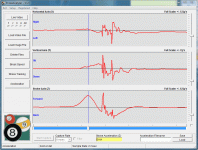
The data shown below was captured at a 2ms rate. Thats fast enough to see frequencies around 500hz. The bottom waveform is the Z axis (stroke axis). Notice the increasing acceleration before the cue hits the cueball, then the sharp decrease where the cue hits the cueball. After that...you see the vibrations and reflections up and down the length of the cue. The upper waveforms display the X and Y axis acceleration. Probably not as useful...but interesting. You can see a picture of the hardware attached to a cue on the screenshots webpage at the StrokeAnalyzer website.
Im going to post this in the Main forum and the "Cue Machinery and Supplies" forum also just to see if it lights a fire somewhere.
Interesting? Useful?
Bob
sales@strokeanalyzer.com
www.strokeanalyzer.com
So what does stroke acceleration have to do with a cue's hit? Well Im not sure. However, during the capture of acceleration data, I noticed some interesting data AFTER the cue hit the cueball. Im not sure what it means or if its useful, but it MIGHT be useful to compare or characterize cues that are known to have a "firm hit" with cues that dont have a similar hit. Ill leave the usefullness of the acceleration data as it applies to cue production and design data up to cue makers to decide. I just wanted to post the data here for discussion.
The data shown below was captured at a 2ms rate. Thats fast enough to see frequencies around 500hz. The bottom waveform is the Z axis (stroke axis). Notice the increasing acceleration before the cue hits the cueball, then the sharp decrease where the cue hits the cueball. After that...you see the vibrations and reflections up and down the length of the cue. The upper waveforms display the X and Y axis acceleration. Probably not as useful...but interesting. You can see a picture of the hardware attached to a cue on the screenshots webpage at the StrokeAnalyzer website.
Im going to post this in the Main forum and the "Cue Machinery and Supplies" forum also just to see if it lights a fire somewhere.
Interesting? Useful?
Bob
sales@strokeanalyzer.com
www.strokeanalyzer.com


