Extreme Outside English - Do you use it?

Colin Colenso

AzB Silver Member
Silver Member
While I hit with extreme inside english quite often, that is a tip or more offset, it's quite rare that I come across shots that require heavy outside english.

Some players tend to use a reasonable amount of OE on shots with draw to hold an angle on a cut, but in these cases, what you may gain in english off the rail is lost in draw. For those shots, low draw with about 1/2 tip of OE is usually sufficient.

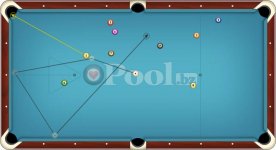
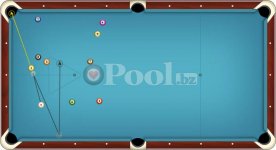
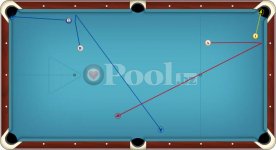
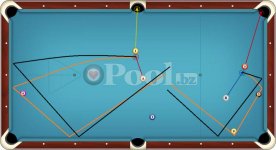
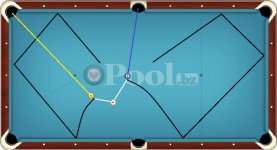
Below I'll attach 3 examples of shots which I play on occasion that require heavy outside english. Perhaps some of you can think of other examples where heavy OE is required.

Colin
 

Attachments

  • Maximum OE 1.jpg
    Maximum OE 1.jpg
    48.3 KB · Views: 631
  • Maximum OE 2.jpg
    Maximum OE 2.jpg
    43.8 KB · Views: 632
  • Maximum OE 3.jpg
    Maximum OE 3.jpg
    42.3 KB · Views: 624
Last edited:
Wow, I actually use those patterns quite often. I also like to use extreme outside on looong thin cuts. <<--depending on position of the next ball of course.
 
Wow, I actually use those patterns quite often. I also like to use extreme outside on looong thin cuts. <<--depending on position of the next ball of course.
I use it on some very thin cuts too, usually around 60-70% max OE to maximize widening throw. Can catch the OB a little thicker and still turn it in, which helps to reach the pocket with less speed on the shot.
 
Last edited:
When it's needed, it's needed. There are an infinite number of reasons to use extreme english just as there are an infinite number of shots to play in any given time. There's no point in listing them.
 
I wouldn't consider either of those patterns all that extreme
The patterns aren't extreme, they require extreme, or heavy outside english. Perhaps not so much for the 3rd diagram where 1/2 tip may suffice.
 
Last edited:
When it's needed, it's needed. There are an infinite number of reasons to use extreme english just as there are an infinite number of shots to play in any given time. There's no point in listing them.
I doubt we could list more than 10 where it wouldn't make more sense to use less than half a tip of OE.
 
I doubt we could list more than 10 where it wouldn't make more sense to use less than half a tip of OE.

I think you are right there are not many. I will add on though.

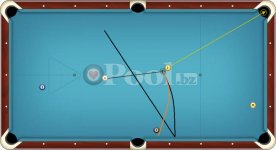
A thin cut where the cueball and objectball are almost parallel to the end rail but you neeed to get the cueball back to the other end of the table.
 
I think you are right there are not many. I will add on though.

A thin cut where the cueball and objectball are almost parallel to the end rail but you neeed to get the cueball back to the other end of the table.
Good one Satori! Yeah, it doesn't help much to draw or stun off these shots, heavy OE is necessary to create an angle.

The same shot from 2 positions diagrammed below:
 

Attachments

  • Maximum OE 4.jpg
    Maximum OE 4.jpg
    43.6 KB · Views: 523
Another one...

This type of extreme outside english shot comes up occasionally.

Usually I'd play this positional shot with deep draw and a touch of outside, perhaps 1/2 a tip at most, but in this situation, the 8 ball is blocking the deep draw path, so to get a nice angle to come across the table for the 2 ball, we'd need a stun draw with a lot of outside english.

The same type of shot can produce an escape route off an end rail also, when doubling around a corner pocket.
 

Attachments

  • Maximum OE 5.jpg
    Maximum OE 5.jpg
    43.8 KB · Views: 515
A couple more examples...

A couple of more examples of using heavy outside as a mechanism to avoid blocking balls.

In the diagrams below, the orange lines are the preferred pathways utilizing draw and a touch of outside. The alternate routes are stun or stun and slight draw with heavy outside english to produce a similar final position.
 

Attachments

  • Maximum OE 6.jpg
    Maximum OE 6.jpg
    52.8 KB · Views: 509
While I hit with extreme inside english quite often, that is a tip or more offset, it's quite rare that I come across shots that require heavy outside english.

Really? You use more extreme inside than outside? I would say i use more outside than inside by a ratio of at least 10:1. I find it rare to ever have to use extreme inside.
 
I think outside is also used a lot of times simply for speed purposes. For example... if you are going one rail for shape it might make more sense to cue it low/outside and hit the shot a little softer which creates less draw going into the rail but the outside spins off the rail so that you still go where you need to. The running (outside) english also picks up speed so that you can shoot softer also.
 
Isn't the third inside?
In the snooker world they'd call that reverse side, but by the definition of outside, if the CB is struck to the side opposite the direction of the cut, that is outside english.

FWIW: On dead straight shots, neither definition (inside or outside) would make sense.
 
Last edited:
Really? You use more extreme inside than outside? I would say i use more outside than inside by a ratio of at least 10:1. I find it rare to ever have to use extreme inside.
Yes, I use heavy inside probably 20 times more often as I use heavy outside and I use heavy inside about as often as I use touch of outside.

But my preferred game is 2 rail, where 2 rails need to be hit every shot. Inside is very effective in this style of play, and having developed a fair degree of skill at it, incorporating back hand english, I tend to use it quite often in standard games of 8,9 ball, US and UK and even snooker.

Below are some common shot types I use heavy IE on:
 

Attachments

  • Inside English Doubling.jpg
    Inside English Doubling.jpg
    39.3 KB · Views: 180
  • More Inside English Shots.jpg
    More Inside English Shots.jpg
    43.6 KB · Views: 171
Last edited:
Lots of reasons to use it, but I tend to like it when it simplifies position by maintaining a stun angle off the object ball.
 
I couldn't help being curious if cue balls spin in the opposite direction when you hit them down under there in Australia? :confused:
 
I think outside is also used a lot of times simply for speed purposes. For example... if you are going one rail for shape it might make more sense to cue it low/outside and hit the shot a little softer which creates less draw going into the rail but the outside spins off the rail so that you still go where you need to. The running (outside) english also picks up speed so that you can shoot softer also.
I agree. It often means a shot can be played softer to get to the same position. On those type of shots, more than 3/8 tip of outside can start messing with the widening throw, so I try to avoid going much beyond the gearing point.
 
Back
Top