Half ball side pocket shots?

Saturated Fats

AzB Silver Member
Silver Member
Why do such an extremely high percentage of side pocket shots go in with a half ball hit? I can't figure out why, but when in doubt I aim for half ball and the shot seems to go in almost every time. This really puzzles me.

 
Possible reasons:
1. The side pocket is a big pocket.
2. You shoot the half ball shot more often than others. Quite often a half ball shot to the side arises because you misplayed position for the corner or the side. Most players these days like to play the corner shots, so you may be overlooking side shots that are viable.
3. The half ball shot has the most throw, so the most variability in outcome angles. A slow stun shot will give a completely different angle than a hard draw shot and there are infinite numbers of outcomes inbetween.
4. If you are cutting a ball into the side, you can sometimes take advantage of object ball curve to increase the effective size of the pocket.
5. You are doing what many aiming systems take advantage of. You start with a small number of cut angles and let your subconscious fill in the blanks, unknowingly adjusting to the correct angle.
 
I will give bit simpler explanation as why such a high % of side pocket shots "seem" to go in with a half ball hit- Most shooters shy away from side pocket shots at steeper angles - you lose the CB too much as one reason why, and those more popular now smaller pocket openings have the side pocket points scaring some folks out of the more shallow side pocket shots.

So, by a process of elimination, either folks are leaning toward getting position on a corner pocket shot more often now- or the side pocket shots most attempted simply ARE in the half ball hit range.
 
Why do such an extremely high percentage of side pocket shots go in with a half ball hit? I can't figure out why, but when in doubt I aim for half ball and the shot seems to go in almost every time. This really puzzles me.

Halfball shots come up all the time.

Here's a neat thing to do, or know....

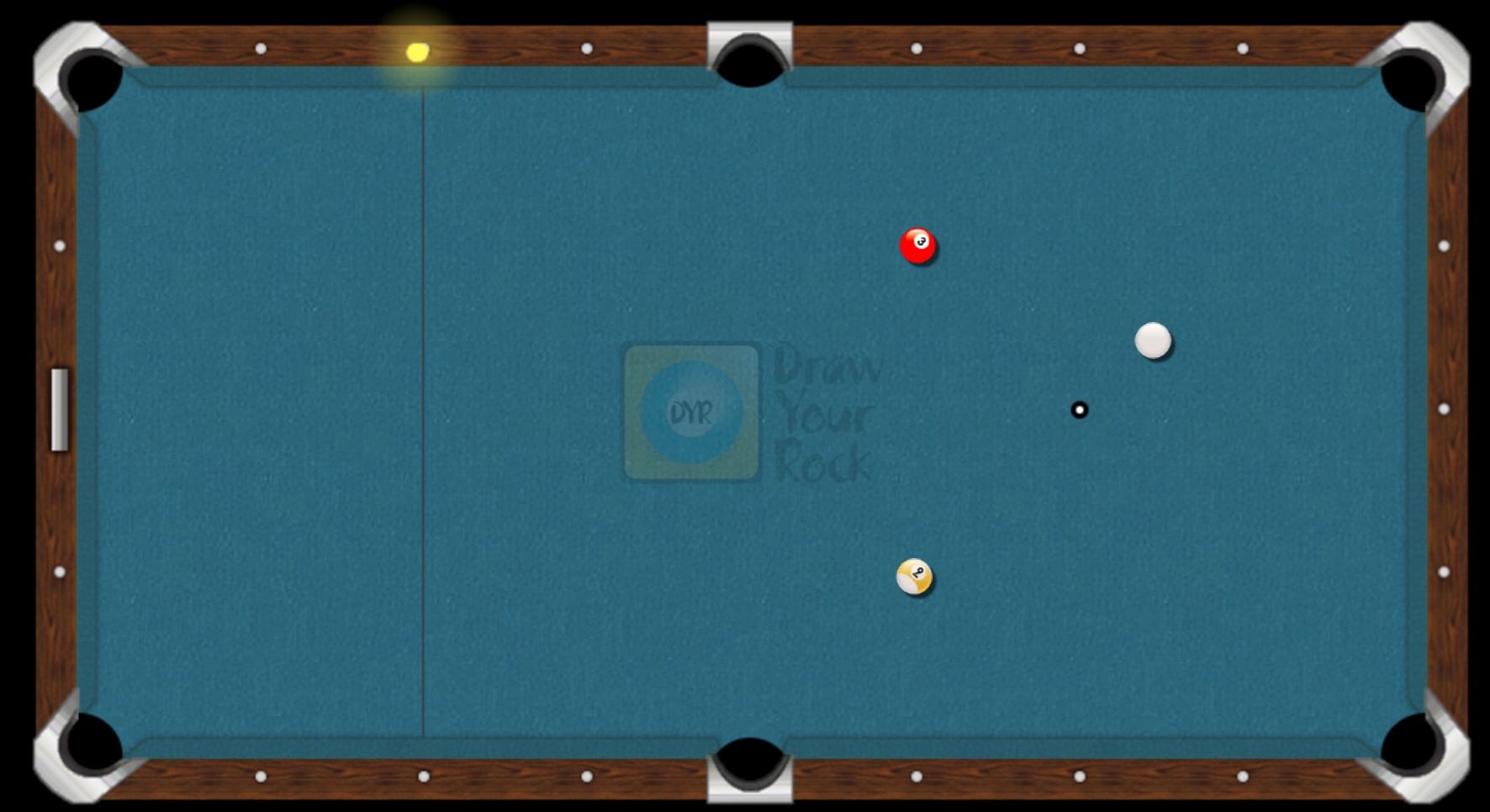
Place a ball anywhere along the line between the the 1st diamonds after the side pocket on each long rail, as shown in the pic, and at least a diamond away from the side rails also. Take the cb and line up it straight into the ob and straight toward the diamond I've highlighted yellow. From there it will be a halfball aim to cut the ob into the side.

In Poolology, the line the balls are on in the pic has a value of 40. Any ball on the line will be on 40. The highlighted diamond is 20. 20 is half of 40, which means if the cb-ob centerline is leading to that diamond, it's a halfball shot to the side pocket. If you move this line of balls back another diamond (away from the side pockets), then the 3rd diamond from the side pocket is used to indicate when a halfball aim will work. (This line would be called 60, and that 3rd diamond is 30.)

full
 
Last edited:
Nice observation/ measuring system and illustration for aiming using the diamonds / geometry/ and the OB full ball hit contact point on the rail relative to the target pocket. I use this system on just about every shot- always "seeing" while standing, where a full ball hit from CB to OB would make the OB hit the rail- then "calculating" how to adjust off that full ball hit on the OB based on the distance from the rail hit to the target pocket. Of course; one needs to adjust the "calculated" OB hit if any sidespin is applied to the CB.
 
Nice observation/ measuring system for aiming using the diamonds / geometry/ and the OB full ball hit contact point on the rail relative to the target pocket. I use this system on just about every shot- always "seeing" while standing where a full ball hit from CB to OB would make the OB hit the rail- then "calculating" how to adjust off that full ball hit on the OB based on the distance from the rail hit to the target pocket. Of course; one needs to adjust the "calculated" OB hit if any sidespin is applied to the CB.

I never looked at it this way until I was asked by a couple of newbies how I am. I didn't have a good answer. Lol. That got me looking harder for better ways of aiming without guessing, so I could maybe help others, and also teach my daughters more quickly than the years it took me tk get a feel for it. And that's when I discovered the use of the inscribed angle theorem to identify known lines for known fractional references.

Now I wish I had started off playing that way, the way you describe, by comparing the cut angle to the straight in alignment. I didn't realize how helpful that was until I came up with Poolology. Now I find myself doing it that way more often, just like you say...stand behind the cb and see where the straight in alignment leads so I'll know how far off from straight in I should aim.

As a "feel" player, this was different. But now there are quite a few shots that come up where I have another way of figuring out what needs to happen as far as where the cb needs to be in order to pocket the ob. Since then, I've noticed just how often halfball shots come up, and that's something I never noticed until I started paying attention to cb-ob relationships.
 
Last edited:
I never looked at it this way until I was asked how I am. That got me looking harder for better ways of aiming without guessing, so I could teach my daughters. And that's when I discovered the use of the inscribed angle theorem to identify known lines for known fractional references.

Now I wish I had started off playing that way, the way you describe, by comparing the cut angle to the straight in alignment. I didn't realize how helpful that was until I came up with Poolology. Now I find myself doing it that way more often, just like you say...stand behind the cb and see where the straight in alignment leads so I'll know how far off from straight in I should aim.

As a "feel" player, this was different. But now there are quite a few shots that come up where I have another way of figuring out what needs to happen as far as where the cb needs to be in order to pocket the ob. Since then, I've noticed just how often halfball shots come up, and that's something I never noticed until I started paying attention to cb-ob relationships.
I, too, looked for more consistency in my game, and to eliminate as many variables as possible. I decided on this system bc I knew, as a working guy, I could never devote enough hours to put every shot to memory. So, in my mind, finding a constant ( the center CB to center OB hit and where that would land the OB on the rail nearest the target pocket became my "constant" to use in aiming a great % of shots. It works well for me. (y)
 
Place a ball anywhere along the line between the the 1st diamonds after the side pocket on each long rail, as shown in the pic. Take the cb and line up any one of those balls to shoot it straight into the diamond I've highlighted yellow. From there it will be a halfball aim to cut the ob into the side.
The cut angles for those shots range from about 25° to 30° - with throw maybe about 22° to 27°...?

pj
chgo
 
In case it matters... the cut angles for those shots range from about 25° to 30°.

pj
chgo

I didn't place the balls very accurately on that chalk pad table. The range begins one diamond distance from the side rail and goes all the way over to one diamond distance from the other side rail. I can fix the quick pic I made, and any ball on that line from the 3 to the 9 will go. The 3 will go into the right side of that pocket and the 9 will go into the left side of that pocket. Any ball on the line between the 3 and 9 will go more cleanly into the pocket.
 
The cut angles for those shots range from about 25° to 30° - with throw maybe about 22° to 27°...?

pj
chgo

Ok. Anyone can set the shots up and shoot them. That's the best way to determine what goes and what doesn't go. Gotta get out from behind the screen and physically do it. Lol
 
Ok. Anyone can set the shots up and shoot them. That's the best way to determine what goes and what doesn't go. Gotta get out from behind the screen and physically do it. Lol
I guess the OB can't be too close the side rail, right? Is there a known distance it must be from either side rail?

I like your system, by the way - not trying to nitpick it.

pj
chgo
 
Not exactly the thread's subject.

I find sometimes when faced with a long shot into a corner pocket where you can shoot to either pocket if you take a closer look you will realize that one pocket or the other presents a tidy half ball hit. Even if it's the back cut direction. I choose this unless there is a compelling shape reason not to.

Half ball shots are everywhere. Look for them, recognize them when you see them no matter where on the table. Whether the balls are close to a pocket or close to each other or far away. They are your good friend.

How do we know it's a half ball hit? The same way we know standing in front of a stairway whether it's too steep, too flat or just right up to code. Because our mind recognizes things we train it to.
 
I guess the OB can't be too close the side rail, right? Is there a known distance it must be from either side rail?

I like your system, by the way - not trying to nitpick it.

pj
chgo

Yep....for these side pocket shots anything closer than a diamond from the rail is definitely subject to hit the point and not go in. And of course if the cb is too close to the ob (about 8 inches or closer) the shots will come off too fat.

It's really just a good tool to help develop a feel or a good eye for cutting balls simply by looking at the shot. And I know you're not nitpicking. You're just a technical guy. That's not a bad thing.
 
Last edited:
Back
Top