How Should I Have Played This Shot

five

AzB Silver Member
Silver Member
I finally got my new Dominiak and played a few racks of 9ball earlier today.

Keep in mind that I am a beginner and haven't gotten to play in the past month.

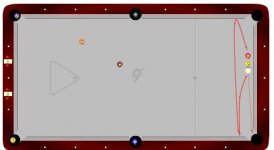
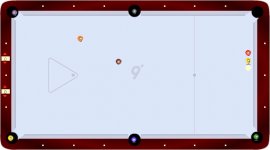
I ran into this shot that gave me some problems. I would like to get some suggestions from veterans to find out what the best way to play this shot would have been.

WEI Code:
START(
%AB1\3%B[2\6%Cr5J9%DB9B7%EP3H0%Ft1\0%GX1L7%H[3B4%Ir5L5%Pr5N0

)END


WEI Screen:
 

Attachments

  • Untitled-2.jpg
    Untitled-2.jpg
    19 KB · Views: 367
Tying up the nine-three is one option, but make DAMN SURE you don't line up an easy combo (straight in or bank) as you'd be giving up rock-in-paw. That's a tough spot, I think you'd be pretty damn good to come out ahead in that game.

Peace
~DC
 
five,

If you were playing for some scratch, it would change some folks answer. If it were a hill/hill game for the money, I would nudge the nine to the rail blocking the three. My opponent, with cue ball in hand not being able to make either the combo or the three, would play safe down table. Now you at least have an opportunity to either duck the shot by playing safe or banking for the win.

I play rudimentary three cushion billiards. A clean hit can be made on the three ball. I believe it is a four rail kick. A fifth rail behind the three ball would give you the potential safety. Your chance of hitting the three and leaving your opponent safe is about 10%. That means you lose 90% of the time. Perhaps more! An advantage to the four/five rail shot is, a small percentage of the time you will kick the three/nine ball combination in.
 
cardiac kid said:
five,

If you were playing for some scratch, it would change some folks answer. If it were a hill/hill game for the money, I would nudge the nine to the rail blocking the three. My opponent, with cue ball in hand not being able to make either the combo or the three, would play safe down table. Now you at least have an opportunity to either duck the shot by playing safe or banking for the win.


Yeah, that's what I meant--well said.

~DC
 
cardiac kid said:
five,
I play rudimentary three cushion billiards. A clean hit can be made on the three ball. I believe it is a four rail kick. A fifth rail behind the three ball would give you the potential safety. Your chance of hitting the three and leaving your opponent safe is about 10%. That means you lose 90% of the time. Perhaps more! An advantage to the four/five rail shot is, a small percentage of the time you will kick the three/nine ball combination in.

I see the 4 rail kick and agree that it is a potential option for a hit, but if you hit the 5th rail before hitting the 3, I don't think you would have enough left on the cue ball for either the cue ball or 3 ball to hit another rail. Maybe after the 5th rail, the 3 ball hits the 9 into the rail on its way up table? I may have answered my own question, but if I didn't please let me know.

I like the safety option of rolling the nine into the rail and three as long as you don't leave too much of the three exposed. To prevent this you could roll the 9 slightly up, but that could leave an easy safety using the 9 as a blocker.
 
cardiac kid said:
A clean hit can be made on the three ball. I believe it is a four rail kick. A fifth rail behind the three ball would give you the potential safety. Your chance of hitting the three and leaving your opponent safe is about 10%.
Would you be kind enough to diagram the 4 rail kick. I would appreciate it.
 
cardiac kid said:
I would nudge the nine to the rail blocking the three. My opponent, with cue ball in hand not being able to make either the combo or the three, would play safe down table.
That is what I attempted to do, but they were able to do a 3-9 combo. It was just a friendly game with one of my friends.

Thanks.
 
Since your almost a cinch to lose from here, why not just go for the win?

It's a long shot but so is everything else.

Jack up, hit the cueball into the rail as shown with left draw, bend it back to the opposite rail, and make the nine - like this:

START(
%AB1\3%B[2\6%Cr5J9%DB9B7%EP3H0%GX1L7%H[3B4%Ir5L5%Pr5N0%Ur1H5
%Vq7D5%Ws4Z2%Xr4L5%_p7Y9%`p7S3%ar0O1%bq0D5%cn8M5%dp0Y4
)END

I haven't tried it, but theoretically it's possible.

Chris
 
If you're a beginner, then I'll assume your opponent was not an advanced player. Tying up the three keeps you in the game against any non-advanced player and the same move has a pretty good chance of working even against a world-cass opponent.

By the way, coming to the forum for advice on your shots is a great idea. Keep it up.
 
I agee with SJM and everyone, twist up the 3 & 9 too many good players don't even consider a good well played foul.
 
OK Guys, I tried my shot and made it the very first time, to re-iterate - jack up, hit the cueball into the rail as shown with left draw, bend it back to the opposite rail, and make the nine. To many players go for the hard safe - why not go for the win? It's like this:
 

Attachments

  • WEI 1.JPG
    WEI 1.JPG
    16.2 KB · Views: 337
TATE said:
OK Guys, I tried my shot and made it the very first time, to re-iterate - jack up, hit the cueball into the rail as shown with left draw, bend it back to the opposite rail, and make the nine. To many players go for the hard safe - why not go for the win? It's like this:

Great shot, Tate. My concern in playing that shot would be having enough speed left once the cueball got to the three, but since you tried it, I guess the shot's there.
 
TATE said:
OK Guys, I tried my shot and made it the very first time, to re-iterate - jack up, hit the cueball into the rail as shown with left draw, bend it back to the opposite rail, and make the nine.
Wow, I would never know to think of that shot. I have so much to learn. Thanks for the input. I will give it a try tomorrow.

TATE said:
Too many players go for the hard safe - why not go for the win?
Easier said than done.
 
I was thinking about Tate's shot but I would not think you would make it on most tables. The good thing though is if you hit half-3/4 of the 3 ball playing it then you get sort of safe, leaving a somewhat easy carom. I play Tate's shot there more then likely, but I hit higher up on the rail then he diagrammed, I aim almost at the first diamond on that rail and bend it back close to the bottom pocket. The reason is because the shot does not work like he diagramed, the english reverses off the second rail so you need to play the angle off the second rail into the 3 and not count on the spin, cause it aint gonna help ya there.
 
Since Five is a beginner I'd have him play a safety foul as suggested. If there is a chance your going to leave a 9 ball combo though, I'd kick behind to move it. It's hard to tell from the diagram exactly. I say this because if the other guy is a beginner he likely won't get out either. Or did he? It's good to have a few tricks up your sleeve, but know them well before you try it in a game/competition situation. Shooting something you don't know is a quick way to lose also. Practice that push foul as well.

Rod
 
Celtic said:
I was thinking about Tate's shot but I would not think you would make it on most tables. The good thing though is if you hit half-3/4 of the 3 ball playing it then you get sort of safe, leaving a somewhat easy carom. I play Tate's shot there more then likely, but I hit higher up on the rail then he diagrammed, I aim almost at the first diamond on that rail and bend it back close to the bottom pocket. The reason is because the shot does not work like he diagramed, the english reverses off the second rail so you need to play the angle off the second rail into the 3 and not count on the spin, cause it aint gonna help ya there.

Yes, you have to play higher up than my diagram showed and bend the ball back with left draw or you might even scratch.

These type of shots are not just tricks as you know. Bending the ball can be very useful when the path of a normal kick shot is blocked.

Chris
 
DeadAim said:
Five,

Let me explain the rail tracking.

The diamond system will ALWAYS be true unless the table is a real piece of s##t. On the diagram I started at cue ball position number 5, I hit through the third diamond with running english on the first rail, this will hit the second diamond on the third rail ( 5 -3 = 2 ), track two goes to the corner pocket on a billiard table or a new 860 cloth.

The following diagram shows the tracking for a "billiard" table.

Pocket billiard tables ALL play differently. New 860 cloth should track as the billiard table, but as the cloth ages the table will begin to track "short", ultimately the second diamond track off the third rail will come up one diamond short of the corner pocket.

If you're playing "serious" 9 ball, one of the first things you should do while practing on the table is check the tables track; this is shown with the thick red line in the diagram.

This is one of the main reasons why players complain about the diamond system and say it's "iffy", if you do not check the rail track OF COURSE your three rail kicks will be off.

I hope this is clear and didn't leave anything out.

Joe

IMO, there is no system that is always true. That's just not possible. Diamond system just gives a good indication where to aim, but never ever gives an exact spot. You have to adjust using feel, experience etc. There are just too many variables: worn/new cloth, humidity, rail condition/hardness, use of natural english (which depends on the angle the cueball hits the first cushion).

Maybe I'm too picky about your sentence "diamond system will always be true" or you are just talking about theoretic imaginary table. You are right about worn cloth giving angles short... And you are also right about learning some kind of diamond system. There are at least 20-30 different diamond systems used, some are simple and some are complicated. But I think you should never fully rely on these systems, because they will never provide you an easy calculated solution for kicking etc.
 
DeadAim said:
You're WRONG, the diamond system is ALWAYS true; I have never seen a table yet were I didn't place the cue ball in one corner, hit diamond three on the first rail, and have it hit diamond two on the third rail. NO hitting hard to lenghten the angle, NO hitting soft to shorten the angle; nice firm stroke with running english. The problem is YOU do NOT know how to hit the cue ball to accomplish this. Get Don Feeney's tape and watch it, he does it EVERYTIME; is he playing on some kind of special table?

I've NEVER seen such a collection of Willie Mosconi's in one place in my ENTIRE life, EVERYTHING I've said at this forum is documented either on tape, DVD, or by word of mouth by PROS; yet, all the wanna-bes here have refuted EVERY word they say. Absolutely UNBELIEVEABLE, Grady would have a field day with you people; if got this collection at super pros together in one place for a week-end he'd NEVER have to shot pool again.

Good grief Charlie Brown, watch out the great pumpkin doesn't hit you in the head and wake you up!

As the english say, "ta, ta"

So, you say that you take the aiming point according to your system and then you can go to any table and don't have to worry about conditions: worn/new cloth, humidity, table brand (cushion hardness) etc. You just aim at the same point according to your system and it works every time on every table ? You say that table conditions don't play any role at all ?

Ok, the original diagram has a 3 or 4 rail kick available. You say, that you can hit the 3-ball every single time in any kind of conditions because you have a fullproof system that gives you 100% accuracy every time ? That's a load of complete bull or you should be on Ripley's Believe It or Not.

As for the diamond system, ask about pros about their diamond systems and you'll notice that there are many different diamond systems available. But, how convenient, you're the one using the only system that is perfect. Wow ! :confused: So, you say that there are countless pros using the wrong system just because they are stubborn and they don't want to learn the ultimate perfect system ? How stupid of them... I'm glad you and Don Feeney can hit them right... Good for you.
 
kyle said:
I agee with SJM and everyone, twist up the 3 & 9 too many good players don't even consider a good well played foul.

Yep- I would add that you are in deep-do-do from there!

Your choice, as alluded to by an earlier post, needs to be made based on the percentages. IMO, your best shot (given the probability of being able to execute your choice sucessfully) is to tie up the 3/9.

Or, you could take just take the cue ball and put it in your pocket.

-pige
 
Hi Five,

I think deadaim is correct. On second viewing, the five rail kick is virtually impossible. It depends on how far from the nine ball the cue ball lays. If there is sufficient room between the cue ball and the nine: Drive the cue ball to just short of the third diamond on the short rail above the three ball. The cue ball goes diagonally one diamond north of the far lower corner pocket. It then strikes the first diamond east of that corner pocket. Travels diagonally back across the table to the first diamond on the same rail you first shot at. Finally, if it still has some speed left, it strikes either the three and goes up table hopefully leaving your opponent with a very difficult shot. At the very best, it strikes the three driving the nine into the pocket. At worst, there is insufficient room between the cue ball and nine to execute my shot. Then deadaim is absolutely correct. Tate's shot is great. I wish I could do it repeatably. I'd play that too!!!!

Anyway you look at it, it is not a beginners shot. It is however, good reason to learn something about the diamond system or three cushion billiards. You don't have to become world champ, just learn the basics. If the jump shot or jump cue is ever banned (hopefully), you will be in a much better position to strike the object ball if your opponent plays you safe. It works great for nine ball, eight ball, any game you play. Try watching the very best one pocket players. They get out of traps time after time with their knowledge of the diamond system.
 
Back
Top