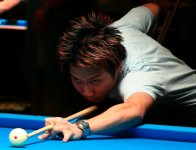
I need to switch to a closed bridge

Old injuries are flaring up more and more. It makes my bridge hand tremor a lot sometimes.

I am thinking of switching to an open bridge so I can stay in the game a little longer.

Would you give me some open bridge tips. When I try open it feels weird.

I am on the long side of 64 and suffer from essential tremmor. Talk to your dr. try low dose "propranolol". A glass of wine or two on top of 20 mg will work wonders.

Good luck:

Bert
 
For most of my pool playing years I played with a closed bridge. Then I learned most pros play with an open bridge because it gives you a better sight picture so I switched to an open bridge. I shot with my fingers spread apart and my thumb out awayfrom my index finger. My cue rests at the vee between my thumb and index finger.

A better way to do this is to bend your thumb nail down, rest the cue between the thumb joint and the knuckle of the index finger. I like this method much better but for some reason it is hard for me to do this. I guess I'm getting old.

I hope this helps you my friend.
 
I think closed bridge has its uses, I usually shoot with a closed bridge, primarily because I believe its easier to maintain correct tip placement when applying sidespin and yada yada.

I still used open bridge for draw shots and other moments where it just feels right, I dunno.

And I disagree of your bridge affecting your aim, I was under the impression as soon as you go down into stance you should already be aiming (even if not correctly).
 
I disagree of your bridge affecting your aim, I was under the impression as soon as you go down into stance you should already be aiming (even if not correctly).
The bridge doesn't affect your aim while standing, but it can affect how well you align your cue with the desired line of aim while making fine adjustment when down in your stance.

Regards,
Dave
 
A closed-bridge's quality is all in how you do it

I think the closed bridge is over rated and will die off as more people realize the best shooters are using it less and less.

I use open bridge for almost all shots, including breaks. The rare exceptions are masse shots and when obstructed by a rail.

I have no problem with extreme english and power draw shots, though the cue sometimes goes into the air after hitting the CB. This can be controlled if one needs to.

Here's me playing some power shots with english using an open bridge.

http://www.youtube.com/watch?v=keznf66dSHE

The best potters and the best power potters use the open bridge. Other than the break shot, and occasional rail shots, it ought to be abandoned. The only reason it lasted as long as it did, is because the styles of games that used it, were not accuracy oriented.

Not one single closed bridge player has ever come close to the accuracy with power as the top 20 snooker open bridge players have achieved.

Not sure I agree with that, Colin. I also play snooker, and although I use the open bridge a LOT in pool, it has more to do with expediency than it does accuracy. In other words, I'm LAZY -- it's easier to slap my hand down on the table like a meat patty (as if slapping a raw hamburger down on the grill), than to form a closed bridge in the air around my cue and place it down on the table.

I have a very well-constructed closed bridge, that has a built-in "V"-channel oriented vertically just like an open bridge does, and I have the same level of accuracy as the open bridge. But on power shots, I do prefer the closed bridge, as it has -- built-in -- the stability to keep the cue from lifting up in the air as the butt of the cue bottoms-out on the heel of your grip hand.

I think most players that have the same opinion of the closed bridge as you do, came from an environment where it was never taught how to form one CORRECTLY. Instead, in your words, you learn to apply adaptations to "control" the cue's movement to the air when the butt bottoms-out on your hand.

A proper closed bridge isn't simply looping your index finger over the cue and connecting with the thumb underneath. You're right in that in the past -- where pool didn't have today's tighter-constrained equipment that requires more accuracy these days -- a simply looped-index-finger closed bridge was sufficient.

To get the same level of accuracy that an open bridge offers, you have to make sure to include one key feature in its construction -- a vertically-oriented "V" channel that the cue can ride onto. This is done by using the index-finger-pressing-down-upon-the-top-of-the-middle-finger (inappropriate termed the "Filipino closed bridge"). But, a key step is letting the index finger's first joint collapse under the pressure, and then pulling the whole thing in ("scrunching" if you will) so that the naturally-formed "V"-channel that the index finger forms when pressing down upon the top of the middle finger, rotates upwards, vertically. Normally, the index-finger-pressing-down-upon-the-top-of-the-middle-finger creates a "V"-channel that is laying on its side:

* like this for a right-handed player (left-handed bridge): ">"
* like this for a left-handed player (right-handed bridge): "<"

"Scrunching" the bridge (pulling it inwards) causes that "V"-channel that's normally laying on its side, to rotate upwards so that it's more vertically oriented.

Alex Pagulayan is a good example -- notice how he pulls-in the closed bridge ("scrunches" it) so that the hand is more of a ball than laying flat. And notice how the cue rests in a now-vertical "V" channel -- just like the open bridge. This bridge is extremely stable, accurate, and like a "Rock of Gibraltar" for power shots.

Just wanted to share this information, because I disagree with the notion that the closed bridge is "outclassed" by the open bridge. It's all in how you do it.

-Sean
 

Attachments

  • Alex_Pagulayan_scrunched_closed-bridge.jpg
    Alex_Pagulayan_scrunched_closed-bridge.jpg
    68.8 KB · Views: 907
Last edited:
Not sure I agree with that, Colin. I also play snooker, and although I use the open bridge a LOT in pool, it has more to do with expediency than it does accuracy. In other words, I'm LAZY -- it's easier to slap my hand down on the table like a meat patty (as if slapping a raw hamburger down on the grill), than to form a closed bridge in the air around my cue and place it down on the table.

I have a very well-constructed closed bridge, that has a built-in "V"-channel oriented vertically just like an open bridge does, and I have the same level of accuracy as the open bridge. But on power shots, I do prefer the closed bridge, as it has -- built-in -- the stability to keep the cue from lifting up in the air as the butt of the cue bottoms-out on the heel of your grip hand.

I think most players that have the same opinion of the closed bridge as you do, came from an environment where it was never taught how to form one CORRECTLY. Instead, in your words, you learn to apply adaptations to "control" the cue's movement to the air when the butt bottoms-out on your hand.

A proper closed bridge isn't simply looping your index finger over the cue and connecting with the thumb underneath. You're right in that in the past -- where pool didn't have today's tighter-constrained equipment that requires more accuracy these days -- a simply looped-index-finger closed bridge was sufficient.

To get the same level of accuracy that an open bridge offers, you have to make sure to include one key feature in its construction -- a vertically-oriented "V" channel that the cue can ride onto. This is done by using the index-finger-pressing-down-upon-the-top-of-the-middle-finger (inappropriate termed the "Filipino closed bridge"). But, a key step is letting the index finger's first joint collapse under the pressure, and then pulling the whole thing in ("scrunching" if you will) so that the naturally-formed "V"-channel that the index finger forms when pressing down upon the top of the middle finger, rotates upwards, vertically. Normally, the index-finger-pressing-down-upon-the-top-of-the-middle-finger creates a "V"-channel that is laying on its side:

* like this for a right-handed player (left-handed bridge): ">"
* like this for a left-handed player (right-handed bridge): "<"

"Scrunching" the bridge (pulling it inwards) causes that "V"-channel that's normally laying on its side, to rotate upwards so that it's more vertically oriented.

Alex Pagulayan is a good example -- notice how he pulls-in the closed bridge ("scrunches" it) so that the hand is more of a ball than laying flat. And notice how the cue rests in a now-vertical "V" channel -- just like the open bridge. This bridge is extremely stable, accurate, and like a "Rock of Gibraltar" for power shots.

Just wanted to share this information, because I disagree with the notion that the closed bridge is "outclassed" by the open bridge. It's all in how you do it.

-Sean
I appreciate the detailed description Sean. Certainly Alex's bridge is much more stable than my own mediocre attempts at a closed bridge. I'm pretty sure my fingers would ache for months if I tried to get my fingers in his formation.

I sounded a bit bombastic in the post you replied to. I wouldn't say the open bridge is of a lower class, I just question its necessity... in terms of presenting significant advantages to overcome the effort it takes to develop a great closed bridge.

A closed bridge may not be an obstacle to achieving high accuracy, but it's interesting that in snooker, a game which requires significant accuracy and power, it has rarely been used.

What advantages would you assign to the closed bridge?
 
I appreciate the detailed description Sean. Certainly Alex's bridge is much more stable than my own mediocre attempts at a closed bridge. I'm pretty sure my fingers would ache for months if I tried to get my fingers in his formation.

I sounded a bit bombastic in the post you replied to. I wouldn't say the open bridge is of a lower class, I just question its necessity... in terms of presenting significant advantages to overcome the effort it takes to develop a great closed bridge.

A closed bridge may not be an obstacle to achieving high accuracy, but it's interesting that in snooker, a game which requires significant accuracy and power, it has rarely been used.

What advantages would you assign to the closed bridge?

Colin:

Yeah, bombastic is a good word to use when you compare those two posts I replied to.

I agree with you that the effort to form the ultimate closed bridge (i.e. one that is formed correctly, and is not simply a finger looped over the top of the cue) is significant, and for much less effort, you can form an open bridge. I admit fully that I use the open bridge a LOT -- for me, it's the same effort as slapping a hamburger patty on the grill -- a very simple motion. And, it works with my rhythm at the table quite well (i.e. a quick pace).

Where I stop, and know that I need a closed bridge, though, is on long power shots. Not so much with draw or follow (because I can do those with an open bridge as well), but, say, long stun shots. Say, in straight pool, I have a long break shot with not much angle into the rack, and I really need to amp up the power to get the cue ball into the rack. I'll switch to a closed bridge, and make the effort to make a good one, because I know that I have the best foundation for really letting my stroke out. Sometimes, with an open bridge, when I let my stroke out, I have to really concentrate on staying still. The open bridge doesn't have the structure over the cue to prevent the cue from going in the air. With the closed bridge, I can lunge forward a bit (just a bit, not like a break shot) and know that I'm not going to go off line and not have to worry about implementing those "adaptations for control" like you mentioned in one of your posts.

Does the closed bridge "hide" problems with one's stroke? Yes, I believe in some players it does, and the closed bridge then becomes a "crutch." This is all too common. But a true cueing student will work with all combinations of stroke, bridge, grips, etc. to work out any inconsistencies seen with certain combinations. One may learn about stroke inconsistencies when using an open bridge -- that's what happened to me. I worked those out. Now, the closed bridge is a tool in my toolbox; not something I rely on to cover-up an inconsistency elsewhere.

I hope I answered your question? Anyway, this is a great topic. Interested in hearing other's opinions about this.

-Sean
 
Colin:

Yeah, bombastic is a good word to use when you compare those two posts I replied to.

I agree with you that the effort to form the ultimate closed bridge (i.e. one that is formed correctly, and is not simply a finger looped over the top of the cue) is significant, and for much less effort, you can form an open bridge. I admit fully that I use the open bridge a LOT -- for me, it's the same effort as slapping a hamburger patty on the grill -- a very simple motion. And, it works with my rhythm at the table quite well (i.e. a quick pace).

Where I stop, and know that I need a closed bridge, though, is on long power shots. Not so much with draw or follow (because I can do those with an open bridge as well), but, say, long stun shots. Say, in straight pool, I have a long break shot with not much angle into the rack, and I really need to amp up the power to get the cue ball into the rack. I'll switch to a closed bridge, and make the effort to make a good one, because I know that I have the best foundation for really letting my stroke out. Sometimes, with an open bridge, when I let my stroke out, I have to really concentrate on staying still. The open bridge doesn't have the structure over the cue to prevent the cue from going in the air. With the closed bridge, I can lunge forward a bit (just a bit, not like a break shot) and know that I'm not going to go off line and not have to worry about implementing those "adaptations for control" like you mentioned in one of your posts.

Does the closed bridge "hide" problems with one's stroke? Yes, I believe in some players it does, and the closed bridge then becomes a "crutch." This is all too common. But a true cueing student will work with all combinations of stroke, bridge, grips, etc. to work out any inconsistencies seen with certain combinations. One may learn about stroke inconsistencies when using an open bridge -- that's what happened to me. I worked those out. Now, the closed bridge is a tool in my toolbox; not something I rely on to cover-up an inconsistency elsewhere.

I hope I answered your question? Anyway, this is a great topic. Interested in hearing other's opinions about this.

-Sean
Good points Sean!

Perhaps because I started playing at 7, on a 12 foot table at home, playing a lot of power billiard in offs, I've never really struggled with power using an open bridge. Thinking about it, I can see how a good closed bridge can add security to power shots, especially while the stroke is developing.

I get the odd awkward bridging shot where I wish I had a great closed bridge.

Another issue I have with the closed bridge is that it tends toward a more downward angled shot, particular when using smaller cue balls as in snooker and english 8 ball. On slippery napless US tables with a higher CB center, it presents less of an issue.

I like to get my open bridge very low on some draw shots.

Another key issue is friction, which greatly affects touch. Even with the open bridge this is an issue in humid conditions, on the closed bridge, it's like torture dealing with the friction in humid conditions when I've tried it. Even with a glove, I don't like the feel of unwanted friction on the cue.
 
Good points Sean!

Perhaps because I started playing at 7, on a 12 foot table at home, playing a lot of power billiard in offs, I've never really struggled with power using an open bridge.

Thanks, Colin! We share approximately the same childhood history with the game. I was taught to use the open bridge, because when I was a child growing up with hunting in my blood, my Dad would tell me to pretend the open bridge's "V"-channel was like the rear sight on iron sights (rifle), and that the tip of the cue was the front sight. He told me to get real low on the cue and try to sight down it, even though the analogy to a rifle has its problems in that you can't get your eye completely level/in-line with the cue.

It was only later on in pool halls that I noticed folks using the closed bridge, and Willie Mosconi's little red book was the first one I read that addressed the closed bridge topic.

Later, after realizing the pitfalls with the "finger looped over the top of the cue" type of closed bridge, I experimented with what I saw Mike Sigel, Steve Mizerak, and Efren using -- with that index-finger-pressing-on-top-of-the-middle-finger bridge. It was much later that I learned to scrunch it in, after my fingers adapted to this style of closed bridge.

Thinking about it, I can see how a good closed bridge can add security to power shots, especially while the stroke is developing.

Actually (concerning the bolded), this is one of the more dangerous times, IMHO. While one is developing his/her stroke, it's very easy to fall into the trap of letting a closed bridge be a "crutch" and hide problems with the stroke. I'm thinking develop with the open bridge first (so that any inconsistencies in the stroke are shown the light of day), and then later work on the closed bridge.

I get the odd awkward bridging shot where I wish I had a great closed bridge.

Those, especially!

Another issue I have with the closed bridge is that it tends toward a more downward angled shot, particular when using smaller cue balls as in snooker and english 8 ball. On slippery napless US tables with a higher CB center, it presents less of an issue.

I like to get my open bridge very low on some draw shots.

By folding my middle finger under, and having the index finger pressing down upon both the second knuckle of that now-folded-under middle finger and the pad of the thumb simultaneously, that place where my index finger is pressing upon my middle finger is now resting right on the table surface -- it's as low as it can possibly go.

I'll see if I can take some pictures tonight when I meet up with my weekly one-pocket sparring partner (Monday nights).

Another key issue is friction, which greatly affects touch. Even with the open bridge this is an issue in humid conditions, on the closed bridge, it's like torture dealing with the friction in humid conditions when I've tried it. Even with a glove, I don't like the feel of unwanted friction on the cue.

Absolutely. In fact, I don't even like the material that the standard pool gloves are made of (e.g. Sir Joseph). I still feel drag with those in a closed bridge, and I think it's due to that synthetic nylon-ey material they use. I use Nancy Cote's FingerSlides (a custom set she makes for me where the tips of the index finger and thumb are fully encapsulated/covered) and this material is much, much better. It's more cotton-ey and less nylon-ey (if that makes any sense?).

In non-humid conditions, I use just a dab of corn starch (not talc). Corn starch is much slicker than talc, and is less messy. Corn starch is sort of pastey, absorbs much more moisture, and is very slick. It's used in sports for perspiration absorption over talc. You don't get the "powder explosions" on the table with corn starch like you do with talc, either. And as the old [hair preparation] TV commercial says, "a little dab will do ya." I just touch the tip of a finger to the corn starch, and use that finger to gently touch the areas where the cue shaft needs to slide -- just two spots inside that "V"-channel of the closed bridge.

In humid conditions, I use the FingerSlides.

Or, if all this is too much of a pain (i.e. I'm particularly lazy), I'll just tough it up, buckle down on my fundamentals, and use the open bridge. ;)

-Sean
 
Back
Top