Jimmy Reid's aiming method

This article by Bob Jewett talks about this system and a bit about its history.
http://www.sfbilliards.com/tucker_system.pdf

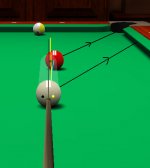
Below is a picture I made a while ago that might help people to get a visual idea of this type of aiming system.

btw: Don't laugh, I also thought I had invented this system a few years ago. Hence the system name on the graphic... lol

Colin
 

Attachments

  • Contact to Contact.JPG
    Contact to Contact.JPG
    26.8 KB · Views: 1,635
Colin's photo shows exactly how I aim. I always begin with center ball. Once the lines have been established I stroke down the green line to the rail. This helps me establish the angle needed.

This "system" can be used with or without center ball hit when the effects of off center hits have been learned.

Personally, I find the use of the word "feel" contributes to more confusion than real help in learning to play. Variables such as squirt, swerve, power, and masse can be learned individually and then combined to learn the different effects that can be obtained. I think that a systematic approach can be taken and that one can introduce them to one's games as they are mastered.

With practice the mind learns how to combine different effects and this, I think, is what people mean by "feel." Feel comes from concentrated study of each of the possible effects over different distances.

I think that to learn to play well one must study each effect and then combine as they are mastered. In this way the player will have a much better mastery of the game because he or she knows what they are doing.

I think that what would be helpful is a systematic sighting approach, such as Colin presents and then a regime based on importance and increasing difficulty of various techniques. For instance, first the player learns center ball hit over various distances with appropriate attention to throw for various cut angles.

The second step would be to learn the effects of hitting above center.
The third step would be to learn to use draw, etc.

In this way the player has a systematic approach to playing any shot.

It is unfortunate that for all the smoke and mirrors presented in many of the posts that some of the truly knowledgeable and talented posters have not devised or presented a systematic approach to learning to play well.

Rather than find fault with other approaches I would prefer to see a systematic approach to playing.
 
Jimmy M. said:
Are you playing in the straight-pool tournament that's coming up down there (the Lucasi Hybrid Classic)?

Yup I will be there and trying to play, Thorsten is helping me with playing straight pool but my back has been in a lot of pain lately so I don't expect to do too well. Either way I will be there trying to make a match out of it.

Thanks to everyone that posted, I didn't get to practice much since Thorsten was on a roll was shooting 90% of the time. Again I don't see much point in practicing with an opponent, for the most part I believe drills will help most people most of the time.
 
Colin Colenso said:
This article by Bob Jewett talks about this system and a bit about its history.
http://www.sfbilliards.com/tucker_system.pdf

Below is a picture I made a while ago that might help people to get a visual idea of this type of aiming system.

btw: Don't laugh, I also thought I had invented this system a few years ago. Hence the system name on the graphic... lol

Colin

Colin,
Can you add a line from the center of the CB to the center of the OB to show that the aim line is "double the distance" from the center of the OB to the contact point on the OB going to the pocket which also results in the green line of aim?
 
btw: Don't laugh, I also thought I had invented this system a few years ago. Hence the system name on the graphic... lol

If you had never heard of it before, I guess you did invent it. In that sense it's been reinvented many times.

pj
chgo
 
Patrick Johnson said:
If you had never heard of it before, I guess you did invent it. In that sense it's been reinvented many times.

pj
chgo

One day I "invented" something that I thought was quite good. We subsequently looked into patents and all the technical difficulties of getting it to a mass production facilitiy. After about one month of research we found that it was already out there.

At first I was disappointed and a little depressed (it could have made millions). Then, after I thought it through I realized that having re-invented the wheel is a heck of an ego boost. The idea really was worth while as someone was already making millions -- so it must have been a good idea to begin with. Yeah -- do it agian Colin. Next time it might be original and it will make you millions.
 
Patrick Johnson said:
It's an old method, as old as ghost ball - nobody alive today invented it. It's called lots of different things: "double overlap", "double the distance", etc. It's also mentioned frequently here on AZB (I've mentioned it myself several times).

Like ghost ball it's "geometrically correct", meaning if you can follow the directions exactly you'll line up exactly right to hit the OB contact point (unadjusted for throw), just like ghost ball. But just like ghost ball and any other system, it takes some "feel" to line up exactly right - you have to:
-....

And therein lies the rub. I find all aiming methods fail me, I think you just have to shoot enough shots that aiming by feel just happens. Not this "muscle memory" nonsense as muscles don't have brain cells, but just plan old fashion Pavlovian & Skinnerian conditioning. We unconciously "learn" to repeat things a certain way when they are successful and avoid them when they are unsuccessful.
 
Feel comes from concentrated study of each of the possible effects over different distances.

For you and me, but not necessarily for everybody.

I think that to learn to play well one must study each effect and then combine as they are mastered. In this way the player will have a much better mastery of the game because he or she knows what they are doing.

I think there are many more players who don't "study each effect" than who do. I suppose you could say that their subconscious minds study each effect, but even so I think it's more descriptively called "learning by feel" (to differentiate it from "learning by consciously studying each effect").

pj
chgo
 
LAMas said:
Colin,
Can you add a line from the center of the CB to the center of the OB to show that the aim line is "double the distance" from the center of the OB to the contact point on the OB going to the pocket which also results in the green line of aim?

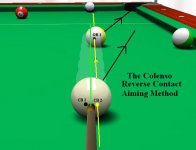
The first diagram is a little out, so here is another one which shows the double distance.
Blue Line - Line through Core Centers of the 2 balls.
Brown Line - Required stroke Line.
Yellow Line - Line from OB Contact Point to Imaginary Mirror of Parallel Point on CB. (Which passes through CB contact Point on the hidden side of the CB).

Colin
 

Attachments

  • Parallel Aiming.JPG
    Parallel Aiming.JPG
    43.5 KB · Views: 731
Last edited:
Patrick Johnson said:
Hey Colin, what drawing tool do you use for those cool 3-D graphics?

pj
chgo

I just take screenshots from a game called DDD Pool, then add a few lines in Paintbrush. I save to JPEG in photoshop so I don't get so much quality loss.

Colin
 
Neil said:
No problem. But I would imagine that Joe got it from Jimmy. And I'm sure Jimmy got it from someone else. I believe that system has been around for a LONG time. Jimmy has it on his videos.
The "Equal Opposites" method of aiming was invented by Marvin Chin, in his book called Billiards Accuracy. It's out of print now, and I was lucky enough to grab a copy of this about 10 years ago.

The book was made in 1982. It had wonderful diagrams of how the system works. This is still the system I use when I can't see the shot, and have to find the contact points.

I'll see if I can scan the diagrams to PDF and put them up tonight.
 
Shawn Armstrong said:
The "Equal Opposites" method of aiming was invented by Marvin Chin, in his book called Billiards Accuracy. It's out of print now, and I was lucky enough to grab a copy of this about 10 years ago.

The book was made in 1982. It had wonderful diagrams of how the system works. This is still the system I use when I can't see the shot, and have to find the contact points.

I'll see if I can scan the diagrams to PDF and put them up tonight.

You got me curious, I guess it is still available if somebody wants to pop for 84 bucks.

http://www.antiqbook.com/boox/bookc/64506.shtml
 
Steve Ellis said:
You got me curious, I guess it is still available if somebody wants to pop for 84 bucks.

http://www.antiqbook.com/boox/bookc/64506.shtml
Jimmy covered the system quite well in No Time for Negative and also in The Art of 8 Ball. Shameless plug for Jimmy Reid! Anyways, Marvin's book is good, but I wouldn't shell out $84 for it! It covered other things besides aiming, but none of the other material was really new. Jimmy gave a very good, thorough explanation of how to actually execute Marvin's system in his videos.
 
Shawn Armstrong said:
Jimmy covered the system quite well in No Time for Negative and also in The Art of 8 Ball. Shameless plug for Jimmy Reid! Anyways, Marvin's book is good, but I wouldn't shell out $84 for it! It covered other things besides aiming, but none of the other material was really new. Jimmy gave a very good, thorough explanation of how to actually execute Marvin's system in his videos.

While I've got his complete video set, albeit on tape (another endangered species). I'll have to give it another look, but I still swear by the aim by feel method.
 
The overlay and double the distance type systems have been around since I played in the 60s, and probably alot longer. Joe refined both to make his system which creates a consistent numbered contact point on the OB which you then line up with the number on the CB to give you a path for the CB to follow to pocket the ball, but not necessarily a target. You line up for the shot on that line. It works extremely well if practiced.

Double the distance, should give you a point of aim or path if done accurately.

I find that using the overlay is quicker and easier for me, also. Which is what the OP was talking about.


Mike
 
Last edited:
Colin Colenso said:
The first diagram is a little out, so here is another one which shows the double distance.
Blue Line - Line through Core Centers of the 2 balls.
Brown Line - Required stroke Line.
Yellow Line - Line from OB Contact Point to Imaginary Mirror of Parallel Point on CB. (Which passes through CB contact Point on the hidden side of the CB).

Colin

Thanks for the update and additions. Many here will relate to your comprehensive dipiction.
 
Deadon said:
The overlay and double the distance type systems have been around since I played in the 60s, and probably alot longer.

I'd be surprised if we couldn't find a description of them from the 19th century.

pj
chgo
 
Actually getting in line is 80% of all shot-making execution. It DOES take discipline. It is easy to get lazy and assume you are in line (guilty here).

I had a world-class player show me the principle and was ONE STROKING shots in from everywhere just based on this principle. Learn how to get "in-line" then the other 20% should be easy...right?
 
I have only paid 1 person in my life for a lesson (in cash..I prefer food and drink)
Jimmy Reid. That one lesson 2 hours 20.00 bucks was my first. I still use his Aim
methiod today. My point in i'm in my 40's i was in my early 20's then.....
So its been around awhile...If you dont know it and love pool.....learn it asap.

I hope the 'hip' is doing better heath wise. God bless ya!
 
Back
Top