Kicking Accuracy

Jal said:
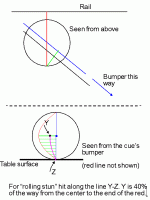
I think you can view all of the relevant lines as lying on a plane perpendicular to the shaft and containing the point O (the point on the surface of the cueball opposite the cushion). From a bird's eye view, the plane would contain the green line in this picture:

Running_English.jpg


Point Y (relocated from Andrew's diagram and Ron Shepard's construction) is at centerball height and located at the intersection of the broken black arrow and the green line. Point Z is in the plane at bed height and underneath the intersection of the blue and green lines.
Jim, there are two components of natural running english. Natural running english off the cushion and natural follow on the bed of the table. That's why there is an X and Y component. I believe you are just looking at the cushion collision. But, the spin isn't true "natural running," if it doesn't naturally follow on the bed before it strikes the cushion.

For that natural follow w/running english, it makes sense to me that the proper stun shot would be a point on that line. Notice that this line is closer to center than your line. And that seems to go hand in hand with your follow up statements (that the offset should be some fraction of your line).

Fred <~~~ IMO, of course.
 
RSB-Refugee said:
Bob,
Your diagram is the same as I pictured in my mind, when I read Ron's quote.
Here is another related question. Is there a line above the cue balls equator that when hit gives the same result? Would it be on the other side of the cueball? IOW, if hitting with follow, does the cue ball need to be "checked"? If there is such a line, would it mirror the other line in reverse? It seems there should be such a line, but the two lines would have to meet at the equator, which is confusing me.

Tracy
Interesting thought, Tracy. But, what the natural rolling follow attempts to do is take the cushion variance out of the equation, and concentrates on the moment of inertia of the ball. A checked shot would rely on cushion parameters.

That being said, just in this natural running english shot, we don't hit above the equator. So, if a line that you're suggesting exists, try it out, but only concentrate on the line portion above the equator.

Fred
 
Colin Colenso said:
Here is the direct link to RSB
http://groups.google.com/group/rec.sport.billiard?hl=en

When I occassionally go there, I go to google groups and just search for billiards, and the link will be somewhere near the top.

Not the easiest discussion board to traverse.

Colin

http://www.recgroups.com/

This is a newer web-based newsgroup reader that looks similar to old-school viewers. It also allows killfiles as well as several standard viewer options.

Fred
 
My bad!

Jal, I actually woke up this morning and realized my error. LOL...what a difference a day and a good night sleep makes. Me thinking that it would be "longitudinal" is totally wrong. If you apply the algorithm to each disc and project it to the 2-D image, it would be a straight line. I just wasn't applying the algorithm correctly to each disc (I was using 40% of the circumferal distance along the surface instead of the orthogonal distance to the centerline).

You know...i have yet to read your reply, but I'm sure you're just pointing out what I just realized. Let me now go check it out. Thanks for your help. :)

EDIT: Doh! Now i think we're BOTH wrong. LOL. Even if you apply 40% of the orthogonal distance to the centerline, the projected line will still be curved, though not as curved as my previous longitudinal solution. I think the real solution is somewhere between my previous solution and your straight line solution. Dang...gotta go to work, this will bother me the whole day. I'll try to think it through later on.
 
Last edited:
jsp said:
EDIT: Doh! Now i think we're BOTH wrong. LOL. Even if you apply 40% of the orthogonal distance to the centerline, the projected line will still be curved, though not as curved as my previous longitudinal solution. I think the real solution is somewhere between my previous solution and your straight line solution. Dang...gotta go to work, this will bother me the whole day. I'll try to think it through later on.
The line in space is curved. But, it's not along a longitudinal line. It can't be, because it's not going from pole to pole.

Fred
 
... IOW, if hitting with follow, does the cue ball need to be "checked"? If there is such a line, would it mirror the other line in reverse? It seems there should be such a line, but the two lines would have to meet at the equator, which is confusing me.

Tracy
The problem is that with follow, the cue ball curves when coming off the rail. The extent of the curve depends on speed and the cloth and the ball. I think for a particular set of conditions, some amount of "check follow" or reverse follow would get a "mirror-perfect" reflection except for the curved path.
However, it is known -- for example in Koehler. I think -- that follow nearly parallel into the cushion always has the exit angle more parallel to the cushion than the entry angle. Bud Harris estimated the angle ratio as 70%.
 
Okay...let me see if I can explain what I think with a picture (I just modified Bob's excellent graphic because i'm too lazy ;)).

Again, think of dividing the CB into horizontal, circular discs. You then want to find the Y points for each disc by following the same procedure as the middle disc.

Notice that the red points (corresponding to the points on the CB directly opposite the cushion) drawn up and down the CB will look like a longitudinal line. Projected on the 2D plane perpendicular to the shaft, the line looks curved, correct? The blue points (corresponding to the points on the CB directly opposite where you're aiming) should also form a longitudinal line. However, projected on the 2D plane, this blue line looks like a perfectly straight vertical line, since you're looking at it directly.

Now, the Y points would be 40% the distance (in the directon parallel to the felt) from the blue line to the red line, in the 2D plane. Because one line is curved and the other line is straight (in the 2D perspective), the corresponding projection of all the Y points in the 2D plane cannot be straight. It has to be curved. The only way it would be straight is if the red line is straight as well, and this cannot be for a sphere (true for a cone, but not a sphere).

Now if I'm wrong, then I'm wrong because I split the CB up into horizontal circular discs and found the Y values for each disc. I still don't know if this methodology makes sense in the physics realm (to determine natural rolling english off the cushion). But it sure makes sense to me in the geometry realm, since i feel that you still want to maintain the same cue angle for each disc. (EDIT: Actually, in my methodology, you WON'T be maintaining the same cue angle for each disc. You would with my previous solution, if the line YZ was a line of longitude intersecting point Y on the equator.) Again, please let me know where my arguments go wrong.
 

Attachments

  • stun2.GIF
    stun2.GIF
    9.8 KB · Views: 205
Last edited:
Cornerman said:
Jim, there are two components of natural running english. Natural running english off the cushion and natural follow on the bed of the table. That's why there is an X and Y component. I believe you are just looking at the cushion collision. But, the spin isn't true "natural running," if it doesn't naturally follow on the bed before it strikes the cushion.
I've always took "natural running" to mean with respect to the cushion, and not the bed. But your point is well taken as I'm sure you know more about the standard usage of the term than I do. Thanks and sorry for the confusion.

Cornerman said:
For that natural follow w/running english, it makes sense to me that the proper stun shot would be a point on that line. Notice that this line is closer to center than your line. And that seems to go hand in hand with your follow up statements (that the offset should be some fraction of your line).
Yes, I agree Fred. Locating Y at (2/5)R above center does get you closer to the offset that I think produces an equal angles rebound. Interesting point. But I think you'll agree that it's probably better to keep the two issues separate: what offsets produce, well, natural running english off the cushion; and what fraction of it gets you a mirror-like reflection. In this thread it may not always be obvious which one is being discussed.

Jim
 
I'm surprised no one has really discussed learning the various "dead" bank shots. There are many such shots, and they require no calculation. You just need to memorize them.
 
Wow. I've played 3-cushion for as long as I can remember and I have never learned this technical stuff. I think I'm missing out. Bob, why haven't you shared this with me???? :confused:.

If I may make a suggestion that might help with 1 rail kicks (without knowing calculus ;)):

But first, you must learn to hit the cue ball a little above center, to get the ball rolling naturally, with NO english. Use a very smooth level stroke at a slow to medium speed. Learn the "Tracks" for the long rail kick and the short rail kicks. You will find kicking the length of the table (head to foot & visa versa) it is basically divide the diamonds in half, same for kicking to the same half of the table short ways (corner to side pocket or less & visa versa). Corner to corner or past the side pockets will result in a slightly longer angle.

Once you are comfortable with the "Tracks" on the diamonds, and you can execute that stroke, here's the tip: Simply find the nearest track to the object ball (using closest diamond or pocket as discussed above), measure the difference from the track to where you actually want to hit the object ball (correct side of the desired hit - the distance should not be more than 7" or so or you should find a different track) and split that difference in half. Then you adjust the point where you hit the rail to achieve the original "Track" longer or shorter the amount you just calculated (i.e. the distance is 5" longer, you add 2 1/2" to original aim point on rail). This will get you very close, the rest is feel & experience.

Remember: the begining of the track calculation (cue ball) is measured from where the butt of your cue stick crosses the rail. If the cue ball is in the middle of the table as you make adjustments to the kick spot, the cue ball spot may change as well and must be factored in. Above works easily when the cue ball is near the rail because that extra layer of adjustments isn't needed so I suggest you start there.

Note: if the cue ball is in a difficult spot to get a good read on its "Track", you can do the calculation above from an easier spot on the cue ball rail and use the spot on the wall system and aim the cue ball to that spot.

Please note that anytime you are using the rails, speed and cue elevation is critical to the results, that's why I suggested to start with a very level cue at slow to medium speeds to get a good feel. Once you feel good about this, you can experiment with different speeds and different english (the clock system works well for me to make adjustments.

My fingers hurt so I'm done. Hope this helps someone.

Dave

 
Last edited:
jsp said:
...Now if I'm wrong, then I'm wrong because I split the CB up into horizontal circular discs and found the Y values for each disc. I still don't know if this methodology makes sense in the physics realm (to determine natural rolling english off the cushion). But it sure makes sense to me in the geometry realm, since i feel that you still want to maintain the same cue angle for each disc. (EDIT: Actually, in my methodology, you WON'T be maintaining the same cue angle for each disc. You would with my previous solution, if the line YZ was a line of longitude intersecting point Y on the equator.) Again, please let me know where my arguments go wrong.
I think you should try asking yourself not where your approach might be wrong, but what is the justification for it. Choosing the offsets your way is interesting, and maybe even has some plausibility on the face of it, but what is the physics behind it?

When you go from the equatorial disk to a lower one, why does the sideways offset have to change at all? Why isn't it the same as at the equator? The answer is that the ball slows down more enroute to the cushion. To adjust for this, the sideways offset has to diminish accordingly to reduce the amount of applied english. But by how much? This is a physics question, not a geometry problem, and the answer is 1 + Bz/R. Your construction doesn't represent this, and there's no reason that it should. It might have, but it doesn't.

Jim
 
12squared said:
Wow. I've played 3-cushion for as long as I can remember and I have never learned this technical stuff. I think I'm missing out. Bob, why haven't you shared this with me???? :confused:.

and

JLW said:
I'm surprised no one has really discussed learning the various "dead" bank shots. There are many such shots, and they require no calculation. You just need to memorize them.

Since the discussion has been heavy on single rail kick accuracy, I don't think the dead bank shots or 3-cushion billiards would necessarily be discussed. No?

And, I agree that the discussion has become extremely technical. If "stun with a hair of inside" gets the job done for some people, then that might be enough.

Fred
 
Jal said:
I think you should try asking yourself not where your approach might be wrong, but what is the justification for it. Choosing the offsets your way is interesting, and maybe even has some plausibility on the face of it, but what is the physics behind it?
You're right. I have no physics to back up my claims. It was just an intuitive answer based more on geometry instead of physics. I was too lazy ("lazy" being a replacement for "dumb") to work the physics out myself.

Jal said:
When you go from the equatorial disk to a lower one, why does the sideways offset have to change at all? Why isn't it the same as at the equator? The answer is that the ball slows down more enroute to the cushion. To adjust for this, the sideways offset has to diminish accordingly to reduce the amount of applied english. But by how much? This is a physics question, not a geometry problem, and the answer is 1 + Bz/R. Your construction doesn't represent this, and there's no reason that it should. It might have, but it doesn't.
Now this is exactly the answer I was looking for. I knew I was missing something...specifically that the ball slows down as it approaches the cushion. I have to admit, although my geometry may be adequate, my physics definitely needs some work. Late last night, I actually opened up Ron Shepard's Amateur Physics for the Amateur Pool Player paper. It's always humbling when I start reading that...it shows how much physics I have forgotten. LOL. Thanks for your help Jal.
 
A very effective way to improve kicking accuracy [and many other aspects of our game] is to play any form of carom billiards. Straight rail, cushion carom, and red ball will dramatically improve one's ability to contact a cushion and then contact another ball. These games can be played on a pocket table, simply make up your own rules when balls fall into pockets. Get a set of billiard balls and go to work. Also, a copy of Daly's billiard book is a good investment. This endeavor has brought tremendous improvement to my overall skill on the pocket table as well as developed a decent understanding and skill at billiards.
 
Cornerman said:
and Since the discussion has been heavy on single rail kick accuracy, I don't think the dead bank shots or 3-cushion billiards would necessarily be discussed. No? Fred

Interesting, I thought my whole post was about single rail kicks except for the intro which was more of a hello to Bob Jewett:confused:. Oh well.
 
Cornerman said:
Since the discussion has been heavy on single rail kick accuracy, I don't think the dead bank shots or 3-cushion billiards would necessarily be discussed. No?

And, I agree that the discussion has become extremely technical. If "stun with a hair of inside" gets the job done for some people, then that might be enough.

Fred
I'm a little confused here. Maybe we are not understanding one another because I called them banks rather than kicks. But those are precisely the shots I'm talking about. One example would be the corner to cross side kick. All you have to know is to aim at the center diamond. There are many, many similar one rail dead kick shots that require no (or at least extremely simple) calculations to be made. You simply have to know that starting from point A and aiming at point B will get you to point C.
 
Back
Top