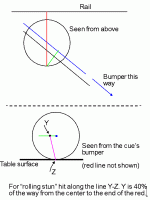
Thank you Bob and Jal for your clarifications. Although I know now what Ron is trying to describe, I still do not agree with it.
Jal said:
jsp said:
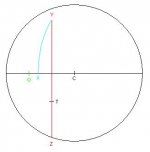
What I imagine line YZ should be is a longitudinal line that goes from the exact top of the CB to the exact bottom of the CB that interesects my point Y, which is the point where the solid black arrow turns into the dotted black arrow. If you look at this YZ line from above (the bird's eye view), the line will appear to be a ray going from the center of the circle (top of the CB) to my point Y.
With some reservations over your first sentence, from what you said after that I also think this is equivalent (functionally) to my way of viewing it. The line YZ, which for you starts on the surface and ends at the contact point with the cloth, when projected onto the aformentioned plane yields the same locus of tip offsets as if you just drew the line directly on this plane
I do not think that my line projected to the aforementioned plane is the same as the straight line that Ron is describing.
Again, if you imagine the line YZ
on the surface of the CB, I believe the line should be "longitudinal" in appearance. Try to imagine the lines of longitude on a globe. Each longitudinal line intersects the top and bottom points of the globe. If you project all the longitudinal lines on the 2-D plane that is perpendicular to the plane encompassing the equator and also the plane encompassing the prime meridian, then these projected lines of longitude will not look straight but curved (with the exception of the prime meridian).
Jal said:
I believe the straight line interpretation is the right one, again, because of how the offsets are measured. I'm all ears if you think this is wrong.
I think it's clear that what I describe and what you describe are not the same thing, considering I see a curved line on the 2-D plane and you see a straight line. So one of us must be wrong. Most likely, I'm the one who is wrong considering you, Bob, and Fred seem to agree with what Ron proposed. So please let me know where my reasoning breaks down...
First, try to imagine slicing the CB into thin slabs (or discs) with each cut being parallel to the table surface. The CB will turn into many stacked circular discs, with the disc encompassing the equator (centerball height) as the largest disc. Now, keep in mind the algorithm used to locate point Y
on the surface of the CB of this middle disc. Then for the other circular discs, use the same algorithm to find the corresponding point Y on those discs. If you connect all of the Y points of all the discs, you have a longitudinal line on the surface of the CB, connecting the original point Y at the equator and the top and bottom points of the CB. Again, projecting this line to the 2-D plane will not be a straight line.
If I had to guess a place where I err, it would have to be my reasoning to use the same algorithm to locate the point Y on the other discs. Though, without busting out some serious equations, this seems like the logical thing to do.