Opinions wanted on the choice of linen wrap

BillPorter

AzB Silver Member
Silver Member
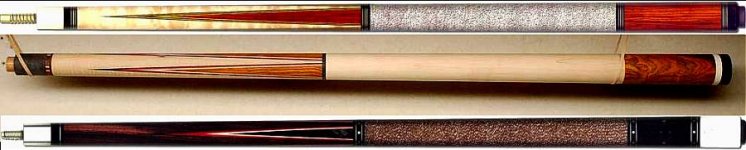
I am having a cue built by Dick Neighbors. Cocobolo points and butt sleeve. I have been thinking about the wrap (I like the feel of a linen wrap) and my first thought was to go with white with green specks like the old Cortland Irish Linen wrap since the cue is sort of an "old school" design. But the currently popular black with white specks might look better. I would appreciate your opinions on the best looking wrap for this cue.

220077480-XL.jpg
 
White with brown speck.
Nice looking cue.
Nice wood for a handle.
I can see Dick uses a " buzz ring". :)
 
JoeyInCali said:
White with brown speck.
Nice looking cue.
Nice wood for a handle.
I can see Dick uses a " buzz ring". :)
Yep, he said he always uses a buzz ring. Do they make a white with double brown specks?
 
Yes, atlas sells it at cuestik.com. I used it on a cue similar to this and was very pleased with the results.
 
i like the white adn brown like Joey said.why does he always use a buzz ring?the black buzz ring might clash a little with the brown linen.
 
Last edited:
GINACUE USE'S - BLACK/BLACK WHITE SPEC LINEN CORD, DOUBLE BLACK w WHITE SPECKLE.
IT'S 3 OR 4 STRANDS THICK, ABOUT 2 1/2 TIMES THE EXPENSE OF ORDINARY IRISH LINEN.
RESEMBLES VELVET CREME, WOULD ACCENT YOUR HOPPE BUTT SLEEVE PERFECTLY.
 

Attachments

  • XYZ.jpg
    XYZ.jpg
    16.3 KB · Views: 283
Last edited:
Its a ring sandwiched between 2 pieces of wood. Its purpose is to eliminate the buzz sound sometimes associated with joining 2 pieces of wood together. I would say the buzz ring on the cue showed will most likely be wrapped over so you will never know its there.................Dave
 
I think the white with brown specks looks great when it is new; however, after some time (expecially if you do not religiously keep your hands clean) it starts to show the green/blueish color of the chalk from the pool table.

You might think about black leather.

Good cuemaking,
 
I have some white/black & White with brown, but I don't think it's double brown. Still If I can help just let me know. I have no white/green speck at all though, just black/green.

I think the white brown would look good, but I tend to aggree with Mr. Arnot, You really have to keep Your hands clean. I see many white based wraps that get dirt and chalk all in them, so even though I have white based colors, I'm not a big fan of using them around here, cause few people take care of their cues that well where I'm located.
I have a couple of rolls of black, one has white specks, and that seems to Be My favorite, and what I use the most, because the linen on that roll presses and polishes off alot better then some of the others I have.

I think You could pretty much go eitherway You want though and it would look good. That's a pretty cue Dick made for You. The black would probably work with it too. I think either color would look good.:) Greg
 
Black

A black wrap will highlight the wood grain and colors. A brown wrap would need to be carefully picked to avoid muddying the look of the cue.

Congratulations on a great-looking cue. Dick is a first-rate guy who makes a first-rate product.
 
nbll01 said:
Its a ring sandwiched between 2 pieces of wood. Its purpose is to eliminate the buzz sound sometimes associated with joining 2 pieces of wood together. I would say the buzz ring on the cue showed will most likely be wrapped over so you will never know its there.................Dave

If I understand this correctly, it eliminates vibration. Imho, this should eliminate the hit of the cue as well, doesn't it?

Regards,

Detlev
 
Detlev Rackow said:
If I understand this correctly, it eliminates vibration. Imho, this should eliminate the hit of the cue as well, doesn't it?

Regards,

Detlev

I would have to strongly disagree. Where have you developed the impression that a buzz-ring eliminates vibration? I have not noticed this over the years and you are one of the first people to ever make that statement, that I know of. All wood is a unit of cellulose fibres, oriented in one direction. When cross cut, these fibres can clearly be seen on the end. These fibres are hollow and allow the tree to move water and nutrients from it's roots to it's outermost branches and leaves and back again. This end grain is where 85% of moisture transfer takes place when drying a piece of wood.

When the a-joint is constructed, in most cues, there is a tenon extending either into the handle or the prong joining these to pieces of wood together. Besides the tenon ,these two pieces of wood have their end-grain abutting each other. Through capillary action, when these two woods are joined, much of the glue is sucked away, up into the pieces, of wood leaving a chance for the joint to be glue starved and then later failing. Of coarse the joint will probably still be solid as the tenon is still glued in place however, now that these faces are still in contact but no longer just one joined piece, these end fibres can have a tendency to rub against each other causing a buzzing noise. Just like a crickets legs rubbing together. Placing a solid piece of material, with no oriented grain, helps to stop this glue from being pulled out of the joint. Makes for one straw pulling in one direction instead of two straws pulling in both directions.

This is one of the things that Balabushka utilized in building his cues although the other night I was told that it was the idea of an earlier cue-maker.

All of my cues for the past 15 years have had a ring at the A-joint. I, and many other cue-makers wouldn't consider building one any other way. If you can't see it then it's below the wrap.

Dick

 
Detlev Rackow said:
If I understand this correctly, it eliminates vibration. Imho, this should eliminate the hit of the cue as well, doesn't it?

Regards,

Detlev
I don't think you are going to miss a 9-ball with it.
Or have less cueball action.
Phenolic is actually harder than maple.
Easy to tell.
Whack a phenolic board with a hammer then whack a maple board with a hammer.:D
 
Back
Top