Question for 14.1 players

papercut

AzB Silver Member
Silver Member
When I'm down to the last 6-7 balls that are fairly open, I start to really bear down and focus on how I'm going to get to the break ball.

If I literally pause here for 3-4 minutes thinking out all the permutations that can get me from the first ball to the break ball while minimizing the cue ball movement (i.e. series of near-stop shots), I'm usually successful.

If I don't pause for a good 3-4 minutes, I usually end up having to play a recovery shot and ultimately screw up the run.

Here are my questions:

For those who can run many balls, was this need to stop and think for a long while part of the learning curve or is it just me? Obviously in a tournament, I can't stop for 3-4 minutes to think of the, say, 5000 permutations that exist on the last 7 balls. Should I rush more or, will the 5 minutes go to 30 sec with enough practice?
 
I think it all depends what you're faced with. In every rack, I try to identify a break shot, a set up shot, and a set up ball for the set up shot. Not every rack is going to have that, and sometimes you need to take a little time to inspect the pack, or think through your strategy so that you can manufacture a break ball or set yourself up to split up a cluster. Don't worry about how fast or how slow you are thinking. Just worry about working your way through the rack. Many players sabotage their runs by chasing numbers or trying to impress or satisfy their opponents pace. Just work your way through the rack, set up your opportunities, and block all that stuff out of your mind. Learn at your own pace. If that means you have to inspect the layoout for a half hour (during practice) then take a half hour. As long as your learning and improving your game, nothing else matters.

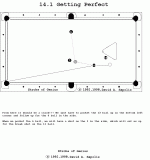
Playing great straight pool requires just as much patience as it it does shotmaking. I usually plan out my racks from the beginning, like in the diagram I have provided. I have an entire collection of 14.1 instructional material trhat I will make available on my website next week, this is a sample of that material.

dissect_02.GIF
 
papercut said:
When I'm down to the last 6-7 balls that are fairly open, I start to really bear down and focus on how I'm going to get to the break ball.

If I literally pause here for 3-4 minutes thinking out all the permutations that can get me from the first ball to the break ball while minimizing the cue ball movement (i.e. series of near-stop shots), I'm usually successful.

If I don't pause for a good 3-4 minutes, I usually end up having to play a recovery shot and ultimately screw up the run.

Here are my questions:

For those who can run many balls, was this need to stop and think for a long while part of the learning curve or is it just me? Obviously in a tournament, I can't stop for 3-4 minutes to think of the, say, 5000 permutations that exist on the last 7 balls. Should I rush more or, will the 5 minutes go to 30 sec with enough practice?

When you're practicing, take all the time you need. When you're playing it is agravating for your opponent if you greatly slow down the pace of play, and it may negatively affect your play as well. Recognizing patterns and the common ways to run out comes with time, instruction, and experience. 14.1 is at least as complicated and challenging as golf. If you're a golfer you'll know what I'm saying. If you're not a golfer, try it for a year. You'll see the similarities.
 
When you get to a point where you have an open table, assuming that you do have a break shot and don't need to come up with something to create one, sometimes it helps to plot your pattern backward. That is, start from the break ball and work your way through the rack in reverse until you get to where the balls currently lay. Sometimes it's easier to see the patterns this way.

papercut said:
When I'm down to the last 6-7 balls that are fairly open, I start to really bear down and focus on how I'm going to get to the break ball.

If I literally pause here for 3-4 minutes thinking out all the permutations that can get me from the first ball to the break ball while minimizing the cue ball movement (i.e. series of near-stop shots), I'm usually successful.

If I don't pause for a good 3-4 minutes, I usually end up having to play a recovery shot and ultimately screw up the run.

Here are my questions:

For those who can run many balls, was this need to stop and think for a long while part of the learning curve or is it just me? Obviously in a tournament, I can't stop for 3-4 minutes to think of the, say, 5000 permutations that exist on the last 7 balls. Should I rush more or, will the 5 minutes go to 30 sec with enough practice?
 
I seem to come up with higher runs if I play 3-4 balls ahead for the first 2/3rds (or so) of the rack, by this point you should have most of the rack split up and then you can pick your brake ball.
 
6 Ball Position

Hi Blackjack -
In your diagram you show the 6 ball in a direct line with the side pockets and the key ball. I understand that you are trying to get a general concept across, but do you not prefer to have the 6 ball actually a little to the right of the side pocket instead? I find it a little easier to get position on the 6 given that my cue ball is coming from the right side in your diagram. When the 6 is where you show it, I have to get the cue ball up to mid table, or nearly so, and I risk getting out of line more. What do you think?

dwhite
 
lots of good information here...

Jimmy M. said:
When you get to a point where you have an open table, assuming that you do have a break shot and don't need to come up with something to create one, sometimes it helps to plot your pattern backward. That is, start from the break ball and work your way through the rack in reverse until you get to where the balls currently lay. Sometimes it's easier to see the patterns this way.


I like Blackjack's ideas, and Jimmy M's too! Personally, I always look for a break shot early in the rack, and have two in mind, if possible. I also pick out the appropriate Key Balls (or 'link shots' as we call them in pool school), and set up shots for the key balls too, while keeping the 'future' break shots in mind, during the run. One thing to remember...side pocket break shots are
very effecitive, but often overlooked. I also thought Gerry's ideas of what NOT to do in running racks, in the other thread, was very good information.
Working backwards from the last half of the rack is a great idea also, and something I frequently do, playing 14.1.

Scott Lee
www.poolknowledge.com
 
qstroker said:
Hi Blackjack -
In your diagram you show the 6 ball in a direct line with the side pockets and the key ball. I understand that you are trying to get a general concept across, but do you not prefer to have the 6 ball actually a little to the right of the side pocket instead? I find it a little easier to get position on the 6 given that my cue ball is coming from the right side in your diagram. When the 6 is where you show it, I have to get the cue ball up to mid table, or nearly so, and I risk getting out of line more. What do you think?

dwhite

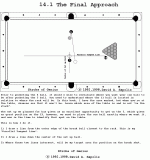
I did the original diagrams for these lessons 15 years ago. Myself and a friend set a video camera for an overhead view of what I was doing. This one of the racks that I selected to diagram. It has 14 parts I believe, and I go shot by shot, "Dissecting the rack". I didn't set it up for optimal shotmaking, the diagrams explain exactly how I ran it out with the layout I was provided off the original spread of the balls. This is the end of the rack & the last 2 diagrams. I am sure other players would have ran it differently, but this is what I planned for. I will have the entire section up on wednesday available for download pdf file.
 

Attachments

  • dissect_12.GIF
    dissect_12.GIF
    14.8 KB · Views: 140
  • dissect_13.GIF
    dissect_13.GIF
    21.5 KB · Views: 135
Back
Top