
shaft cutting

Kim,

From my experience in this area, I think the chatter you are getting is doubtless the result of your speed and feed rates not the orientation of your cutter. Also, the more you hog the material the more deflection you will get in the center so be careful to take very light passes as you get to finish dimension. As long as your tool post router set up is very solid the shaft doesn't care which vector it is attacked from between centers.

Here is a link to a thread I posted a few weeks ago concerning using a laser RPM tachometer to monitor your rpm rates that might help you.

http://forums.azbilliards.com/showthread.php?t=230972

One tip I can offer is that the slower lathe rpm speeds and the slowest of feed rates are the key. I use a saw tapering machine with 60 carbide blades running at 1750 rpm or 105,000 cuts per minute ,which makes more cuts per unit of time than my old 2 fluke router set up at 30,000 touches. These guys using 6 wings at 30,000 are getting 180,000 touches per minute. Once you get to a certain high rpm speed on your cutter I think it is academic, but the more touches your get per minute will be beneficial to a smooth rms finish especially if you are cutting silver stitch rings. Run your router balls out and you should be fine. The multi wing cutters is good advice for the router set up.

The feed rate and the lathe speed is the area you need to focus on. The laser devices are less than 25 bucks shipped. Get one and you will be happy.

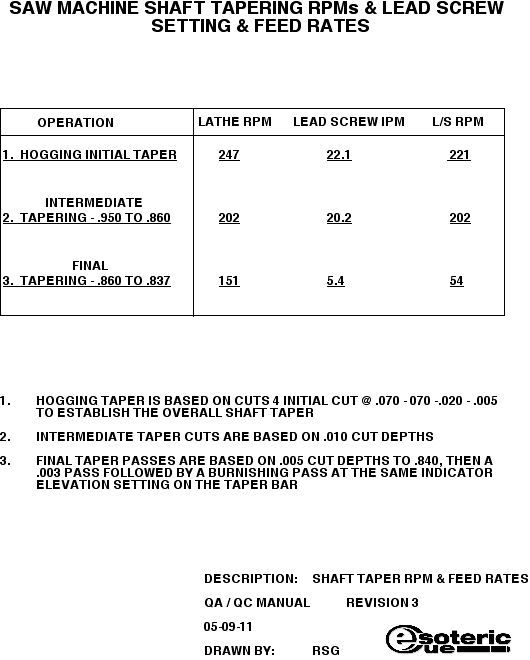
Here is a chart that I use on my set up, it may help you.

Good Luck,

Rick Geschrey
CFR.jpg


Rick,

I started this post a while back, and since then, I have learned and experienced a lot.

I have tried horizontal, vertical, wing cutters, and straight cutters. I have found that I get the best and smoothest cut on shafts with the router mounted vertically with a 3/4 inch straight bit.

The important things that influence the smoothest cut are:

1. Before I cut a shaft, I clean and give the lathe a lube job. This includes the ways, the saddle, the taper slide, and the feed screw. I can do this in about 2 minutes so why not.

2. I carefully set the pressure on the live center to only use the spring pressure. I have the Taig lathe live center in the tail stock.

3. I run the feed rate at about 4 inches per minute and the router full speed.

4. I set the speed on my Hightower lathe to the lowest setting, about 180 rpm.

I ate the bearings in my PC router and replaced it with a Dewalt from Lowes. It seems to be a little smoother. I am going to re bearing the PC.

I had 7 unfinished cue butts hanging. I had a party and some guests saw them and I sold 5 and they aren't even done yet. I hope to finish them up by the end of the month.

The finish is my nemesis right now. I have settled down to the water based sealer/epoxy/water based poly sequence. This was after I did a cocobolo and BEM cue. I finished it and sanded it off twice. I even ruined the maple rings.... cut them off and re did them twice too. The coco oil ran all over and stained the maple. I have the right sealer now. (labor seems to be the price of my education)

The education continues.

Kim
 
six wing cutter

Kim,

From my experience in this area, I think the chatter you are getting is doubtless the result of your speed and feed rates not the orientation of your cutter. Also, the more you hog the material the more deflection you will get in the center so be careful to take very light passes as you get to finish dimension. As long as your tool post router set up is very solid the shaft doesn't care which vector it is attacked from between centers.

Here is a link to a thread I posted a few weeks ago concerning using a laser RPM tachometer to monitor your rpm rates that might help you.

http://forums.azbilliards.com/showthread.php?t=230972

One tip I can offer is that the slower lathe rpm speeds and the slowest of feed rates are the key. I use a saw tapering machine with 60 carbide blades running at 1750 rpm or 105,000 cuts per minute ,which makes more cuts per unit of time than my old 2 fluke router set up at 30,000 touches. These guys using 6 wings at 30,000 are getting 180,000 touches per minute. Once you get to a certain high rpm speed on your cutter I think it is academic, but the more touches your get per minute will be beneficial to a smooth rms finish especially if you are cutting silver stitch rings. Run your router balls out and you should be fine. The multi wing cutters is good advice for the router set up.

The feed rate and the lathe speed is the area you need to focus on. The laser devices are less than 25 bucks shipped. Get one and you will be happy.

Here is a chart that I use on my set up, it may help you.

Good Luck,

Rick Geschrey

CFR.jpg

I'm having a problem getting all six wings hitting. When I move the blade slowly by hand only a few actually hit?
thanks Bill
 
I'm having a problem getting all six wings hitting. When I move the blade slowly by hand only a few actually hit?
thanks Bill

That's the way they are .
Best ones are ground by your local grinder.
Tell them to grind them evenly .
Btw, Rick's chart only works for his setup imo.
It's of no use to router setup.
 
Last edited:
That's the way they are .
Best ones are ground by your local grinder.
Tell them to grind them evenly .
Btw, Rick's chart only works for his setup imo.
It's of no use to router setup.

Hi,

Joey is right but if you get a laser device it may be a good starting point for each individual set up.

I am still tweaking and revising my final cut numbers on shafts because the joint diameter is over .300 more than and the tip end and the finish is not absolutely consistent when viewed with a loupe. The dia. difference and its effect on the surface area effects cutter touches per minute and changing lathe speed by only 10 rpm has an effect.

I am going to clean my carbide teeth to remove any sap or pitch that may be present on the cutters and take near final cuts on 20 shafts this week. I don't think I can get it any better but I will try.

Extrapolate and test using numbers to track final effect and you can't go wrong. The less sanding the better!

Rick G
 
Hi,

Joey is right but if you get a laser device it may be a good starting point for each individual set up.

I am still tweaking and revising my final cut numbers on shafts because the joint diameter is over .300 more than and the tip end and the finish is not absolutely consistent when viewed with a loupe. The dia. difference and its effect on the surface area effects cutter touches per minute and changing lathe speed by only 10 rpm has an effect.

I am going to clean my carbide teeth to remove any sap or pitch that may be present on the cutters and take near final cuts on 20 shafts this week. I don't think I can get it any better but I will try.

Extrapolate and test using numbers to track final effect and you can't go wrong. The less sanding the better!

Rick G
Router setups are very finicky.
You move that bit in or out 25 thou, might be the difference between a great cut and barbe poles.
Also, adjustable spindle speed is a must as those wing cutters only need about 33% max of maximum speed. We're hogging out spinning wood, not flat boards by hand.
I think one thing I like about router setup over saw setup is it,s easier to operate it by hand. Meaning, I can taper the shaft from the tip then back out 6 inches or so before the joint. I can then dial in that collar to about 2 thou over the mandrel's size.
Also I set aside one bit just to do final passes. IT feels great when I take .005" off a shaft and it's feels like it's been sanded already.

We should have gone to guitar making .:D
 
Back
Top