
You are using an out of date browser. It may not display this or other websites correctly.
You should upgrade or use an alternative browser.
You should upgrade or use an alternative browser.
spliced vs. cnc?
- Thread starter tduncan
- Start date

spliced points are cut deep into the wood and go almost to the middle of the forearm depth wise.
CNC points are inlaind into shallow pockets about 1/8" deep.
you will hear lots of people say that spliced is better,myself i am not sure which is better.
the spliced points will be sharper than the CNC points even if the cuemaker uses the small bits and most don't.the CNC points will most always be completely even where average cue makers struggle to get the spliced points all the exact same height.but as far as one being structurally better than the other i really don't see how the spliced points could be better,but i know lots of people will say they are.
CNC points are inlaind into shallow pockets about 1/8" deep.
you will hear lots of people say that spliced is better,myself i am not sure which is better.
the spliced points will be sharper than the CNC points even if the cuemaker uses the small bits and most don't.the CNC points will most always be completely even where average cue makers struggle to get the spliced points all the exact same height.but as far as one being structurally better than the other i really don't see how the spliced points could be better,but i know lots of people will say they are.

short spliced, or half spliced, points can also be done using CNC machining. if you mean Floating points, they are usually made with CNC, or pantograph, but are more consistent with CNC. Not all Floating points have rounded edges. I was talking to someone at SBE, and since floating points are essentially inlays, all they need to do is have the inlay be sharp, which can be made with cnc technology, and the inlay pocket be rounded, and then insert inlay into pocket, and fill gap with dark epoxy, this will only work with a dark wood thats being inlayed into. The dark epoxy will essentially hide the pocket and is camouflaged with the wood.
The more recent Joss have rounded points on the outside points, but on the inside points, they are sharp. Alot of meucci is CNC, but it doesnt mean they couldnt have used the spliced technique at one point, depends on the age of the cue i suppose.
The more recent Joss have rounded points on the outside points, but on the inside points, they are sharp. Alot of meucci is CNC, but it doesnt mean they couldnt have used the spliced technique at one point, depends on the age of the cue i suppose.

Anytime you mess with the intergrity of the wood in the cue it changes the hit. Some more than others!! This is the best way I can explain it. If you have a Curly Maple forearm and add 4 spliced points of Ebony to it, it has to create a harder hit than just Curly Maple forearm without any points or even floating points. The Ebony is a harder more dense wood so it has to change the hit. Not to mention the glues used adds strength to it also. When you add short spiced points you are cutting v grooves almost half way about a half inch. into the curly at the A joint area. When you do floating points in a cue you are only inlaying the points in around .150 into the forearm. This is why short spliced cues has to have a firmer hit than a cue without any points or inlaid points. Even when you use softer woods other than Ebony it will still be more firm than just a cue with out points at all. There is all kinds of wood you can use for points in a cue that will change the hit a lot. Some more than others!! I hope this helps!

Cosmetically, I think a lot of people will agree the sharp points look way better than rounded CNC stuff...

Cosmetically, I think a lot of people will agree the sharp points look way better than rounded CNC stuff...
Is this old horse stile alive?
I thought it was beat to death long ago.
There are hundreds perhaps thousands of posts here if you care to search for them all dealing which which is better ... Spliced or CNC.
You might as well ask which is the best beer.
Miller Light or Bud Light.
Course the best is Shinner Bock ...
 ... IMHO!
WIllee
Course the best is Shinner Bock ...
I agree, havent had Shiner Bock in a while, Upstate NY, or rather all of NY State doesnt have a shiner Distributor, which sucks.
I'm not sure the comparison is spliced vs. cnc. He just said "sharp", which could be either one.
And yes, sharp points are generally better looking, in my opinion.
Did you read the title and the first post of this thread?
Still not sure?
Willee

There is more structural integrity in a well built full spliced cue than in any other. Especially if the correct wood combination is chosen. There is much more work done to a spliced cue than one with inlaid cnc cut points. At the same time you can build a cue with cnc and have sharp points, its a fact. The reason you see the rounded points on most cnc cut points is because of the travel radius of the cutting tip. You have to taper the inlay to get it sharp at the end, so its more coding going into the cnc program, so its just cost effective to do the rounded end. To answer your question about the meucci, its a short spliced forearm.
Hope that helps,
Grey Ghost
Hope that helps,
Grey Ghost

Sure of what? Why would you automatically assume ignorance on the part of jtrombetta? (Who wasn't the OP)Did you read the title and the first post of this thread?
Still not sure?
Sure of what? Why would you automatically assume ignorance on the part of jtrombetta? (Who wasn't the OP)
OK Sheldon ... let me splain ... I quoted Jtrombetta ... but was also commenting to the original poster Tduncan, and his question.
Assuming ignorance ????
Back off the auto finish Sheldon ... it is killing your brain cells.
Or are you just trying to start something?
Hope that clears things up for you.
I'll try to keep my posts at a simpler level in the future.
Willee
Last edited:

What you are comparing is a method of cutting a 90 deg (V bottom point) into a forearm or butt sleeve of a cue and a method of controlling the X,Y, Z and fourth, fifth, etc axis of a mill. These are apples and oranges.
I believe what you are asking is should the inlay be V bottom or flat bottom. A V bottom or 90 degree cut can be made into the forearm using many means, one of which is a CNC mill. Conversely, a flat bottom inlay can be cut into a forearm using several methods also, again one of which is a CNC mill.
The V bottom or 90 degree inlay method of a short splice is made by cutting a path increasing toward center in a straight line from the outside edge of the front of the forearm angling towards the center of the forearm at the handle end. This forms a 90 deg angled pocket in the forearm that a square or section of a square can be glued into. It is deep at the back and runs out at the front thus producing a sharp point at the end.
A flat bottom inlay is cut at the same approximate depth the entire length and width of the inlay. The part is then cut an pushed flat into the pocket and glued. These inlays can be made to look sharp by many methods but are normally cut with a round endmill. Many leave the ends rounded.
Either of these methods can be accomplished with a CNC mill, a standard hand crank mill, a mill with automatic rapid feed, some pantomills, etc, etc, etc.
Which is better......just depends what you like.
The sharp points look better in my opinion also which is why I prefer to cut V bottom points into forearms with my CNC mill.
Kenny Murrell
I believe what you are asking is should the inlay be V bottom or flat bottom. A V bottom or 90 degree cut can be made into the forearm using many means, one of which is a CNC mill. Conversely, a flat bottom inlay can be cut into a forearm using several methods also, again one of which is a CNC mill.
The V bottom or 90 degree inlay method of a short splice is made by cutting a path increasing toward center in a straight line from the outside edge of the front of the forearm angling towards the center of the forearm at the handle end. This forms a 90 deg angled pocket in the forearm that a square or section of a square can be glued into. It is deep at the back and runs out at the front thus producing a sharp point at the end.
A flat bottom inlay is cut at the same approximate depth the entire length and width of the inlay. The part is then cut an pushed flat into the pocket and glued. These inlays can be made to look sharp by many methods but are normally cut with a round endmill. Many leave the ends rounded.
Either of these methods can be accomplished with a CNC mill, a standard hand crank mill, a mill with automatic rapid feed, some pantomills, etc, etc, etc.
Which is better......just depends what you like.
The sharp points look better in my opinion also which is why I prefer to cut V bottom points into forearms with my CNC mill.
Kenny Murrell
Your assumption could be valid, but not necessarily. Same goes for mine. I'm sorry you failed to grasp that.OK Sheldon ... let me splain ... I quoted Jtrombetta ... but was also commenting to the original poster Tduncan, and his question.
Assuming ignorance ????
Back off the auto finish Sheldon ... it is killing your brain cells.
Or are you just trying to start something?
Hope that clears things up for you.
I'll try to keep my posts at a simpler level in the future.
There's nothing to clear up, I'm WAY ahead of you on this one, trust me. Or are you trying to start something?
What many fail to grasp or execute, is the fact that inlays can be made that look as good or even better than V-points. Materials that would be very difficult to use with V-points can be used for veneers, like silver, recon stone, etc.Which is better......just depends what you like.
The sharp points look better in my opinion also which is why I prefer to cut V bottom points into forearms with my CNC mill.
silver, turquoise, ivory.
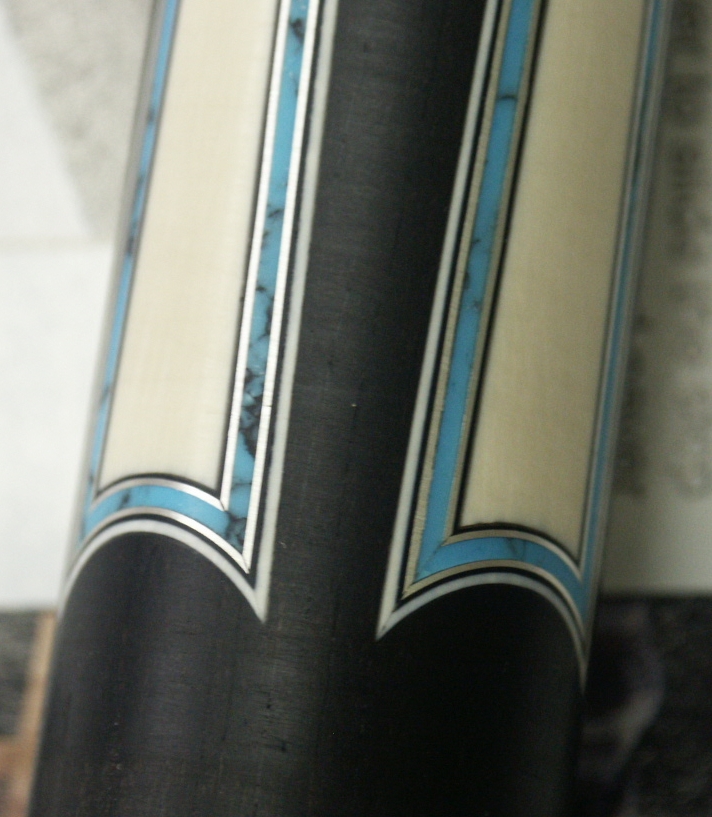

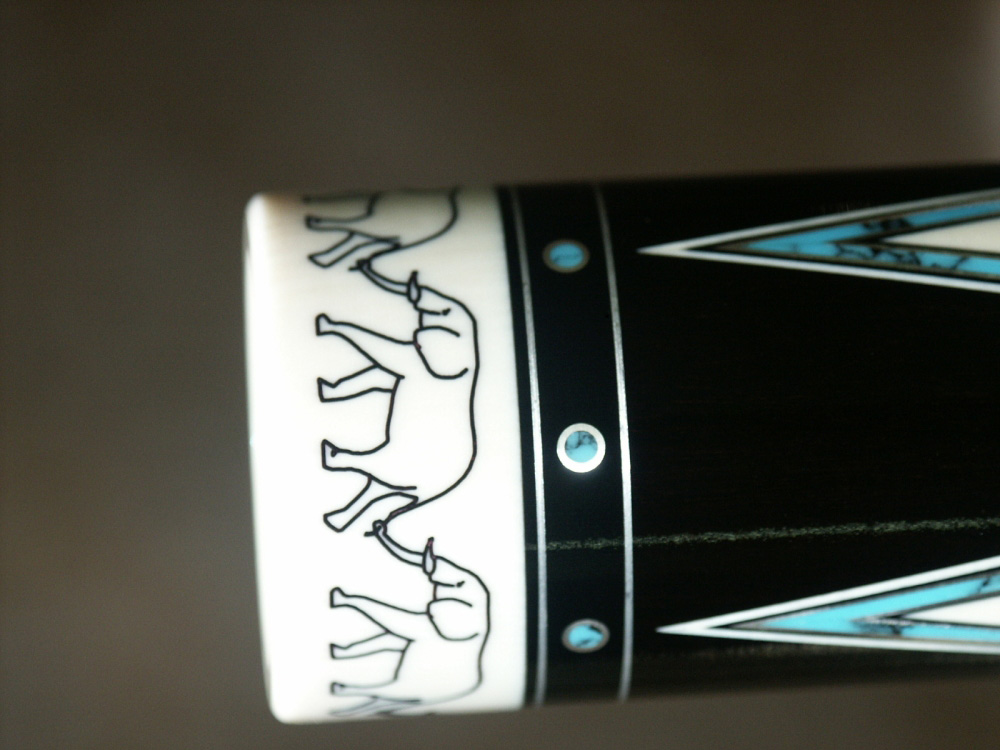
Veneers ONLY?
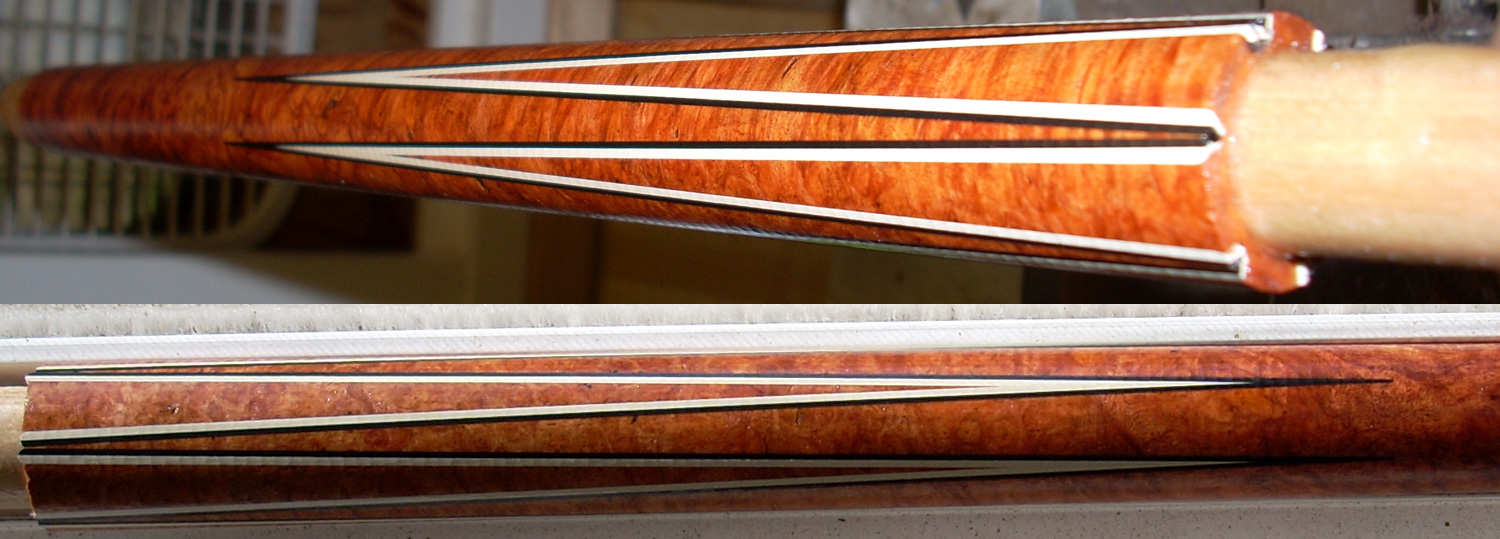
Didn't go as sharp as I could have on the very tips...

Ivory/malachite veneers


Sheldon, nice work on those cues...
My .02 on all this. I have the equivalance pretty close to that of an electrical engineer with schooling and work experience. In that field people hold on to their little secrets about THD, effects of dc power supplies, UPS stations, back up generators, etc. the list goes on and on. Cuemakers are the same, we don't like to share ALL of our secrets because we are in a competitive field. The cues I have put pictures of on here are the ones my wife and kids have beat on for several years and by no means show the 100 or so that I have built over the years. I'm not szamboti or balabuska but I have been known to make a decent looking and hitting cue. That being said, I cut my points in with a porper B and a 90 degree router bit. Bet a lot of people don't understand what happens to the points if you don't have the router bit centered into the middle of the wood or the points cut in the same depth. Also I modified the back end of my taper bar so I can get longer and thicker points. People go and buy fancy equipment and are tickled pink just to be able to inlay a little dot into a cue. John public pays for your learning curve and people lose sight of the basic tastes in cue work such as sharp or rounded points. I have used a pantograph before with the man who taught me how to build cues and his isn't that easy to use but it does beautiful work. JMHO
Last edited:
What many fail to grasp or execute, is the fact that inlays can be made that look as good or even better than V-points. Materials that would be very difficult to use with V-points can be used for veneers, like silver, recon stone, etc.
Sheldon, after seeing this cue I am humbled.
You ARE way ahead of me.
What a fantistic piece of work.
Course I always have been partial to turquoise and silver in a cue.
Wow ... very impressive indeed!
Willee