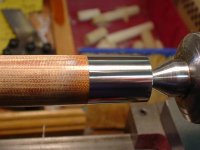
trimming a stainless collar down to proper taper/size

BarenbruggeCues said:
Turn everything down to slow, slow , slow when cutting....

BUT, do not turn down the feed rate to low, it must be maintained or the work will harden (ie: do not cut with a manual feed 'cause you'll likely pause, use power feed).

Dave
 
DaveK said:
BUT, do not turn down the feed rate to low, it must be maintained or the work will harden (ie: do not cut with a manual feed 'cause you'll likely pause, use power feed).

Dave

Can't remember where the feed rate was but you are correct......let it run in and curl a happy chip.

May have to play with the depth of cut and feedrate a bit.....but once you get it you won't need a file but for a very short time if at all.
 
Thanks Barenbrugge for the very helpful insight. I may put it to use tomorrow to correct a mismatch between a stain I thought would match and the collar that doesn't(OOPs):eek: I don't remember being that 'color challenged'
Dave
 
Cue Crazy said:
Has anyone here made a mandrel to turn and polish the SS before installing it on the cue, that way It only needs facing when installed? Your gonna want the wood below the SS collar anyway to make room for building the finish up to it, correct? I'm just wondering If this is possible. I have played around with the idea, and seems Like it may work If everything can be kept deadnuts during the proccess. I modify and center drill My ss pins on a smaller metal lathe, and HSS tooling seems to work for Me with those, although Like Dick mentioned I have to keep the oil to them so they don't heat up too much, and that wouldn't be a good mix while on the cue.My cues are still mostly built & assembled on a cuelathe until I move, and I don't really use SS collars anyhow, but sometimes someone will ask If I'll do them, so I've been toying with the idea of trying It. I'm thinking of threaded collars here, and realize there could be some problems doing the thinner slip tenon collars this way due to the fact they won't screw on a mandrel the same way. Also would it be better to polish the collars before intalling? SS always seems to create a mess of black gunk. Greg
If you make one I would center drill the threaded end and make the threads a real tight fit. I would only leave .001 - .002 clearance on the threads. This way it should be real close to where it will be on the cue. Just have to check the runout on the piece back at the chuck before you cut the threads and face the end of the thread..
 
Kiss

Dave38 said:
I need assistance yet again. I finally got my stainless collar threaded on, and went to trim it to the taper of the butt, and also cut it close to final size. I found out that is easier said than done. I got it down, but it took alot of work including using a dremel with a grindstone in it.
Is there an easier way, that gives a better result? I used a standard lathe cutter tool, a file, dremel, and not nessarily in that order. I got a lot of chatter with the cutter tool. Any thoughts are welcome. Thanks,
Dave

Sorry I'm late to the discuss.

Some random thoughts.
1. if you need to use a file, you are definitely NOT doing
it the right way.

2. Once again, DaveK demonstrates a superior level of understanding
of machining - do it with power feed - do it with an appropritate
cutter.

I use a $1.00 tool steel 5/16 late 'bit' ground to my own 'secret sauce'
profile. I can't tell you things like rake, etc, but there is plenty of info
on how to grind lathe tools for machining various materials.
It took about 5 mins to grind mine, requires touch-up and honning
once in a while.

For the insert users, you can also find info on which inserts work best.
All those letters in the name/classification relate to what they are
designed to cut best.

For 25 years, Ive been getting good results with a simple method.

1. Offset tailstock to match taper of butt<for me it's something like
.022>

2. Spindle aprox 500 rpm, feed rate SLOWEST - two passes .010 and
.007 feeds - takes about 2 mins - attack with 220 paper and so
on - Gives a shiny collar of .840 dia.

I drive the butt with a super high-tech gizmo mounted in the chuck.
made from brass rod, filed to a pyramid point - cost $.50.

A real machinist would remove the chuck and use a lathe 'dog'.
I am ready to polish in less time than I could get my chuck off.

One self critique, I could have a better chip breaker, mine are more long and stringy than I would prefer.

Dale

 
Last edited:
Thanks Guys,

The information posted here addressed all of my questions...looking forward to taking down my next SS collar. Now, I can see how a small or mini metal lathe would come in handy.

Regards,
Duc.
 
RocketQ said:
If you make one I would center drill the threaded end and make the threads a real tight fit. I would only leave .001 - .002 clearance on the threads. This way it should be real close to where it will be on the cue. Just have to check the runout on the piece back at the chuck before you cut the threads and face the end of the thread..


Thank You for the imput John,

Yes that's was what I was thinking, I was gonna center drill that end, not only to true the piece up, but for use as tailstock support afterwards also. I can see the threads needing to be tight like you say so the piece doesn't shift on the mandrel when being cut. Maybe I'll give it a shot when I get some extra time here. I have to confess I already made a dummy from a hardwood dowel, to practice polishing the collars. I wanted to see if I could get the mirror finish on them like My pins, and turns out that was pretty successfull. The dummy runs really true for what it is, even with no tailstock support, and the centering at the shoulder was really good too, so hopefully when I make the real thing, I'll be able to get a mandrel running true enough to pull it off this way. Thanks Again:) , Greg
 
Stainless Steel Collars

Atlas sells UniLoc pre-tapered collars for about 10 bucks each. Considering the problems tapering SS without the proper equipment it might be a cheap alternate. I have used them as well as non-tapered. The only drawback is that they are threaded 18 tpi, I think (just drew a blank).

Bob Flynn
Denali Pool Cues
 
QMAKER said:
Atlas sells UniLoc pre-tapered collars for about 10 bucks each. Considering the problems tapering SS without the proper equipment it might be a cheap alternate. I have used them as well as non-tapered. The only drawback is that they are threaded 18 tpi, I think (just drew a blank).

Bob Flynn
Denali Pool Cues


It Isn't the uniloc collars I don't think, but I have some that are 18tpi and pretapered similar to them. The only problem with mine is even after sanding and polishing, they are .875 on the OD. If they were closer to size, that would be great, because I can thread them on the cue straight enough with minimal runout as there are, just too big for My final size. Greg
 
I'm alittle confused, if you set the collar on a drive center, as described in previous posts, and then offset the tailstock slightly to achieve the taper, wouldn't that make the predrilled and pre tapped hole in the middle, offset? Another words, wouldn't the wall of the collar be thinner on one side than the other? If so, that would offset the weight distribution, and the cue could appear to wobble if rolled. I would think that an old fashoned type taper bar that bolts or clamps to the lathe, would be more the answer. I'm not a machinest by any means, therefore, maybe I'm not seeing the whole picture and as a result, I may be way off base. please clarify if possible.
Thanks,
Dave
 
Dave38 said:
I'm alittle confused, if you set the collar on a drive center, as described in previous posts, and then offset the tailstock slightly to achieve the taper, wouldn't that make the predrilled and pre tapped hole in the middle, offset? Another words, wouldn't the wall of the collar be thinner on one side than the other? If so, that would offset the weight distribution, and the cue could appear to wobble if rolled. I would think that an old fashoned type taper bar that bolts or clamps to the lathe, would be more the answer. I'm not a machinest by any means, therefore, maybe I'm not seeing the whole picture and as a result, I may be way off base. please clarify if possible.
Thanks,
Dave

No, as that is your pivot point. If you are going to use a steel joint it would go on before drilling and tapping for the pin anyway. You would be running off of the center.
I, myself, don't do it this way anyway. I use the compound set at about -3/4 of a deg and leave the tail stock centered. My lathe has chucks on both ends of the spindle so what I do is chuck the cue up between chucks with the joint and about one inch of prong protruding from my front chuck. I then bring the tail stock up and put a bearing dead center into the center on the cue. This makes the joint pretty solid. I use a sharp carbide cutter with a large radius to cut the stainless. None of my lathes that I use for joint work have a power feed on the compound so I must feed by hand which is never the most precise. Carbide cuts best at higher speeds. If your set-up is not rigid enough to make good cuts at speed then it is better to use a tool steel cutter at more moderate speeds.

Dick
 
Dave38 said:
I'm alittle confused, if you set the collar on a drive center, as described in previous posts, and then offset the tailstock slightly to achieve the taper, wouldn't that make the predrilled and pre tapped hole in the middle, offset? Another words, wouldn't the wall of the collar be thinner on one side than the other? If so, that would offset the weight distribution, and the cue could appear to wobble if rolled. I would think that an old fashoned type taper bar that bolts or clamps to the lathe, would be more the answer. I'm not a machinest by any means, therefore, maybe I'm not seeing the whole picture and as a result, I may be way off base. please clarify if possible.
Thanks,
Dave

In a word, no.

The cutting tool is still the same distance from the workpiece surface
as it whirls around the tailstock center. As the carriage moves the workpiece surface is farther away. So, you cut a conical shape
rather than a cylindrical one.

Dale
 
AHHHH, now I see. As I said, I'm not a machinist. I may try this today, as I need to put another one on. Thanks, guys
Dave
 
I really appreciate the assitance guys, today I tapered my first collar using the 'proper' way and boy was that alot easier than using a file. This one isn't perfect, but looks a lot better than the other one I did with a file. I used my Micro Lathe to do it, and it cut the SS like butter. I made the mandrel yesterday using a carbide threading mill and a router. Many thanks to Dick and Pdcue for taking the time to explain the theory of all this to the dense beginner that I am. Here's a pic of the piece.
DSC00027.jpg
 
Dave38 said:
I really appreciate the assitance guys, today I tapered my first collar using the 'proper' way and boy was that alot easier than using a file. This one isn't perfect, but looks a lot better than the other one I did with a file. I used my Micro Lathe to do it, and it cut the SS like butter. I made the mandrel yesterday using a carbide threading mill and a router. Many thanks to Dick and Pdcue for taking the time to explain the theory of all this to the dense beginner that I am. Here's a pic of the piece.

Dave,

Congrats! Very good results.

Hard as it may be to believe, I wasn't born knowing that
you could taper a workpiece by offsetting the tailstock.

Dale
 
Cuemaster98 said:
Have you tried to use your router on the tool post with a 1/4" carbide 4 flute end mill? Useing the taper bar and small cuts with the speed of the router and the rotation of the lathe makes a very nice & clean cut. This has worked best for me on the small lathes such as Hightower's & Porper's machines. No vibration or chatter like with the cutter bit.
David


I take it's dangerous then? Chris said a carbide bid with small pass should work fine. I've also got a Mini grinder so I will give that a try and see how it'll work out.

Thanks.
When I say carbide bit, I mean a left hand or right hand standard tool bit. Not a router bit. I have cut them with a router, but was not happy with the result. Several small passes with a sharp carbide tool bit using the taper bar and second slowest or second fastest speed is what works best. A wet paper towel applied to the the back side while cutting has always worked well for keeping it cool. I do like the ice cube cooling idea mentioned earlier also.
 
Back
Top