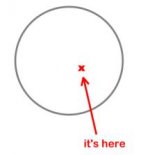
Where is the Center of the Q Ball?

Dawgie said:
When I first started playing seriously ( one year ago this past June) I kept hitting the c/b slightly off center to the right. I learned this through the center hit excerise that requires you to hit the c/b to the rail and have it come back to hit your tip. NO SPIN ALLOWED. I moved my center hit point over to the left a little and the c/b started to come back straight to my cue tip. Now when I hit the c/b it always looks like it is a little to the left. I think the reson for me hitting a little off center in the beginning was due to shadows around the c/b. the lighting is good but you will always see a bit of shadow to one side of the ball of the other which gives you an optical illusion as to where the center actually is.


I think this is a great way to learn to strike the center of the cue ball horizontally (meaning you learn not to use side spin). The only difference I suggest, is the change I made for a young woman who amazingly enough struck every shot with extreme left english, and argued me down that she hit the center of the cue ball. Put a striped object ball on the foot spot and aim at the center diamond on the head rail (the short rail where you break). I added a piece of chalk on the diamond for her to aim at. The ball on the foot spot should have the number facing you in the center of the ball. You can check the other side of the cue ball to make sure the other number is the same height, or use the second object ball touch method suggested by Snorks and credited to poolsponge (I really like this method, kudos to the sponge.).

This gives you an aim point. Once you get used to where the center aim point on the ball is, you can watch the stripes immediately after the strike for your vertical center feedback. If you hit it correctly, the stripe should not move for a short period immediately after the hit. If the top of the stripe moves toward you immediately after the hit, you struck too low, if it moves away from you, you hit too high.

Then watch the rail for sidespin feed back. If it strikes the rail and moves to the left, then you know you hit too far to the left of center and the same for right of center.

Sorry so long.
 
Patrick Johnson said:
If you want to describe a hit that makes the cue ball stop when it hits the object ball, say "stop shot hit" or "stun hit" (or "kill shot hit" if you must, although that can be confused with a sidespin hit). That way you don't confuse where you're hitting the cue ball with what you expect to happen as a result.

pj
chgo

That's just what I'm talking about: confusing where you're hitting the cue ball and expecting a result. Hitting the exact geometrical center of the cue ball does not create the result that is typically expected.

When I think of playing a ball "center," I think of the cue ball coming off of the object ball at exactly 90 degrees. The reality of it all is that you may have to hit the cue ball a little below center to get those results.

This brings me to the conclusion that it doesn't matter if you "know where the center of the cue ball is" or not, what matters is that you know where to hit the cue ball to create the "center ball hit" result.
 
That's just what I'm talking about: confusing where you're hitting the cue ball and expecting a result.

Well, except that's not what I said.

When I think of playing a ball "center," I think of the cue ball coming off of the object ball at exactly 90 degrees. The reality of it all is that you may have to hit the cue ball a little below center to get those results.

What's wrong with just saying that? Saying "hit it wherever you need to in order to get the result you want" isn't very helpful. You need to describe a spot on the cue ball.

pj
chgo
 
Klopek said:
I've foudnd this to be true to a degree, but might change it to "over-thinking". The nights I'm off are the nights something doesn't feel right and I try to think my way into stroke. The nights I'm on are the nights when I seem to be on autopilot. The kind of thinking going on in this thread almost always leads to a decline in one's game.

Isn't your autopilot the real guage on how much muscle and eye memory have you acquired which is really what you wanna know when you're trying to determine your current level?
 
nineballman said:
For years I thought the center of the cue ball was somewhere it's not.

Where is the center of the cue ball to you?

Most people who have trouble finding the center of cue ball are not aiming with their dominant eye. Some people actually use both eye's to focus and to aim with, while others use their non-dominant eye to aim with. These are basic skills that can be changed, by keeping your dominant eye directly over the cue, you will be in line with your shot, and it will also give you the right sight picture for aiming.

To find your dominant eye pick an object like a pool ball and stand around ten feet directly in front of it. Look directly at the object you have chosen, and place your hands about 1 to 2 inches from your face. Make your thumb and fore finger into the shape of a triangle and center the object you have chosen in the triangle. Next close your left eye keeping your right eye open, if the object disappears you are left eye dominant. If you can still see it, then close your right and keep your left eye open, if the object disappears your right eye dominant.

Once you have determined your dominant eye, get down behind the cue ball and move your tip forward to where you think the center of the ball is. Then close your none dominant eye, and make any adjustments necessary to what you now see as center. Then place the cue ball on the spot of the table and shoot the cue ball into the diamond at the foot spot, once contact is made with the cue ball don't move, if you have hit the center, the cue ball will rebound back into your cue tip. This may take a little practice but this will get you familiar with the true center of the ball, and with a little practice you should be able to repeat this drill ten times in a row.

Hope this helps!!!!
 
Center of the Cue Ball?

I have always thought it is approximately half way up the vertical axis. Because your cue is on an incline, what you may perceive as the center could be actually just a hair above center.
 
gee, pat nice to see you around! i stop in az from time to time . see you next time.

linda moss
 
"x" marks the spot. or you can use the red/blue dot. unfortunately if the dot happens to be on another side of the cb, you may be forced to shoot at the ob rail first.
 

Attachments

  • x marks the spot.jpg
    x marks the spot.jpg
    3.6 KB · Views: 211
nineballman said:
For years I thought the center of the cue ball was somewhere it's not.

Where is the center of the cue ball to you?

This is actually a very good question that I really doubt anyone (in the know) will actually share with you.

I will give you a couple of hints and that is all. Center ball changes depending on where the CB lies in correlation to the rails, and (if you are right handed) you will naturally cut balls better to your right.
 
Scottster said:
This is actually a very good question that I really doubt anyone (in the know) will actually share with you.

I will give you a couple of hints and that is all. Center ball changes depending on where the CB lies in correlation to the rails, and (if you are right handed) you will naturally cut balls better to your right.

Wow, I didn't know center ball was a secret of the pros
 
Scottster said:
This is actually a very good question that I really doubt anyone (in the know) will actually share with you.

I will give you a couple of hints and that is all. Center ball changes depending on where the CB lies in correlation to the rails, and (if you are right handed) you will naturally cut balls better to your right.
LOL.

pj
chgo
 
kildegirl said:
WE AIM THE CENTER OF THE CUE BALL AT THE EDGE OF THE OBJECT BALL FOR ANY AND ALL SHOTS.

HAL

You mean for 1/2 ball hits? Surely you don't aim the center of the Q ball at the edge of the object ball for a 85 degree angle shot? I think you would way undercut the ball if you did.
 
I'm sorry but knowone here has any real grasp about finding the center of the cue ball, but there is much to know and if you practice on a 6x12 you'll learn quickly not to try and spin a ball in. I will give you this bit of knowledge that I have learned from a player in Tulsa, OK everyone has a crooked stroke, the sooner you understand this the closer you can get to finding the center. Also the PoolTCHr is right in some of what he says about the relation to which the stroke approaches the cue ball. I don't need a Mathematician to tell me about center axis and core of the cue ball, I must beg to differ with the hippie pool player, this is definitely an area in which to medetate on even while your away from the table.
Sincerely, Danny Harriman
 
Just Hit The Ball

Just put the ball in the pocket: center, bottom, left, right, high, low. Just hit it and quit thinking so much.

I know quotos are thrown around here quite often, so here's another one just to make sure we meet our quote for the month.

This was Lee Trevinos response to the question about rules and which rules he thought about while playing a round of golf. " I don't know about too many rules, I just walk up and hit the ball where I want it to go".
 
just to clarify ......thinking is fine when when you are not playing ... the center of the ball is in the middle of the ball....the left is on the left , the right is generally on the right.......
 
seymore15074 said:
It just isn't a matter of where; there is no absolute point other than the geometrical center point. This geometrical center point falls short of having much significence.

A "center ball hit" should be relating to a kill shot at the appropriate speed, which will have a relative tip-to-cue ball place to hit. Elevation will move this place, but most importantly speed will have a huge influence on where this place is located. Longer shots must be hit firmer, dropping the place to hit, and short shots that are hit firm will be very close to, the textbook center location.

This concept alone is a HUGE milestone in performance. Not a single game will go by without some application of this experience; and unfortunately, that is what it takes--experience.

Yeah, you probably can't overstate how important things like this are
to ever progress beyond the ball-banger level.

This idea alone is more than adequate demonstration of the value
of Bob Jewett's concept of progressive drills.

Dale
 
hippiepool said:
just to clarify ......thinking is fine when when you are not playing ... the center of the ball is in the middle of the ball....the left is on the left , the right is generally on the right.......
Someone may hire an ancient Greek sophist who'll persuade us that none of the things you just said are even remotely true. Call me reckless, but I'm willing to go out on a limb and agree with all of it (tentatively).

Jim....feels good to finally say enough is enough and take a stand :mad:
 
Back
Top