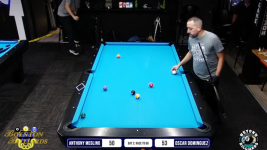
Playing peekaboo

When players look down the line of the ball to check a safety, or snooker, when the next player is getting ready to, or is assessing the table, or even getting down on the shot. Some players run, dance and crouch over a safety played, or a ball that's hooked, when they should just sit the F down... It's annoying enough in casual games, or games for petty cash. But when the shot clock is on, it's literally using someone's time, of which is limited.

I personally dislike it, though I cannot say there is not the odd time where I have done this myself. Should it be ok to have a look? Is it sharking? Should your opponent sit the F down? The table isn't changing because they have a look... but the tempo of the game, the psychology of the opponent/situation could change as a result.

I am curious on others thoughts.
Your opponent can do all the assessing he wants when it's his turn......

Custom and High End Cues on the Decline?

I thought "custom" meant built to your specifications, these are just cues that are exclusive to their website
Like a lot of production makers, you can probably contact Joss and have them change out woods, stains, etc. on production cues to meet what you want. Hell, McDermott will do it. I don't remember for sure, but I bet Joss would be willing to make you a 1/1 cue if you asked/paid for it.

Custom and High End Cues on the Decline?

They have a custom cue line on their web page with some pretty nice offerings. Pricing $600. - $1300 and there abouts.

Custom cue Archives - Joss Cues https://share.google/WhLJ2guGYDPIJvPgy

View attachment 879303

I thought "custom" meant built to your specifications, these are just cues that are exclusive to their website

Myth or real - Stroke smoothness as a requisite for certain shots

Just curious: are you like a 100 ball runner or maybe a 700 FR?

Lou Figueroa

Lou, the first three sentences are mine, the rest his. The qualifier, "if you produce the same impulse" makes his statement true. if you produce the same impulse is the catch. What he has said is if two impulses are exactly the same they will give the same result. True enough, but the different strokes aren't going to give the same impulse the vast majority of the time.

One definition of "impulse" from physics: a force acting briefly on a body and producing a finite change of momentum:

If I give exactly the same impulse to a cue ball with a feather or a freight train I will get the same result! His statement as written can be defended as true. On the other hand, try to deliver the same impulse with a half inch stroke and an eighteen inch stroke! He is playing word games.

Hu

Woods used by southwest cues

I recently acquired a Brazilian Rosewood Southwest. It looks a lot like ebony. I’m wondering if it is on par with the prices of ebony or is it worth slightly more due to the rarity?


Taken from google:

In 1992, Brazilian rosewood (Dalbergia nigra) was listed on CITES Appendix I, the highest level of protection, effectively banning international commercial trade due to severe depletion. This action, taken in June 1992, aimed to halt the devastation of the species caused by overharvesting. Consequently, any international sale of instruments or wood requires strict documentation proving it was harvested before this 1992 date.
Key Aspects of the 1992 Ban:
  • CITES Appendix I Listing: Effective June 11, 1992, this designation bans international trade of raw timber and products, including guitars.
  • Previous Regulations: Export of raw logs from Brazil was already banned in 1967.
  • Impact on Instruments: While many guitars with Brazilian rosewood were built, the 1992 ruling made international travel and commerce with them complex, requiring CITES permits.
  • Exceptions: Items manufactured or in the US prior to the June 1992 listing date are generally considered "pre-Convention" and may be sold within the US, but international trade remains highly restricted.
Post-1992 Considerations:
  • Strict Liability: The Lacey Act imposes strict liability for illegal wood, meaning illegal materials can be seized even if the owner was unaware of the violation.
  • Distinction from Other Woods: Unlike other rosewood species, Brazilian rosewood (Appendix I) was not included in the 2019 exemptions for musical instruments.
Possession is not illegal, but moving, selling, or shipping across international borders without documentation is prohibited.


Brazilian rosewood (Dalbergia nigra) is significantly rarer and more legally restricted than ebony, classified as an endangered species with international trade banned, while various ebony species remain available, though threatened. Brazilian rosewood is considered a "forbidden fruit" with extremely limited, high-priced stock, whereas ebony is an upscale, high-density wood that is still used in modern production.
  • Brazilian Rosewood Rarity: It is highly restricted under CITES Appendix I, with logging prohibited since 1992. Only pre-ban or salvaged wood is legally available, making it far more expensive and scarce.
  • Ebony Rarity: Various species (e.g., Gaboon, Macassar) are used, and while threatened, they are not as critically restricted as Brazilian rosewood. New, sustainable sources like "Cruella Cam Ebony" are actively used to mitigate scarcity.
  • Usage & Characteristics: Brazilian rosewood is cherished for its resonant tone and rich, varied figuring in guitars. Ebony is favored for its hardness (over 3000 on the Janka scale, compared to rosewood's ~1600–2000) and smooth, dark, dense feel.
While both are premier materials, Brazilian rosewood is generally regarded as much harder to acquire and significantly more valuable due to its legally restricted status.

Filter

Back
Top