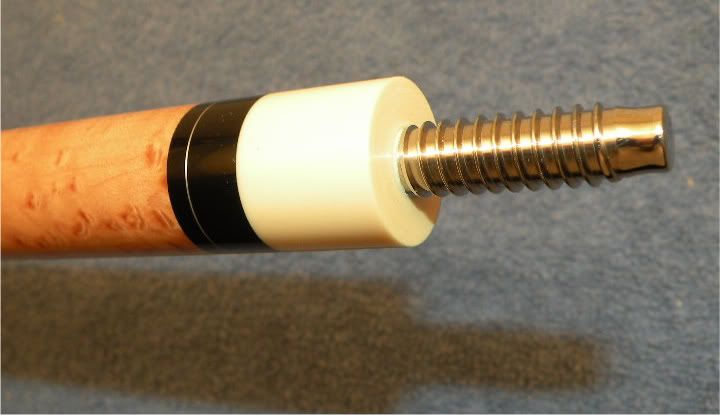
Ivory joints, piloted vs flat faced

I've play with both. I thought flat faced, big pin was Nuts till I got
a James White. It has the piloted Ivory joint. All I can say is it is
The Absolutely The best feeling and playing joint I've played with!
 

  1. Flat faced 3/8" or radial
    Don't use ivory on shaft-"spliting ivory joint looks terrible because you either have to round the edges or when the finish starts to wear it's very noticable" IMO
 
I've play with both. I thought flat faced, big pin was Nuts till I got
a James White. It has the piloted Ivory joint. All I can say is it is
The Absolutely The best feeling and playing joint I've played with!

You can not compare this cue, with another. Please, it has to be apples to apples. James White will have a different shaft taper than others. As a cue maker who has done both types of joints many times, there is no difference. Again I say the the joint screw has only one job. That being to hold the shaft to the butt section. The fact that one cue has a piloted & the other does not, has very little to do with the hit or feel of the cue...JER
 
Flat Faced is the way to go in my opinion. WHY? Because it is less likely to crack. There are ways to make the piloted ivory joint less likely to crack, like adding a sleeve on the inside of the pilot hole for added strength. But solid Ivory material flat faced is still stronger in my opinion.
 
You can not compare this cue, with another. Please, it has to be apples to apples. James White will have a different shaft taper than others. As a cue maker who has done both types of joints many times, there is no difference. Again I say the the joint screw has only one job. That being to hold the shaft to the butt section. The fact that one cue has a piloted & the other does not, has very little to do with the hit or feel of the cue...JER
OK.. what are the advantages or disadvanages with either of these? If it does not make a difference in the hit.. why build both?
 
One of the most profound statements I've read lately :
"There are many different ways to build a cue correctly."
 
One of the most profound statements I've read lately :
"There are many different ways to build a cue correctly."
obviously!.. there are many ways to build a cue correctly. My question is there must be reasons as to why the same cue maker would offer both types of ivory joints.. I am merely trying to decide what is best for me when I order my next cue.
 
I think a lot of people out there are under the assumption that schons and joss cues are better playing and looking production cues. Some cuemakers like to leave those joint options available for people who believe their new custom cue will hit as good as their or a friends production cue. In all reality the custom should out perform all the way...
 
obviously!.. there are many ways to build a cue correctly. My question is there must be reasons as to why the same cue maker would offer both types of ivory joints.. I am merely trying to decide what is best for me when I order my next cue.

You say "obviously" as though you understand what I'm saying.
If in fact you do, then wonderful.
But the fact that you're still asking, tells me that you don't.
If the statement were universally understood, there wouldn't be the controversy and outright hostility regarding construction methods that are discussed here in the Cue Maker's section. Fire-storms are the result of closed-mindedness.

If you're contemplating an ivory joint for your 'new cue' then you should be made aware that you run the risk of that joint cracking no matter what construction method is used. It's one of the mysteries/drawbacks of ivory.

I don't see, in this thread anyway, where any one CM states that he currently offers installation of an ivory joint in several different ways. In general, he's settled on the method that works best for him and will usually stick to it until he has reason to change. But being a 'custom cue maker', he might just entertain the method that you prefer because of the very nature of being 'custom'. Then, he might not. Is he wrong in adhering to his chosen method? No, not at all. He's chosen his particular method because that is the method that works best for him. We've all experimented. That's how we've reached our own conclusions.

So at the end of the day, is one method better than another?
No, not unless you can prove it.
Ask for opinions and you'll likely receive many.
Ask for proof to substantiate those opinions and you'll see the room empty.
The only thing that is 'obvious' is that there are many methods.
 
Flat Faced is the way to go in my opinion. WHY? Because it is less likely to crack. There are ways to make the piloted ivory joint less likely to crack, like adding a sleeve on the inside of the pilot hole for added strength. But solid Ivory material flat faced is still stronger in my opinion.
Thank you for taking the time to answer this question. Do you find a difference in the feel of the "hit" each one has?
 
I think it is a good investment to have an ivory joint collar. You should be able to feel and hear the difference. I personally think you can hear a more distinct billiard ball type sound when you hit the balls. Might have been the booze, I don't know for sure...
 
I only offer flat faced Ivory joints. I will do a thick Ivory sleeve , but I prefer the flat faced capped joint. I like it simple & I like what works best, for me in the past. No problems & that's the way I like it...JER
 
mmmmm.....Ivory your way


025-3.jpg


012-5-1.jpg
 
Last edited:
i buy 2 cues from the same maker,one flat,one piloted and I can't tell the difference,but i am not a good player
 
Last edited:
I have heard and would also believe that capped ivory joints, not threaded flat faced ones would give a "hard hit" and not a solid of stiff hit. This is what I have heard and it makes sense to me. [/I]
 
Back
Top