
Forward stroke power

nrhoades

AzB Silver Member
Silver Member
I'm making progress in learning just how lightly to grip and swing the cue during my stroke. It is difficult to describe a "feeling" in words, or where my current level of hand pressure lies. But, I think I've found a decent way to ask the following question, so please forgive the abstractness.

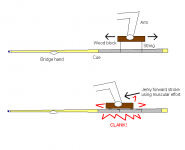
Consider this virtual experiment. The picture attached shows a pool cue with a wooden block tied to the grip with two strings a few inches in length. The wooden block is held by the hand and the pool cue is allowed to dangle.

The block is coupled to the cue via the strings, and decoupled from my hand. In other words, no matter how hard I squeeze the wooden block, the "looseness" of the effective grip remains the same as the string coupling.

A jerky movement of the shooting hand during the stroke will cause the wooden block to come into contact with the pool cue.

My question:

Is it possible to shoot most shots in pool, even those that require power, without causing a "clank"?
 

Attachments

  • cueblock.PNG
    cueblock.PNG
    13.1 KB · Views: 648
If the strings can rotate 360 degrees, you would have a hard time delivering the cue in a straight line.

That aside, I think the answer to your question is yes for soft shots. For power shots, the cue would come up and hit the wood block, if only because of the natural pendulum motion of the grip hand.*

*I use the term "pendulum" loosely here. Even with piston strokes, there is some measure of rise and fall in the cue.
 
wtf? Dude... seriously? Develop your stroke by what is comfortable, natural, and relaxed. There is no right or wrong other than the obvious. Watch Tommy Kennedy, Ralph Souquet, and Fransisco... it looks like they are not even playing the same game as each other. I feel like looseness in the wrist is important, and I can only keep my wrist relaxed if my grip is light, especially on powershots/break. It may be different for you. Figure it out with a cue in your hand, not a 2x4 + yarn contraption...

To answer your question, of course the block would hit the cue with a powerful stroke... if your understanding of physics is such that you have to ask that question, pool may not be the game for you. Sorry to sound like a d**k... but come on...
 
Last edited:
As far as the "clanking" in a literal sense...I don't think the pool stroke is long enough to generate the speed necessary for a power shot without "clanking". But as far as a mental image/trick, I see this being handy to help smooth out the backstroke and transition to a forward stroke.
 
Yes! In fact, on may shots I use nothinig to hold the cue at all, the friction between the girp on the cue caused by gravity and two of my fingers are completely sufficient to accelerate the cue to the required velocity and hold it on line. The only time I actually grip the cue is after contact as the cue slides backwards in the fingers.

It is only when you are trying to use more than a certain velocity that actually gripping the cue is required. Certainly Breaks, force follow, force draw fall into this catagory. I can roll the CB 8 diamonds up table and 8 diamonds back down table before more than pure gravitational friction is required to add power to the shot.

Also note, my cues do not have linen grips, with linen grips you don't have the friction of a glossy grip.
 
The advice on the light grip is to avoid locking your wrist.

Grip is probably the wrong word to describe, it's more like cradling the cue.
 
Yes! In fact, on may shots I use nothinig to hold the cue at all, the friction between the girp on the cue caused by gravity and two of my fingers are completely sufficient to accelerate the cue to the required velocity and hold it on line. Also note, my cues do not have linen grips, with linen grips you don't have the friction of a glossy grip.

Thank you Mitch.
 
wtf? Dude... seriously? Figure it out with a cue in your hand, not a 2x4 + yarn contraption... if your understanding of physics is such that you have to ask that question, pool may not be the game for you. Sorry to sound like a d**k... but come on...

"Consider this virtual experiment."
 
"Consider this virtual experiment."
Why not try the "real" experiment?

I would agree (without trying it) that the "hung string grip" is not sufficient for many pool shots.

Good thought experiment,
Dave
 
I'm making progress in learning just how lightly to grip and swing the cue during my stroke. It is difficult to describe a "feeling" in words, or where my current level of hand pressure lies. But, I think I've found a decent way to ask the following question, so please forgive the abstractness.

Consider this virtual experiment. The picture attached shows a pool cue with a wooden block tied to the grip with two strings a few inches in length. The wooden block is held by the hand and the pool cue is allowed to dangle.

The block is coupled to the cue via the strings, and decoupled from my hand. In other words, no matter how hard I squeeze the wooden block, the "looseness" of the effective grip remains the same as the string coupling.

A jerky movement of the shooting hand during the stroke will cause the wooden block to come into contact with the pool cue.

My question:

Is it possible to shoot most shots in pool, even those that require power, without causing a "clank"?
I think the answer to the question is "yes" but it would take a while to learn.

The stroke would have a backswing and a forward swing. The backswing should be easy enough to do -- take as much time as you want. On the forward swing let's suppose you are coordinated enough to bring the cue stick through in a straight line. That's not easy because you will have to drop the block as you get an angle on the strings to move the stick forward. But let's suppose you learn the motion.

What is the maximum forward force you could get to bring the stick forward? Pretty simple geometry says it is a force equivalent to the weight of the stick at the attachment point (which could be all of the stick weight if you balance it right) times the tangent of the angle of the string from the vertical. As the angle of the string approaches horizontal, the force forward gets arbitrarily large.

Another way to state the multiplier is that if you take the reciprocal of the slope of the string, that's how many g's the stick is being accelerated forward by. A 1% slope means that the force forward must be 100 times the weight of the stick or about 120 pounds. Will a 1% slope clang? Not if the connection is at the top of the stick.

Is it possible for a person to learn the timing required to make power shots successfully? I would not bet against it.

But it seems like you have one wrong assumption in your statement of the problem above. A string coupling is not necessarily weaker than a normal hand grip on the cue. It depends on how stretchy the string is.
 
well it depends on the power your looking for a power stun shot is diferant than a power follow or draw,, someone correct me if Im wrong,, the cue tip stays on the tip much longer hitting high ,, I have found thru many hours of expieriment that moving the hand back creats more power and a more loopy stroke


1
 
... someone correct me if Im wrong,, the cue tip stays on the [cue ball?] much longer hitting high ...
That's not what has been observed with ultra-high-speed video. The tip does stay on the cue ball somewhat longer (maybe up to twice as long) for any off-center hit but it does not depend on what kind of spin you're using. For masse and jump shots, using follow is often a bad idea.
 
Last edited:
Nice post

This is a great analogy, I love it and the answer to your question is yes. I have seen it done with Buddy Hall and as recently as last night with the modern day John Morra of 2012 not like the old John Morra of 2011 and past years. You just have to be able to play the angles like Danny "D". Remember the power and accuracy don't come from the long as your life back swing but the long smooth follow thru. John looks like he is pushing the balls he hits. Its such a soft and smoothe follow thru he uses to get him to his next shot. The only time he hit the balls hard is on the break and on stop shots. Here take a look and this is not the most recent video http://www.youtube.com/watch?v=IvTHWnBAbrQ It looks like everyday he is getting smoother and appears to be pushing the ball around the table.
 
try this
grip the cue between the thumb knuckle and middle index knuckle
all fingers pointing to the floor
the cue should not "clang" into your palm
 
i reread your 1st post
if get you right what you want to accomplish is very difficult
if i understand correctly
the wood block /strings /and cue would all have to be moving at the same rate thruout the whole stroke to not get a "clang"
whether jerky or smooth as the wood accelerates from backward to foward
the the block of wood will get ahead of its place relative to the cue
the stings will go from perpendicular to slanted
the farther ahead the wood gets the more slanted the strings and the closer the cue gets to the wood
eventually the wood touches the cue if it gets far enough ahead
whether jerky or smooth
i hope you can follow this
 
Is it possible to shoot most shots in pool, even those that require power, without causing a "clank"?
It is fairly clear (along the lines of Bob's post) that the theoretical answer is yes, but it is also clear that the practical answer is no.

It seems like your question might be "leading." Did you have a follow-on question, observation, or theory (e.g., concerning grip technique) based on the virtual-experiment discussions?

Good thread (especially if it leads to useful technique advice).

Regards,
Dave
 
Back
Top