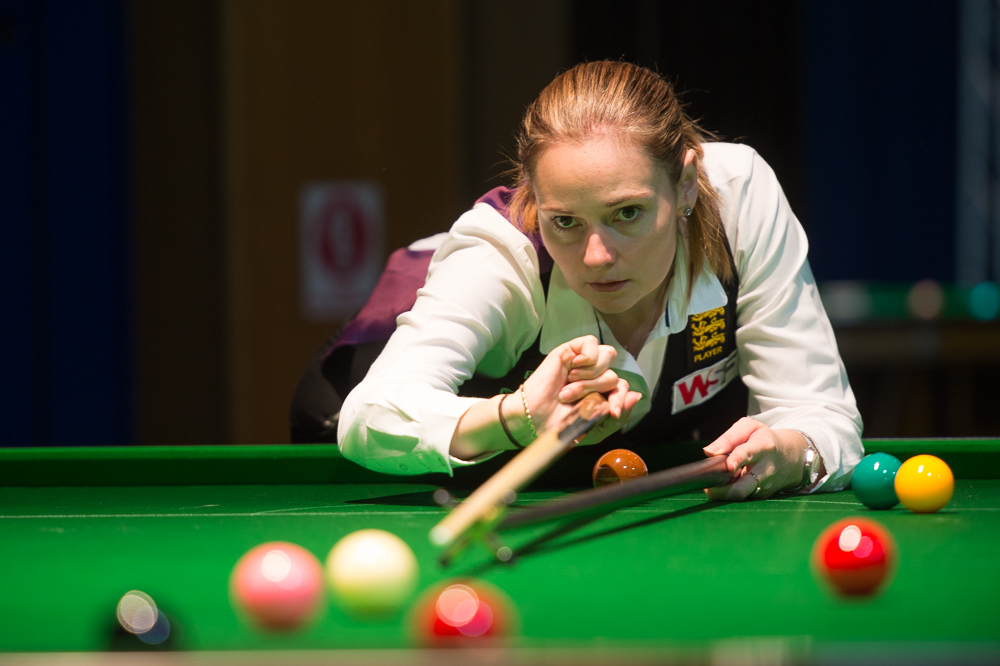
Higher skill pocket billiards players - 9 ball or snooker players?

OP back at yah.... how many snooker players have the ability to win against the top one pocket players?
Since it's full rack pool you'd think they would do very well in this discipline, but?
Alex P is one of thee best, but not one of thee best in snooker.
I think the 9' play area develops quite a different feel and array of shots, that snooker players don't ever shoot, think of or develop.
 
Didn't World Snooker #1 Judd Trump play in a WNT major a couple years ago and matched up with Jayson Shaw? If I recall correctly, Shaw skunked him. IMO, they are two different disciplines with slightly different skill sets required to play at a world class level. IMO, it's like asking who's better: The #1 Cricket batter or the #1 Baseball batter?
Shaw said afterwards that he played safeties he knew Trump didn't know how to get out of. He also of course is a much better pool player.

It is apples and oranges - snooker players who had dabbled in pool have done well in tournaments but probably need to get lucky with layouts/patterns against the top players (high 700s and 800s) to have a chance of beating them. The very best pool players on the otherhand will rarely make breaks bigger than 50 or 60 and will lose to top amateur players in a race to 4 pretty much all the time.

Snooker is harder. Pool involves skills that snooker players rarely master. That's about the long and short of it.
 
Alex P is one of thee best, but not one of thee best in snooker.
I think the 9' play area develops quite a different feel and array of shots, that snooker players don't ever shoot, think of or develop.
For sure. When Alex P tried to qualify for the world snooker tour (and he did well but didn't ultimately fell short) he was complimented, by snooker players, for playing safeties that snooker players wouldn't see. There's always something to learn and the cross-pollination (that is happening more and more) is a good thing.
 
there is anecdotal info to suggest the following cue sports tier heirachy,

Carom (maybe should not be on list as not pocket billiards)

Russian Billiards/Chinese Pool/English Billiards
Snooker
UK pool
American pool

no chip on shoulder required because pool 'might' be the least difficult,
its without a doubt imo the most fun and plenty tough enough
Surely you have to differentiate between types of game for American pool? I'd say 9 ball on an American table is as difficult if not more difficult than 8 ball on a UK table. But 8 ball on a UK table is way harder than 8 ball on an American table.

I'm not sure where to place carom as it's so different to all the others. And English billiards is dead, no one plays it so don't see the point in including it.

My list would be:

Russian Pyramid
Snooker
Hey Ball
American 10 ball
UK 8 ball/ American 9 ball
US 8 ball

Admittedly I've never actually played Russian pyramid or Hey Ball (I'm wondering how many people that have this debate actually do have experience in all of them). I've not included one pocket or banks pool, thought they were obscure enough to not merit being on the list and I don't have that much experience of them. The list could get quite long if we try to make it exhaustive as I think South America have a lot of regional cue sports you could consider too (sinuquinha & sinuca brasileira are 2 that I'm aware of).
 
Allison Fisher and Karen Corr. A detail is why they chose to switch to pool while the male snooker players have (mostly) not.
For Allison Fisher, who showed up on the WPBA scene for the entire 1995 season. I suspect it was all about money.

For Karen Corr, whose first year of WPBA play was 1999, it was surely about seeing the results Allion was achieving at pool and feeling confident that she could enjoy similar success. Still, for Karen, the other issue was the women's professional snooker tour was starting to losing steam. It did, in fact, fold in what I believe was 2002, and when it did, two of the more successful members of that tour, Kelly Fisher and KIim Shaw, moved to the US to try their hand at pool, each playing the 2003 WPBA events.

In the end, they all came for the same reason. The women's snooker tour was not on firm financial footing and playing on it was not paying the bills.
 
Last edited:
Marlon Manalo was a snooker player who quite easily transitioned and he had many successes at pool. Mark Gray and Tony Drago, similarly, both showed that if a skilled snooker player tries pool for a while, they can succeed at rotation pool. Mark Gray even qualified for Team Europe in 2016 and won 3 of his four matches at the Mosconi Cup. Right now, the snooker player trying his hand at pool is Patrick Fraser, who has had some good results and is never an easy opponent. We'll see if he is successful.

My opinion is that if a top snooker player dedicates two years to pool, he'll be a great pool player. I do not believe, however, that it's true in the opposite direction. Those who begin with pool, with Mark Selby the only exception that comes to mind, tend to lack the stroke fundamentals to ever be truly elite snooker players.
 

Allison Fisher, Kelly Fisher, and Karen Corr were all world number one snooker players, who all started their careers in snooker. As SJM mentioned, they started playing pool for the money.

So they are examples of world number one snooker players that became dominant world number one pool players.
 
It's difficult to compare women vs men in pool. There's millions more men playing.
The worlds best rotation women players are likely from China.
 
It's difficult to compare women vs men in pool. There's millions more men playing.
The worlds best rotation women players are likely from China.
I'd imagine the ratio to female to male players playing would be similar between pool and snooker. If anything I'd imagine there are more female pool players than female snooker players. So the argument is pretty relevant to me. If the top female snooker players move to pool for financial reasons and end up being the top players I reckon the top snooker players would also likely dominate if pool ended up having more money than snooker.

Steve Davis has a Mosconi cup win and can say he's beaten Earl Strickland and Effren Reyes. He's said as much as he loved 9 ball his focus was always snooker and he'd only practice 9 ball for a day or 2 before a tournament. He was also way past his prime at snooker when he started playing pool. I think if he'd had pool as his main focus he would have been considered 1 of the greats.
 
I see two separate issues.

(1) transferability of skills can be asymmetric


It can, for example, be easier to go from Violin to Viola than from Viola to Violin, (and perhaps snooker to American pool, over American pool to snooker) without violin being a harder or somehow more impressive instrument than Viola. It's more about whether the instrument/game specific sub skills happen to be amongst the slowly acquired sub skills.

(2) which, between snooker and pool, is deeper and more developed?
Snooker is often cited here. But I think we should be more circumspect.

But before I justify that, let me introduce a depth-of-development concept for a sport or skill. No matter the skill or sport, we have the notions of "best in the world," and "greatest of all time." What makes a skill look impressive to us is usually not something absolute; it is that someone does it better than almost anyone else in the available talent pool.

If you were to gather the world's 50 best unicyclists into Wembley Stadium and have them demonstrate their skill, they would seem unbelievably talented and skilled and their display would be unprecedented.
If you were to gather the world's 50 best at soccer-ball control into Wembley Stadium and have them demonstrate their skill, they too would seem unbelievably talented and skilled and their display would be unprecedented.

But there is a key difference.

The soccer skill is far more deeply developed in the population. There are billions of preadolescents whose heroes are soccer players, who see soccer skills as highly valued in their communities and a key to the future they yearn for. As a result, there is a large meritocratic funneling such that the world's 50 best comprise a far more impressive group in an absolute sense. Importantly, we don't see this depth when we're looking at the best because we often mistake rarity for depth. Those impressive unicyclists probably wouldn't be the best in their local county if unicycling had a generation with world-wide soccer-like popularity and culling.

The best surfers in the world look amazing. But the talent really comes just from people who happen to grow up around certain coastal communities. Half of the best hockey players in the world come from Canada or Sweden (just over 50 million people). Surfing and hockey are less developed sports than soccer--and less developed even than American football or baseball or basketball.
Snooker has a genuinely global fan and federation footprint (governing bodies, TV viewers, players), but the world-class player pipeline is still much less geographically distributed than that footprint suggests. A very large share of top snooker players are either from the UK or from China and living/training in the UK. If we ask what fraction of the prize money goes to people who can eat breakfast at home and then walk, drive, or hop a train to Sheffield by lunchtime, I suspect the answer is: quite a lot.

Right now, 10 of snooker's top 16 were from the British Isles: England, Wales, Scotland, or Northern Ireland. And several of the non-British names that make the list look more international--Zhao, Si, Ding, and likely others--are in fact living or training in Sheffield and the UK snooker system. So while snooker is clearly international in one sense, its elite talent-production base is still surprisingly concentrated.

That does not prove pool is deeper. But it should at least make us hesitate before casually assuming that snooker’s stronger institutional structure means it must have the more developed talent pool. My own guess is that, while pool is still an undeveloped sport by major-sport standards, it has become the more globally developed of the two. The top end is no longer mainly American. The top 16 active Fargo players come from Vietnam, Austria, Poland, Scotland, Singapore, the Philippines, Iraq, Spain, Taiwan, and USA. The elite is more geographically distributed than it used to be.

So even though pool’s governing structure is a mess, its talent base may actually now be broader and deeper than snooker’s. If that’s right, the goal is not to imitate snooker mechanically. It’s to avoid squandering the broader global player base pool has managed to create.

Snooker may have settled into a kind of local maximum: a very successful UK-centered sports/entertainment product that is international enough to look global, but still concentrated enough to make outside breakthrough unusually hard.

 
I think the difference between the sports which British players aren't appreciating is 9 ball involves moving the cue ball a lot more. Sometimes frames go funny, but for the most part snooker players only have to move the cue ball a few feet at a time going from black to red. They'll have to move it more at the end potting the colours, but they'll normally be on their spots so it's pretty much the exact same every time.
I'm glad someone finally mentioned this. While I don't disagree that some aspects of snooker skills are easier to transfer to 9 ball than vice versa, what you don't see in snooker is the power draw shot that's often required in 9 ball to move the cue ball from one end of the table to the other. As any pool player can tell you, this is far and away the hardest shot to master with any consistency, far harder than simply potting a ball from a great distance. I'm sure the top snooker players could add that skill to their repertory, but whether they could do it on the level of the top 9 ball pros isn't something I'd take as a given.
 
The BIG question is WHY do people keep wanting to compare the skill-sets required for different games?? Cricket and baseball, both use a wooden tool to hit a ball. Would anyone with even half-a-brain try to compare a skilled batter vs a skilled batsman?? No. Pool/billiards/snooker/pyramid/etc all use cues and balls but they are all different enough to make direct comparisons a waste of time.
 
I didn't read the other comments, apologies.

All of cue sports is the same game, just with different dials turned higher then others.

Snooker has the object-ball-aiming dial turned way up. But their strokes are simple, the game is simple, and a lot of center ball is used with lighter balls. Pool players smoke snookers players as far as stroke goes, no question.

Russian pyramid has carom-line-aiming dial turned way up, but again the game is simple, and you just need a lot of power near center ball and precision aiming.

Pool is half way between carom and snooker, where you need a mix of object ball aiming and ball path manipulation. A lot of dials turned mid level.

Three cushion has cue-ball-path-manipulation and table-knowledge dials turned up full volume. Aiming is important but not as important as other disciplines. You need a very good and accurate stroke, but you don't need extreme object ball precision like you do in snooker.

Balkline has a huge demand for object-ball-throw knowledge and precision banks, far beyond that of any other game.

5-pins has the kicking dial turned up to the max.

All of disciplines should be played, and none should be disregarded.
 
I see two separate issues.

(1) transferability of skills can be asymmetric

It can, for example, be easier to go from Violin to Viola than from Viola to Violin, (and perhaps snooker to American pool, over American pool to snooker) without violin being a harder or somehow more impressive instrument than Viola. It's more about whether the instrument/game specific sub skills happen to be amongst the slowly acquired sub skills.

(2) which, between snooker and pool, is deeper and more developed?
Snooker is often cited here. But I think we should be more circumspect.

But before I justify that, let me introduce a depth-of-development concept for a sport or skill. No matter the skill or sport, we have the notions of "best in the world," and "greatest of all time." What makes a skill look impressive to us is usually not something absolute; it is that someone does it better than almost anyone else in the available talent pool.

If you were to gather the world's 50 best unicyclists into Wembley Stadium and have them demonstrate their skill, they would seem unbelievably talented and skilled and their display would be unprecedented.
If you were to gather the world's 50 best at soccer-ball control into Wembley Stadium and have them demonstrate their skill, they too would seem unbelievably talented and skilled and their display would be unprecedented.

But there is a key difference.

The soccer skill is far more deeply developed in the population. There are billions of preadolescents whose heroes are soccer players, who see soccer skills as highly valued in their communities and a key to the future they yearn for. As a result, there is a large meritocratic funneling such that the world's 50 best comprise a far more impressive group in an absolute sense. Importantly, we don't see this depth when we're looking at the best because we often mistake rarity for depth. Those impressive unicyclists probably wouldn't be the best in their local county if unicycling had a generation with world-wide soccer-like popularity and culling.

The best surfers in the world look amazing. But the talent really comes just from people who happen to grow up around certain coastal communities. Half of the best hockey players in the world come from Canada or Sweden (just over 50 million people). Surfing and hockey are less developed sports than soccer--and less developed even than American football or baseball or basketball.
Snooker has a genuinely global fan and federation footprint (governing bodies, TV viewers, players), but the world-class player pipeline is still much less geographically distributed than that footprint suggests. A very large share of top snooker players are either from the UK or from China and living/training in the UK. If we ask what fraction of the prize money goes to people who can eat breakfast at home and then walk, drive, or hop a train to Sheffield by lunchtime, I suspect the answer is: quite a lot.

Right now, 10 of snooker's top 16 were from the British Isles: England, Wales, Scotland, or Northern Ireland. And several of the non-British names that make the list look more international--Zhao, Si, Ding, and likely others--are in fact living or training in Sheffield and the UK snooker system. So while snooker is clearly international in one sense, its elite talent-production base is still surprisingly concentrated.

That does not prove pool is deeper. But it should at least make us hesitate before casually assuming that snooker’s stronger institutional structure means it must have the more developed talent pool. My own guess is that, while pool is still an undeveloped sport by major-sport standards, it has become the more globally developed of the two. The top end is no longer mainly American. The top 16 active Fargo players come from Vietnam, Austria, Poland, Scotland, Singapore, the Philippines, Iraq, Spain, Taiwan, and USA. The elite is more geographically distributed than it used to be.

So even though pool’s governing structure is a mess, its talent base may actually now be broader and deeper than snooker’s. If that’s right, the goal is not to imitate snooker mechanically. It’s to avoid squandering the broader global player base pool has managed to create.

Snooker may have settled into a kind of local maximum: a very successful UK-centered sports/entertainment product that is international enough to look global, but still concentrated enough to make outside breakthrough unusually hard.
Thank you for providing this context about the geographics of snooker. And thank you providing your insight as to the transferability issue.
 
I'm glad someone finally mentioned this. While I don't disagree that some aspects of snooker skills are easier to transfer to 9 ball than vice versa, what you don't see in snooker is the power draw shot that's often required in 9 ball to move the cue ball from one end of the table to the other. As any pool player can tell you, this is far and away the hardest shot to master with any consistency, far harder than simply potting a ball from a great distance. I'm sure the top snooker players could add that skill to their repertory, but whether they could do it on the level of the top 9 ball pros isn't something I'd take as a given.
I would say the very top snooker players already have the power draw shot in their arsenal as if they've got a long red that's tempting them but not high percentage after an opponent has played a poor safety, they will often take on a length of the table pot and draw it back into baulk, knowing if they miss it will be reasonably safe, and if they pot they can either take one of the baulk colours into a middle pocket or roll up behind a baulk colour to play a safety. They possibly don't have to be as precise about the amount of draw as pool players and they are used to lighter balls so maybe it doesn't transfer to American pool, but the top snooker players can definitely play a draw shot the length of the table.

Trump is the very best at it, this compilation includes a few examples of the type of shot I'm talking about. He also likes showboating at the end of frames once the frame is won so there are quite a lot of those types of shots in the video too

 
  • Wow
Reactions: bbb
I would say the very top snooker players already have the power draw shot in their arsenal as if they've got a long red that's tempting them but not high percentage after an opponent has played a poor safety, they will often take on a length of the table pot and draw it back into baulk, knowing if they miss it will be reasonably safe, and if they pot they can either take one of the baulk colours into a middle pocket or roll up behind a baulk colour to play a safety. They possibly don't have to be as precise about the amount of draw as pool players and they are used to lighter balls so maybe it doesn't transfer to American pool, but the top snooker players can definitely play a draw shot the length of the table.

Trump is the very best at it, this compilation includes a few examples of the type of shot I'm talking about. He also likes showboating at the end of frames once the frame is won so there are quite a lot of those types of shots in the video too


Yeah I had the same thought. While Judd does have the most of these shots I’d say all of the top players have the ability to cue from baulk hit a red near the black and screw back into baulk. I’ve even seen amateur players recreate those shots - the main difference is the amateur probably misses the pot more often than not when trying to generate that power.
 
Yeah I had the same thought. While Judd does have the most of these shots I’d say all of the top players have the ability to cue from baulk hit a red near the black and screw back into baulk. I’ve even seen amateur players recreate those shots - the main difference is the amateur probably misses the pot more often than not when trying to generate that power.
I don't play snooker often, but the last time I played I tried one of those length of the table pots screwing into baulk, potted the ball, but my attempt to screw back in actuality ended up being a perfect stop shot. You are hitting the ball such a long distance it's hard as an amateur to not lose all your backspin to the friction of the cloth.
 
I have not read all the posts, here is a video that provides insights into differences in the pool vs snooker comparison.
Edit: oops forgot the link. 🤷‍♂️
 
I don't play snooker often, but the last time I played I tried one of those length of the table pots screwing into baulk, potted the ball, but my attempt to screw back in actuality ended up being a perfect stop shot. You are hitting the ball such a long distance it's hard as an amateur to not lose all your backspin to the friction of the cloth.

I was thinking of the guy from the Break from Life YouTube channel.
 
I'm not reading that drivel....

My comment is I believe the sport of Snooker has found the highest level of players when compared to pool. The reason is money. Kids, teens, young adults, etc, can all take the sport super seriously, and with the backing of their parents, because it leads to a profession. (Similar to other professional sports in the USA).

Pool doesn't have that. So it won't attract as many raw players that choose to make it their lifestyle.

Its not a matter of what game is harder, etc, its a matter of what game attracts the most talent.
 
Back
Top