PCB Material
Printed Circuit Boards can be broadly categorized into 2 types; rigid and flexible. Flexible PCB is much more expensive and should only be used on areas where space is limited, for example, inside a camera or telescope. PCB or in particular rigid PCB are composite material which made from a reinforcement material immersed in a temperature resistant polymer. Conducting material like copper foil is bonded on top of the laminate. Foil thickness, regardless of the manufacturing process, is specified for printed circuit boards in ounce of copper foil per square foot. Some common materials for printed wiring boards are:-
Phenolic-resin-impregnated Paper, (e.g. XXXP, XXXPC, FR-2)
Epoxy-resin-impregnated Paper, (e.g. FR-3)
Epoxy-resin-impregnated cloth surface cellulose paper core, (e.g. CEM-1)
Epoxy-resin-impregnated cloth surface nonwoven fibre glass core, (e.g. CEM-3)
Acrylic-polyester-impregnated random glass mat, (e.g. FR-6)
Epoxy-impregnated fiberglass cloth, (e.g. G-10, FR-4) and
Other resin system like polyimides (Kapton) and polytetrafluoroethylene (PTFE).
Notes:-
Kapton is a registered trademark of E.I. du Pont.
The classification of material inside the bracket follows National Electrical & Manufacturers Association, USA, (NEMA) grading.
The number of X represents the amount of resin present in the board; the amount of resin increase with the number of X. P suffix indicate punchable at elevated temperature and PC suffix indicates that the board can be cold punched.
XXXPC, FR2 and CEM-1 is normally used for single sided consumer electronics application.
CEM-3, G10 and FR4 are normally used for double sided computer/industrial electronics application.
CEM-3, G10 and FR4 are normally used for double sided computer/industrial electronics application.

 . so I want to ask if it would be possible to have some inlays done out of a PCB. I think a couple of windows of pcb would look really nice in a cue.


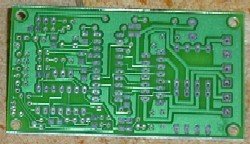

 sorry its been a long week.


 . Last, but far from least, you can whip up a PCB that has whatever graphics you want really, to a fine resolution, including the tracks of copper, the solder mask, and a silk screen layer, and get it made quite easily. I'm speaking of making a custom PCB with some graphics for the purpose of inlaying it in a pool cue. Making one that actually works is a bit of a drag, it's what my wife often complains about when she gets home from work.