Banks & Kicks

Based on experience, I disagree with the comments on center ball vs. english. If I use say 1 tip of 10:30 english to hit a certain spot, and instead hit at 11, or 10, or use 1.25 tips, etc., the variation is very minor. That's because the rail, assuming a relatively normal angle, would "add" running english to the shot anyway. When the ball goes into the rail with the english already there, it will tend to add or subtract as needed and sort of "smooth out" the amount of english. That's why when playing 3 cushion using running english and a 1/2 ball hit off the first object ball is the most forgiving shot, you really have a small range of values for both that end up at the same place on the third/fourth rail.

I'm not saying I won't kick using center ball, I certainly do. And as another poster said, using top/draw requires more judgement and feel as the reactions can vary from table to table and even rail to rail potentially and very sensitive to speed and entry angle. It's just that if I kick 1 rail at a ball, I know numerous systems using running english, and I prefer them over the dead ball or center ball systems, I have more leeway with the hit and speed where I can still hit the ball.

I'm not sure if there is any physics to back this up, and maybe I'm just crazy. But as an example, when I kick 3 rails into the corner, I don't have to use exactly x speed and x amount of english, I can vary my speed and english, within reason, and still make it to the corner. If I plan a 3 rail route with center ball, a little running english or inadvertent inside english will change the route more drastically and cause the ball to miss.

Just my experience, maybe Dr. Dave/Bob/etc. have something to back it up or refute it physics-wise?

Scott

Multi-rail kicks are more feely for me, but, like you, I tend to use running english as anything else can have a wide range of effects on the 2nd rail. Also, Diamond tables tend to kick back, so top I've felt has been more true to the angle on simple kicks.

As I said, I like to minimize the variables. Center with a good hit tends to produce good results for myself and my friends. The question was posed by somebody asking for help because their kicks/banks were off by almost a diamond. For that, I'd go with a more broad approach and assume that it was in regards to single rail kicks and banks.
 
The biggest mistake people make on kickshots...

Is looking at angle in/angle out through center ball.

If you take the extra step of looking at angle in/angle out through the contact point on the cue ball, or on the object when lining up banks, your accuracy will improve ten fold...

It's easy to find, it's always on the point of the ball that is directly parallel to the rail it is contacting.

Aim through the contact point for the angle in/angle out and then parallel shift on the ball to center ball and you have the aimline for the standard hit, then you have to adjust for speed of hit, and any english you have to use etc...

There is always feel involved in banks and kicks. That's the biggest downside to them.

No system will get you there 100%...

Jaden
 
Thanks for the link Dr Dave much appreciated.

It seems I was using the "reference lines" aiming method all along, I just didn't know it.
The way I think things through is very similar, and after 30 seconds of practice I was back making full table kicks with ridiculous accuracy. I think my bad run of form kicking and banking wise was just down to me being sloppy. Its far too easy when trying to figure out a 3 or 4 rail kick to confuse your self and just think "EFF IT!", ill just hit the damn CB.

In regards to previous posts about playing a kick with running english;

I very rarely kick at a ball slowly (unless I have to). So through experience I've kind of gained a feel for hitting a ball into a rail at speed, with running english to help it maintain the 'natural' angle off the rail. I think the best way to describe it is "gearing english" for kicks. If that makes any sense?

Any way, thanks for the replies and help.
 
I've kind of gained a feel for hitting a ball into a rail at speed, with running english to help it maintain the 'natural' angle off the rail. I think the best way to describe it is "gearing english" for kicks. If that makes any sense?
A simple way to visualize how much english = gearing english: gearing english = tip offset 2/5 of distance to CB's "opposite contact point".

It works for CB contacts with rails or OBs and changes automatically with the angle of approach. (It also works for putting immediate rolling follow on the CB.)

natural running english.jpg

pj
chgo
 
Last edited:
A simple way to visualize how much english = gearing english: gearing english = tip offset 2/5 of distance to CB's "opposite contact point"....
I think Ron Shepard was the first to come up with this idea. It's too bad that he never made the transition to AZB.
 
I think Ron Shepard was the first to come up with this idea. It's too bad that he never made the transition to AZB.
Yes, Ron, you and Mike Page were the RSB technical experts who taught me just about everything I (claim to) know. It's also too bad that Ron doesn't get into Chicago more... haven't seen him in years.

pj
chgo
 
A simple way to visualize how much english = gearing english: gearing english = tip offset 2/5 of distance to CB's "opposite contact point".

It works for CB contacts with rails or OBs and changes automatically with the angle of approach. (It also works for putting immediate rolling follow on the CB.)

View attachment 250158
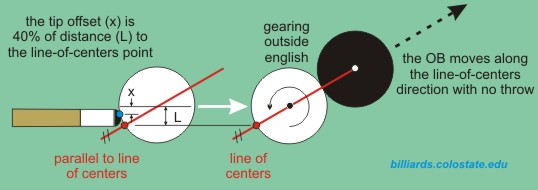
This technique, which I like to call the "40% rule," is also useful for judging the amount of outside english required for no throw on cut shots. Here's a diagram from my outside English resource page:

gearing_outside_english.jpg

Regards,
Dave
 
I think Ron Shepard was the first to come up with this idea. It's too bad that he never made the transition to AZB.
Agreed. Ron contributed many great ideas for translating pool physics principles into useful pool-playing advice. That's too bad he isn't on AZB to contribute further insights.

Regards,
Dave
 
Yep, I remember Ron from the RSB days, learned quite a bit from him (and the other usual suspects still here) as well.

Cuetable and Photoshop sure beat drawing diagrams with pipes, dashes, underscores, and other assorted ANSI characters, right?? :)

Scott
 
no matter what system you use. practice and get used to kicking on the table you use the most. that way when you go out you have a comparison when warming up for a tourney/match and can make adjustments .
 
You should also start experimenting with what shooting into a rail with stun and draw does. Also there is a big difference to what happens shooting into a rail at an acute angle vs a shallow angle. Its not just learning angles but also how hitting different speeds and english will change angles. Try this one. Hit a ball at a shallow angle with straight outside (9 or 3 on the clock) and see what happens. You might be surprised how much it shortens up the kick.
 
Back
Top