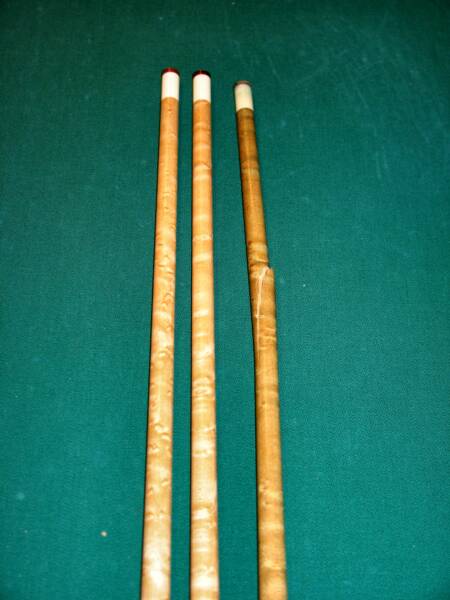
Once again, trhe Birdseye misunderstanding
DJKeys said:
I was interested in the opinions of the AZ group on this. I have a good friend who is a wood turner and he said that the "eyes" in Birdseye Maple are actually imperfections or knots in the wood. That being said, it would follow that "nicely figured" birdseye maple with a lot of eyes would be less solid than a piece of maple without figuring. I really don't know if it makes any difference in the hit, but I was curious as to why cuemakers these days use highly figured pieces of maple rather than those with less "imperfections".
Do the imperfections have any effect on the hit of a cue with a BEM nose, or are they so minute that it wouldn't matter and the cue looks more interesting?
Thanks for any input on this.
First off, birdseyes are certainly not knots.
birdseye figure, most common in maple, but occuring in other species,
is not a defect, not a desease, not caused by stress, nor the result of
insect infesstation...
I think I've covered all the most popular urban legends about Birdseye
Maple.
as far as suitability for cues goes, in my experience, roughly 20 years
of working with BEM, the hard<sugar maple>variety is just as stable and
'strong' as straight grained maple, tho I did have reservations about
the intensely figured pieces when I first started.
My favorite theory for why some people insist on thinking BEM
must be suspect is based on, of all things, pianos...
Once upon a time, when this was still America, and we still made things,
one of the products of industry was the piano. One of the components
of a piano was a maple contraption called the 'piano action'.
Eventually there came to be a commercial grade of lumber known as
'piano action maple', which was straight grained, hard maple that was
within a stated tolerance for gran runoff, AND, not containing any
knots or voids, bark inclusions, and various other defects.
Also not allowed, but not a structural defect were figure effects like,
birdseye, curl, highlights, pin speck, etc.
SO, birdseye figure could keep a board from being classified
as piano action grade, but that never did make it 'defective'
FWIW - the PA grade was the early standard for cue shaft wood,
tho, these days the requirement for grain runoff is much more stringent
for shafts
Dale