Below is an explanation written by FargoRate co-founder, Mike Page, about intentional losing (i.e. sandbagging) in order to lower a Fargo Rating. It is a very interesting read.
************************************************************************************************
I'd like to provide some clarification regarding a few recent comments about Fargo Ratings.
I saw:
(1) A new player can dump until established to get a rating below skill level -- This is true
(2) Fargo Ratings are like chess ratings -- This is only true on the surface. What FargoRate does is actually much more sophisticated than what is done in Chess.
(3) Including games played in low-entry weekly tournaments or league will make the system more easily manipulated -- This is the complicated one, and while we can't make definitive statements, it is more untrue than true.
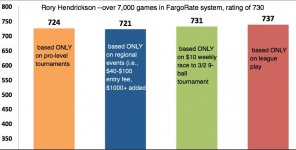
First, please understand that legitimate games from any events are valuable not only in determining a player's rating but also for connecting all players together. The graphic here shows Rory H. from North Dakota. He would be a 12-speed in the old Oklahoma system. He is a 730 based on over 7,000 games. But we can break up his rating and dissect it in many different directions. We can look at old games vs recent games. We can look at games played against weak players as compared to games played against strong players. And we can separate games according to how much Rory paid to play them or the prize money at stake. That's what we did here. We calculated a rating based ONLY on pro-level events, based ONLY on larger regional events, based ONLY on low-entry weekly tournaments, and based ONLY on league. As you can see the calculated rating is within several points of 730 no matter how we slice it. What this means is that a player like Rory can establish a rating with a mixture of just 50-100 games in each category, and it would be a decent rating.
To make things easier I will call league and low-entry tournaments LE events. So the question on many people's mind is, what about the player who either dumps LE events--i.e., loses on purpose, or drinks heavily during LE events, or cares more about socializing than winning during LE events? Won't these bring the rating down below the player's true skill level?
This is where the Fargorate Custodian comes in. FargoRate has a way to assign less significance to some games than others. An example of this is older games are weighted less than more recent games in determining your rating. The idea of the Custodian is to analyze games slicing and dicing a number of different ways looking for inconsistencies that are likely larger than expected from normal statistical fluctuation. As an example, suppose Rory's performance in LE events was 670 rather than 730. The Custodian would flag this category of game and, depending on how bad the games smell, assign a lesser weighting to the games. This doesn't have to be that the person is intentionally attempting to manipulate. It could be they just don't care about league and fool around a lot.
The Custodian has the ability to get more and more sophisticated in an Artificial Intelligence kind of way. That is, more data confirms or goes against his smell test generating a better sense of smell.
We don't talk much about these efforts because the VAST MAJORITY of reported cases of clear sandbagging don't pass muster. When we imported tens of thousands of league games a few months ago, we looked at the effect on the ratings for the "known sandbaggers." These are the people who talk about sandbagging, who tell their teammates to protect their rating, who brag about their own cleverness in manipulation "the system." reality tells a different story.
Still, there are people who significantly underperform under certain circumstances. For one recent Oklahoma player, the rating from low-entry weekly events--enough games to be established--was about 100 points below the same player's rating looking just at bigger events. The Custodian went to work. For this player, the low-entry fee events are treated as though they occurred a decade ago, and a game carries only a tenth the weight as does a game played in a larger event.
The vast majority of games played in league and low-entry-feel tournaments are just fine and serve to generate better ratings for all of us from which we all benefit. The Custodian is just there to keep the corridors clean...
************************************************************************************************
I'd like to provide some clarification regarding a few recent comments about Fargo Ratings.
I saw:
(1) A new player can dump until established to get a rating below skill level -- This is true
(2) Fargo Ratings are like chess ratings -- This is only true on the surface. What FargoRate does is actually much more sophisticated than what is done in Chess.
(3) Including games played in low-entry weekly tournaments or league will make the system more easily manipulated -- This is the complicated one, and while we can't make definitive statements, it is more untrue than true.
First, please understand that legitimate games from any events are valuable not only in determining a player's rating but also for connecting all players together. The graphic here shows Rory H. from North Dakota. He would be a 12-speed in the old Oklahoma system. He is a 730 based on over 7,000 games. But we can break up his rating and dissect it in many different directions. We can look at old games vs recent games. We can look at games played against weak players as compared to games played against strong players. And we can separate games according to how much Rory paid to play them or the prize money at stake. That's what we did here. We calculated a rating based ONLY on pro-level events, based ONLY on larger regional events, based ONLY on low-entry weekly tournaments, and based ONLY on league. As you can see the calculated rating is within several points of 730 no matter how we slice it. What this means is that a player like Rory can establish a rating with a mixture of just 50-100 games in each category, and it would be a decent rating.
To make things easier I will call league and low-entry tournaments LE events. So the question on many people's mind is, what about the player who either dumps LE events--i.e., loses on purpose, or drinks heavily during LE events, or cares more about socializing than winning during LE events? Won't these bring the rating down below the player's true skill level?
This is where the Fargorate Custodian comes in. FargoRate has a way to assign less significance to some games than others. An example of this is older games are weighted less than more recent games in determining your rating. The idea of the Custodian is to analyze games slicing and dicing a number of different ways looking for inconsistencies that are likely larger than expected from normal statistical fluctuation. As an example, suppose Rory's performance in LE events was 670 rather than 730. The Custodian would flag this category of game and, depending on how bad the games smell, assign a lesser weighting to the games. This doesn't have to be that the person is intentionally attempting to manipulate. It could be they just don't care about league and fool around a lot.
The Custodian has the ability to get more and more sophisticated in an Artificial Intelligence kind of way. That is, more data confirms or goes against his smell test generating a better sense of smell.
We don't talk much about these efforts because the VAST MAJORITY of reported cases of clear sandbagging don't pass muster. When we imported tens of thousands of league games a few months ago, we looked at the effect on the ratings for the "known sandbaggers." These are the people who talk about sandbagging, who tell their teammates to protect their rating, who brag about their own cleverness in manipulation "the system." reality tells a different story.
Still, there are people who significantly underperform under certain circumstances. For one recent Oklahoma player, the rating from low-entry weekly events--enough games to be established--was about 100 points below the same player's rating looking just at bigger events. The Custodian went to work. For this player, the low-entry fee events are treated as though they occurred a decade ago, and a game carries only a tenth the weight as does a game played in a larger event.
The vast majority of games played in league and low-entry-feel tournaments are just fine and serve to generate better ratings for all of us from which we all benefit. The Custodian is just there to keep the corridors clean...