FargoRate Custodian - Keeping the Data Clean

CSI Media

CueSports International
Silver Member
Below is an explanation written by FargoRate co-founder, Mike Page, about intentional losing (i.e. sandbagging) in order to lower a Fargo Rating. It is a very interesting read.

************************************************************************************************

I'd like to provide some clarification regarding a few recent comments about Fargo Ratings.
I saw:

(1) A new player can dump until established to get a rating below skill level -- This is true

(2) Fargo Ratings are like chess ratings -- This is only true on the surface. What FargoRate does is actually much more sophisticated than what is done in Chess.

(3) Including games played in low-entry weekly tournaments or league will make the system more easily manipulated -- This is the complicated one, and while we can't make definitive statements, it is more untrue than true.

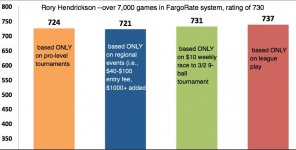
First, please understand that legitimate games from any events are valuable not only in determining a player's rating but also for connecting all players together. The graphic here shows Rory H. from North Dakota. He would be a 12-speed in the old Oklahoma system. He is a 730 based on over 7,000 games. But we can break up his rating and dissect it in many different directions. We can look at old games vs recent games. We can look at games played against weak players as compared to games played against strong players. And we can separate games according to how much Rory paid to play them or the prize money at stake. That's what we did here. We calculated a rating based ONLY on pro-level events, based ONLY on larger regional events, based ONLY on low-entry weekly tournaments, and based ONLY on league. As you can see the calculated rating is within several points of 730 no matter how we slice it. What this means is that a player like Rory can establish a rating with a mixture of just 50-100 games in each category, and it would be a decent rating.

To make things easier I will call league and low-entry tournaments LE events. So the question on many people's mind is, what about the player who either dumps LE events--i.e., loses on purpose, or drinks heavily during LE events, or cares more about socializing than winning during LE events? Won't these bring the rating down below the player's true skill level?

This is where the Fargorate Custodian comes in. FargoRate has a way to assign less significance to some games than others. An example of this is older games are weighted less than more recent games in determining your rating. The idea of the Custodian is to analyze games slicing and dicing a number of different ways looking for inconsistencies that are likely larger than expected from normal statistical fluctuation. As an example, suppose Rory's performance in LE events was 670 rather than 730. The Custodian would flag this category of game and, depending on how bad the games smell, assign a lesser weighting to the games. This doesn't have to be that the person is intentionally attempting to manipulate. It could be they just don't care about league and fool around a lot.

The Custodian has the ability to get more and more sophisticated in an Artificial Intelligence kind of way. That is, more data confirms or goes against his smell test generating a better sense of smell.

We don't talk much about these efforts because the VAST MAJORITY of reported cases of clear sandbagging don't pass muster. When we imported tens of thousands of league games a few months ago, we looked at the effect on the ratings for the "known sandbaggers." These are the people who talk about sandbagging, who tell their teammates to protect their rating, who brag about their own cleverness in manipulation "the system." reality tells a different story.

Still, there are people who significantly underperform under certain circumstances. For one recent Oklahoma player, the rating from low-entry weekly events--enough games to be established--was about 100 points below the same player's rating looking just at bigger events. The Custodian went to work. For this player, the low-entry fee events are treated as though they occurred a decade ago, and a game carries only a tenth the weight as does a game played in a larger event.

The vast majority of games played in league and low-entry-feel tournaments are just fine and serve to generate better ratings for all of us from which we all benefit. The Custodian is just there to keep the corridors clean...
FR Pic.jpg
 
Ok...

Below is an explanation written by FargoRate co-founder, Mike Page, about intentional losing (i.e. sandbagging) in order to lower a Fargo Rating. It is a very interesting read.

************************************************************************************************

I'd like to provide some clarification regarding a few recent comments about Fargo Ratings.
I saw:

(1) A new player can dump until established to get a rating below skill level -- This is true

(2) Fargo Ratings are like chess ratings -- This is only true on the surface. What FargoRate does is actually much more sophisticated than what is done in Chess.

(3) Including games played in low-entry weekly tournaments or league will make the system more easily manipulated -- This is the complicated one, and while we can't make definitive statements, it is more untrue than true.

First, please understand that legitimate games from any events are valuable not only in determining a player's rating but also for connecting all players together. The graphic here shows Rory H. from North Dakota. He would be a 12-speed in the old Oklahoma system. He is a 730 based on over 7,000 games. But we can break up his rating and dissect it in many different directions. We can look at old games vs recent games. We can look at games played against weak players as compared to games played against strong players. And we can separate games according to how much Rory paid to play them or the prize money at stake. That's what we did here. We calculated a rating based ONLY on pro-level events, based ONLY on larger regional events, based ONLY on low-entry weekly tournaments, and based ONLY on league. As you can see the calculated rating is within several points of 730 no matter how we slice it. What this means is that a player like Rory can establish a rating with a mixture of just 50-100 games in each category, and it would be a decent rating.

To make things easier I will call league and low-entry tournaments LE events. So the question on many people's mind is, what about the player who either dumps LE events--i.e., loses on purpose, or drinks heavily during LE events, or cares more about socializing than winning during LE events? Won't these bring the rating down below the player's true skill level?

This is where the Fargorate Custodian comes in. FargoRate has a way to assign less significance to some games than others. An example of this is older games are weighted less than more recent games in determining your rating. The idea of the Custodian is to analyze games slicing and dicing a number of different ways looking for inconsistencies that are likely larger than expected from normal statistical fluctuation. As an example, suppose Rory's performance in LE events was 670 rather than 730. The Custodian would flag this category of game and, depending on how bad the games smell, assign a lesser weighting to the games. This doesn't have to be that the person is intentionally attempting to manipulate. It could be they just don't care about league and fool around a lot.

The Custodian has the ability to get more and more sophisticated in an Artificial Intelligence kind of way. That is, more data confirms or goes against his smell test generating a better sense of smell.

We don't talk much about these efforts because the VAST MAJORITY of reported cases of clear sandbagging don't pass muster. When we imported tens of thousands of league games a few months ago, we looked at the effect on the ratings for the "known sandbaggers." These are the people who talk about sandbagging, who tell their teammates to protect their rating, who brag about their own cleverness in manipulation "the system." reality tells a different story.

Still, there are people who significantly underperform under certain circumstances. For one recent Oklahoma player, the rating from low-entry weekly events--enough games to be established--was about 100 points below the same player's rating looking just at bigger events. The Custodian went to work. For this player, the low-entry fee events are treated as though they occurred a decade ago, and a game carries only a tenth the weight as does a game played in a larger event.

The vast majority of games played in league and low-entry-feel tournaments are just fine and serve to generate better ratings for all of us from which we all benefit. The Custodian is just there to keep the corridors clean...

View attachment 452253

I am a 12 in the oklahoma rating system and a 540 something in the fargo... explain that one. Although technically I don't have enough games in Fargo for it to be accurate yet.

Jaden
 
Another Fargo question begging a sound reply

I recently played in a Joss stop to play in a higher level tournament and to keep my ego in check when playing lower level players in USAPL. It was inadequately explained IMO to my league operator that the fact that I played in that event, not how I did, gets APL teammates "coupled" with others players from other parts of the country. I might add that I won three matches and lost two, all to amateurs.

As a result of "coupling," ALL the members of my team and others in our division went up from 30 to 50 fargo points.!

There's a final local Joss stop coming up this weekend. Guess I better not play and be content to play on my present level for fear of further coupling repercussions to myself and everyone around me.

Please explain, if you can.
 
Coupling

TeeA: Here is an explanation of "coupling" also written by Mike Page. Coupling is good and is what makes FargoRate more accurate across regions.

********************************************************************************************

FargoRate – The Island Issue

A key value of Fargo Ratings is that a 500 in Connecticut plays the same as a 500 in Oregon. The daily optimization uses the web of connections among us to insure this.

There is, however, occasionally a group of players that is unconnected or poorly connected to the main web of interactions. We call such groups Islands. With enough games among themselves, island groups can develop reliable ratings internally and yet be improperly connected to the rest of the world.

To understand the island issue, you have to understand that basic match/game information-wins and losses against a particular opponent-do not determine a rating for you, they determine a rating difference between you and your opponent.

For instance, if you heard that Putin and Trump have secretly been playing pool every Friday night for a year and that Putin is up 700 games to 500 games over Trump, you can say confidently that Putin is 50 points better than Trump. But you don’t at this point know how either of them play. Are they 350 and 300? 625 and 575? 800 and 750? You don’t know. The data is consistent with any of these. If neither player has ever played anyone else, you have no way of deciding. The two players, Trump and Putin, are a small island. So long as they keep just playing each other, FargoRate makes the right predictions because those predictions only depend on the rating difference, and the rating difference is right.

To learn more, we need coupling games, games between members of the Island and the giant web of players. If Putin played 200 games against Jayson Shaw and the score was 100 to 100, then it is clear Putin plays at near 810 speed. Note that in that event we now know Trump plays near 760 speed even though Trump has not played outside the island group. Even one member of an island group becoming well connected to the rest of the world brings the entire island in line. And when the group moves into line, it shifts up and down as a group (like the 50-point gap between Putin and Trump staying the same).

Here is an analogy. Suppose you are wondering how much money John, Paul, Ringo, and George have in their pockets. But all you are allowed to do is ask two at a time to compare and report the difference. After a few rounds you will learn that Ringo has $50 more than George, who has $10 more than Paul, who has $200 more than John.
Fair And Fun For Everyone!

At this point they could have John ($0), Paul ($200), George ($210), and Ringo ($260). Or they could have John ($1000), Paul ($1200), George ($1210), and Ringo ($1260), and so on. So you are completely ignorant to how much money they have. But it is an unusual ignorance, because as soon as you somehow determine how much ONE has, you then know them all.

So suppose we are adding many historical games for 100 players comprising a league in Alaska. Typically we will find at least a handful of players among the 100 have played games outside the group. Perhaps one moved to Alaska from Washington. Perhaps a few others have played a couple years at BCAPL Nationals in Las Vegas, and so forth. If collectively there are several hundred of these coupling games, the whole group will be fine. If there are only 100 coupling games, then the group is weakly coupled. As more coupling games are added, the whole group can see shifts up or down as the coupling improves.
 
I recently played in a Joss stop to play in a higher level tournament and to keep my ego in check when playing lower level players in USAPL. It was inadequately explained IMO to my league operator that the fact that I played in that event, not how I did, gets APL teammates "coupled" with others players from other parts of the country. I might add that I won three matches and lost two, all to amateurs.

As a result of "coupling," ALL the members of my team and others in our division went up from 30 to 50 fargo points.!

There's a final local Joss stop coming up this weekend. Guess I better not play and be content to play on my present level for fear of further coupling repercussions to myself and everyone around me.

Please explain, if you can.


Hi Tee -

There is some information on the general issue just posted that you may find helpful. I will add some to it being specific about your particular situation.

There are a lot of games in the system for players in the Capital-Area (Schenectady NY ) USA Pool League (USAPL)--years of data. So FargoRate has a good grasp on how players in your league play relative to one another--who beats whom, and by how much. This means your ratings are good relative to one another. The rating differences are right. We also want to make sure your league is properly matched up with other USAPL leagues and with other geographic areas generally--make sure a 400 in your league plays the same as a 400 in Pittsburgh and a 400 in Arizona.

One way this happens is at national league events, like the USAPL National Championships in Vegas in July, where members of these groups compete directly against one another. Fortunately FargoRate has many more and much better mechanisms than simply waiting for and relying on the occasional direct matchup.

There is a big web of nearly 100,000 connected players out there, and anytime a player like you plays matches in that connected web, you help to make your whole league part of that web.

You played Turning Stone in January, and you played Turning Stone last January, and well as several times years ago. Your play in those events was a large part of how the Capital Area USAPL has been connected to the rest of the world. Now you played six matches at Sharpshooters. You went 9-4 against an unestablished 576, 9-5 against an established 556, 9-1 against an established 533, 9-4 against an unestablished 602, 8-9 against an established 630, and 6-9 against an established 638. The more you play, the better the ratings for your entire league.

There is nothing about being dinged for just playing. And FargoRate knows the strength of your opponent, so it doesn't matter whether you play weak opponents or strong opponents.
 
I am a 12 in the oklahoma rating system and a 540 something in the fargo... explain that one. Although technically I don't have enough games in Fargo for it to be accurate yet.

Jaden

You're not a 12 in Oklahoma as far as I know and it looks like your Fargo is a starter rating which is essentially meaningless anyway as you pointed out.

You might have been put in as a 12 somewhere to protect a tournament from out-of-towners but if you lived here I am pretty sure you wouldn't be a 12 speed.
 
I am a 12 in the oklahoma rating system and a 540 something in the fargo... explain that one. Although technically I don't have enough games in Fargo for it to be accurate yet.

Jaden

I wrote that for people in Oklahoma, and I suspect you don't know what "OK 12-speed" means. You have 11 matches from US Bar Table, Swanee, and two Mezz events. So it's not enough for an established rating but an idea of your speed is starting to emerge.

OK-12 essentially means pro speed but not top pro speed

In OK, it means a notch--and maybe a small notch-- below Chip Compton and Joey Gray. John Gabriel, who played in DCC Bigfoot Challenge this year, is an OK 12.

In CA, it would include players like Ernesto Dominguez, Beau Runningen, and Sal Butera, players who go to 9 (pro) in the Mezz events but are a notch below Oscar, Vilmos, Rodney...
 
To Be Dinged, Or Not To Be Dinged

Hi Tee -

There is some information on the general issue just posted that you may find helpful. I will add some to it being specific about your particular situation.

There are a lot of games in the system for players in the Capital-Area (Schenectady NY ) USA Pool League (USAPL)--years of data. So FargoRate has a good grasp on how players in your league play relative to one another--who beats whom, and by how much. This means your ratings are good relative to one another. The rating differences are right. We also want to make sure your league is properly matched up with other USAPL leagues and with other geographic areas generally--make sure a 400 in your league plays the same as a 400 in Pittsburgh and a 400 in Arizona.

One way this happens is at national league events, like the USAPL National Championships in Vegas in July, where members of these groups compete directly against one another. Fortunately FargoRate has many more and much better mechanisms than simply waiting for and relying on the occasional direct matchup.

There is a big web of nearly 100,000 connected players out there, and anytime a player like you plays matches in that connected web, you help to make your whole league part of that web.

You played Turning Stone in January, and you played Turning Stone last January, and well as several times years ago. Your play in those events was a large part of how the Capital Area USAPL has been connected to the rest of the world. Now you played six matches at Sharpshooters. You went 9-4 against an unestablished 576, 9-5 against an established 556, 9-1 against an established 533, 9-4 against an unestablished 602, 8-9 against an established 630, and 6-9 against an established 638. The more you play, the better the ratings for your entire league.

There is nothing about being dinged for just playing. And FargoRate knows the strength of your opponent, so it doesn't matter whether you play weak opponents or strong opponents.

Thanks Mike for the reply. Just to set the record straight and then make one important point: I didn't play Turning Stone last January. I have played in some in previous years to have fun hoping to play some world pros while trying to keep my wife from losing our home on the slots. So we make it a mini vacation. I've never beat a real pro there.

The six matches at Sharpshooters you refer to was a local Joss stop, like the one upcoming at Trick Shots, which I try to support because I frequent these local rooms. These matches were likewise a couple of years ago and were all against local amateurs with the exception of Jennifer Barretta.

Here's the rub: You already had this data in your system when you switched our USAPL over to Fargo ratings about a month or so ago. So my initial rating would have incorporated all of the games (including the ones you cited) I've played when that change occurred. Two weeks ago, I play in a Joss stop at Sharpshooters again, and the sky falls in on everyone but very new players in my division. So why would a 3-2 outcome against all amateurs have 30-50+ point increases when similar results where already factored in.

Do you really mean the more I play, the higher ("better") the ratings for my league. I understand what you're trying to accomplish with Fargo. But with the tens of thousands of games played daily in the pool world, the NSA would have significant problems collecting ALL of the daily data and processing it. Just hope you're end game doesn't come at the expense of a fun league.
 
Thanks Mike for the reply. Just to set the record straight and then make one important point: I didn't play Turning Stone last January.

My bad. I meant January 2016 and January 2015, not last January and the one before.

I have played in some in previous years to have fun hoping to play some world pros while trying to keep my wife from losing our home on the slots. So we make it a mini vacation. I've never beat a real pro there.

Yes. Over the years, you, in a race to 9, got to 5,2,6,3,6,4 against Sossei, Shuff, Davis Jr, Engel, Sambajon, and Zuglan. This is winning 26 out of 80 (33%) games against opponents rated about 735 on average.

This is what is expected of a player rated about 100 points below his competition, or about 635

Against opponents rated 623 to 678 (9 matches) you won 45% of the games--performing at about 612 speed

Against opponents rated an average of 546 (8 matches) you win 68% of the games --performing about 650 speed.

Some of these matches are quite old and not given much weight. I'd say your Fargo Rating of 565 is likely running a little light. What do you think?

Here's the rub: You already had this data in your system when you switched our USAPL over to Fargo ratings about a month or so ago. So my initial rating would have incorporated all of the games (including the ones you cited) I've played when that change occurred. Two weeks ago, I play in a Joss stop at Sharpshooters again, and the sky falls in on everyone but very new players in my division. So why would a 3-2 outcome against all amateurs have 30-50+ point increases when similar results where already factored in.

Again, many of the older games are not given much weight. So when you play 82 new games against well-connected opponents, it can have a pretty big influence.

Do you really mean the more I play, the higher ("better") the ratings for my league.

You use two words there, higher and better. Better is what I mean, yes.

I understand what you're trying to accomplish with Fargo. But with the tens of thousands of games played daily in the pool world, the NSA would have significant problems collecting ALL of the daily data and processing it. Just hope you're end game doesn't come at the expense of a fun league.

Though you may not agree, to many a rating system that constantly evolves to give each league division and geographic region a fair shake against other league divisions and geographic regions is one aspect of what makes for a fun league.
 
Just a final comment or two

Thanks Mike for the reply. Just to set the record straight and then make one important point: I didn't play Turning Stone last January. I have played in some in previous years to have fun hoping to play some world pros while trying to keep my wife from losing our home on the slots. So we make it a mini vacation. I've never beat a real pro there.

The six matches at Sharpshooters you refer to was a local Joss stop, like the one upcoming at Trick Shots, which I try to support because I frequent these local rooms. These matches were likewise a couple of years ago and were all against local amateurs with the exception of Jennifer Barretta.

Here's the rub: You already had this data in your system when you switched our USAPL over to Fargo ratings about a month or so ago. So my initial rating would have incorporated all of the games (including the ones you cited) I've played when that change occurred. Two weeks ago, I play in a Joss stop at Sharpshooters again, and the sky falls in on everyone but very new players in my division. So why would a 3-2 outcome against all amateurs have 30-50+ point increases when similar results where already factored in.

Do you really mean the more I play, the higher ("better") the ratings for my league. I understand what you're trying to accomplish with Fargo. But with the tens of thousands of games played daily in the pool world, the NSA would have significant problems collecting ALL of the daily data and processing it. Just hope you're end game doesn't come at the expense of a fun league.

My bad. I meant January 2016 and January 2015, not last January and the one before.


Yes. Over the years, you, in a race to 9, got to 5,2,6,3,6,4 against Sossei, Shuff, Davis Jr, Engel, Sambajon, and Zuglan. This is winning 26 out of 80 (33%) games against opponents rated about 735 on average.

This is what is expected of a player rated about 100 points below his competition, or about 635

Against opponents rated 623 to 678 (9 matches) you won 45% of the games--performing at about 612 speed

Against opponents rated an average of 546 (8 matches) you win 68% of the games --performing about 650 speed.

Some of these matches are quite old and not given much weight. I'd say your Fargo Rating of 565 is likely running a little light. What do you think?


Again, many of the older games are not given much weight. So when you play 82 new games against well-connected opponents, it can have a pretty big influence.


You use two words there, higher and better. Better is what I mean, yes.


Though you may not agree, to many a rating system that constantly evolves to give each league division and geographic region a fair shake against other league divisions and geographic regions is one aspect of what makes for a fun league.

Rating Systems: Like that infamous expression, everybody has one, and they all believe theirs is the best. APA has the Equalizer; TAP has the T.A.P. Handicap System; NAPA has the Elo Rating System; Tony has a totally subjective parallel system; and USAPL has the AIC (Artificial Intelligent Custodian). Been exposed to all of them and they all have positives and negatives. It's not easy coming up with a full proof system, I get it. And I'm not opposed to Fargo and its evolving nature. I see eight ball scoring evolving to the where only the game winner matters to match the system. Guessing that nine ball and ten ball will eventually follow suit.

Great for ease of scoring but leaves out some essential factors. Doesn't it matter how you win your match games? No more stats entered in eight ball as to MOB, LOT, Innings, DEF, etc. Just suppose I told you accurately that in those 26-against-pro matches I won, that 25 were won because my opponents hung up the nine ball. And I still brag to friends how in that match 10 years ago against Sambajon, I had him 5-0, dogged the next game to go up 6-0, and then won only 1 to his 9 when he decided to start taking me serious...what a powerful break for a jockey...lol. (My break today is as good as its ever been and watching him close up helped me get there)

"Some of these matches are quite old and not given much weight. I'd say your Fargo Rating of 565 is likely running a little light. What do you think?": No I don't and apparently AIC agrees that anything higher wouldn't pass the smell test. I left the safety of the island before and plan on doing so again tomorrow. Kevin Ketz was a good friend and I will be playing in his Joss Memorial stop. I'm not trying to piss the guy off at the switch, I sincerely don't get the consequences of that last trip. Most insulated USAPL players will never venture off the island. But I'm a promoter of the game, love the game, and want to get better every day I screw my cue together...regardless of my age.

I apologize if anything I said is not clear and/or taken the wrong way.
 

Attachments

  • wilson.jpeg
    wilson.jpeg
    99.5 KB · Views: 735
Rating Systems: Like that infamous expression, everybody has one, [...]

I apologize if anything I said is not clear and/or taken the wrong way.


It's all good.... AIC was pretty funny. Good luck tomorrow.
 
Rating Systems: Like that infamous expression, everybody has one, and they all believe theirs is the best. APA has the Equalizer; TAP has the T.A.P. Handicap System; NAPA has the Elo Rating System; Tony has a totally subjective parallel system; and USAPL has the AIC (Artificial Intelligent Custodian). Been exposed to all of them and they all have positives and negatives. It's not easy coming up with a full proof system, I get it. And I'm not opposed to Fargo and its evolving nature. I see eight ball scoring evolving to the where only the game winner matters to match the system. Guessing that nine ball and ten ball will eventually follow suit.

Great for ease of scoring but leaves out some essential factors. Doesn't it matter how you win your match games? No more stats entered in eight ball as to MOB, LOT, Innings, DEF, etc. Just suppose I told you accurately that in those 26-against-pro matches I won, that 25 were won because my opponents hung up the nine ball. And I still brag to friends how in that match 10 years ago against Sambajon, I had him 5-0, dogged the next game to go up 6-0, and then won only 1 to his 9 when he decided to start taking me serious...what a powerful break for a jockey...lol. (My break today is as good as its ever been and watching him close up helped me get there)

"Some of these matches are quite old and not given much weight. I'd say your Fargo Rating of 565 is likely running a little light. What do you think?": No I don't and apparently AIC agrees that anything higher wouldn't pass the smell test. I left the safety of the island before and plan on doing so again tomorrow. Kevin Ketz was a good friend and I will be playing in his Joss Memorial stop. I'm not trying to piss the guy off at the switch, I sincerely don't get the consequences of that last trip. Most insulated USAPL players will never venture off the island. But I'm a promoter of the game, love the game, and want to get better every day I screw my cue together...regardless of my age.

I apologize if anything I said is not clear and/or taken the wrong way.


I have only played bcapl...napa.and apa so I will.not even mention the other leagues since have no comment to make concerning them.

I only played bcapl for a year but its handicapping system seemed the easiest to manipulate.

Napa was like wise for a year. It's handicapping system seemed to do as intended and I must say its extended race format.....compared to other leagues seemed to take care of the ....any thing can happen is a short race syndrome.

I have been playing apa for over 6 years now and have over 1,200 matches so far. Since I have been exposed to apas handicapping system the longest I have more to say about it than the others..

I am captain of 4 teams in apa.and thus I pay a whole lot of attention to the handicapping system whereas in the other leagues I just showed up and played whoever I was matched up against and left the worrying about handicaps and all the other bs associated with running the team to others .

The apa system ....imo is designed to curb sandbagging and makes an honest effort to handicap players .....as long as the scoresheets are filled out properly. Lax scorekeeping is a pet peeve of mine.

There are 2 flaws ...again imo....with apas equalizer system.

1. You mentioned this in your post. How you win. Give you an example. I took a loaded team to a big money apa tournament. My 2 was raised to a 3 in the quarter finals prohibiting us from throwing our best roster and basically knocking us out of the finals.she lost her first 2 matches and won her 3rd match 2-0 and was raised to a 3 before the 4th match. What gets me was why she was raised. Her opponent made an early 8 in the 2nd inning in the first rack. She made the 8 on the break the 2nd rack. She won 2-0 in 2 innings due to her opponents mishap and a lucky break and was raised.

2.. The 2nd flaw...which Fargo rate seems to address is your opponents skill level. I could give numerous examples I have encountered over the years but I will say.....a s/l 5 that has 4-5 easy wins over 4's and skunking the 2nd worse 3 in town does not mean he is capable of playing as a 6. That happened to ne of my players. His first match as a 6 was against another 6 and he lost 18-2. Of course he was lowered back to a 5 the following week but the damage was done. His lopsided loss knocked us out of playoffs.

Not saying Fargo rate is perfect but the more I read about it the more I like it.
 
I generally think Fargo rating is pretty accurate and do not like sandbagging at all but am sorry to hear this.

Fargo rating is supposed to be a data driven system. Once someone arbitrarily starts deciding which wins and losses are meaningful, you are back to a rating system that is someone's opinion. How do you determine if someone has a bad day, started working more and can't play as much versus sand bagging?

If you discount losses arbitrarily, are you going to discount wins equally? What if someone has a tournament and gets all the rolls, slips in a couple of 9s and has a good showing? Do you discount this as reverse sandbagging?

Slippery slope for Fargo and I hope you reconsider this direction.


Sent from my iPad using Tapatalk
 
  • Like
Reactions: JC
Is there anything that keeps Fargo from posting the skill levels from whatever league they play? Without the comparison from league skill level to Fargo rating it's hard to see the big picture. Even if you can't post skill levels. It would be nice that when you look someone up and the have a Fargo rating. It also showed the comparison to other league ratings. If Fargo is more accurate than it should be easy to see which leagues have a flawed system.

Sent from my SM-G930V using Tapatalk
 
1. You mentioned this in your post. How you win. Give you an example. I took a loaded team to a big money apa tournament. My 2 was raised to a 3 in the quarter finals prohibiting us from throwing our best roster and basically knocking us out of the finals.she lost her first 2 matches and won her 3rd match 2-0 and was raised to a 3 before the 4th match. What gets me was why she was raised. Her opponent made an early 8 in the 2nd inning in the first rack. She made the 8 on the break the 2nd rack. She won 2-0 in 2 innings due to her opponents mishap and a lucky break and was raised.

Though I feel for you as we have had it happen to us, but I do not believe you are seeing the whole picture here. I would tell you that at every higher level event the APA should be suspicious of every single 2 in the place, especially males. I will explain this further below but in your situation there are only 2 ways this would result in her being raised:

1.) They saw her shoot all matches and/or people complained and thus she was watched and they felt she was not rated properly.

2.) She was very close to being raised and 2 of her previous bad wins fell off her rating and these 2 much lower ones came on thus pushing her past that threshold. Those types of wins don't occur often and though most of us would feel they really shouldn't factor in, they do to some extent.

Continuing from above, I personally will say this about 2's. The only people that are going to be a 2 and remain a 2 for more than a few weeks are going to be people that simply have absolutely no interest in learning the game and improving. They rarely shoot extra games to practice or even warm up. They are simply there for the social aspect of it and shoot just because. Or they, less commonly, have a physical/mental disability preventing them from advancing. With that said it is not out of the ordinary for them to then all of a sudden want to actually concentrate and play better when they get to higher level tournaments just for the team. Thus they do shoot better, think better and play better so they should be raised as their abilities truly are better than what they show during normal league play.
 
Something that a few of you may not yet realize, but.......FargoRate doesn't care who wins or loses the match.
 
Back
Top