Full Splice Question

masonh said:
i would think some Bubinga,Purpleheart,Zircote,some Rosewoods,Bocote and maybe some dense Maple heartwood would make decent one piece cues.

Never tried zircote, but the rest of these I know for fact make great one peice cues & I never had issues with warpage. Don't forget cocobolo, too. It's actually very nice for one peice butts if you can find a lighter weight piece. Maybe I live on another planet but maple is the most warp proned wood I use, besides olive. Seems good rosewoods are stable once cured, no matter how many cuts or how thick the cuts. Maybe it's because of the figure that maple is warp proned. Shedua makes for great solid butts, too. I'm working on some curly jatoba, but it seems pretty heavy.
 
Maybe I live on another planet but maple is the most warp proned wood I use, besides olive


i have been saying this for months.ever since i started studying wood and building cues,i have been trying to figure out why Mpale is the mainstay wood used in cue constuction.it is under weighted,not as strong as other cue woods,and also as you mentioned more prone to warp than many cue woods.
 
Last edited:
masonh said:
i have been saying this for months.ever since i started studying wood and building cues,i have been trying to figure out why Mpale is the mainstay wood used in cue constuction.it is under weighted,not as strong as other cue woods,and also as you mentioned more prone to warp than many cue woods.

A brief tangent from the main topic, but . . .

I know it's a very, very distant second, but ash is probably the second most popular shaft wood other than maple. I think purple heart has been experimented with in more recent years, but whatever happened to ash shafts? I think they were also used in golf clubs. What are ash's characteristics (stiffness, durability, stability, etc) as compared to maple?

Also, I'm still not buying weight and/or balance as a reason for the origination of spiced cues. Cue makers have known how to weight the butt end with lead for about as long as the game has been played. If a person wanted a heavier cue or wanted to change the balance point a bit further back, adding some lead is WAY more simple than trying to splice two different woods together. Reduced warping may be the more likely answer, but I wish some historical documents could confirm. The 1800s is probably the key time frame in question. Where are our billiard historians?
 
icem3n said:
Pre 1900. It was a one piece full splice cue. What about the above three quarter of the cue? Why not worried about the 1st half of the cue getting em straight? Those are the most problem area, right?

I have never seen one that stayed straight and I've worked on many, especially the ones in this book.

http://www.poolndarts.com/p-4921-Stelllinga-s-Pool-Billiard-Collectibles-Book/

Weight may have a little to do with it. Even though a cue can be weighted, a naturally weighted cue has a better feel and balance to it. The less non-wood "stuff" you add to cue, the better "feel" the cue has.
 
stiffness and very little warpage

i believe laminated wood either, flat laminated, radial laminated, butterfly or, 4 prong full splice shafts or butts are all stiffer and will stay straighter over time. butterfly and full splice allow you to get the weight distribution the way you need without using weight bolts. imo most times when two or more woods are correctly glued together the combination is stronger than either of the woods alone. just my way of thinking. chuck
 
Mr Hoppe said:
A brief tangent from the main topic, but . . .

What are ash's characteristics (stiffness, durability, stability, etc) as compared to maple?


Since ash is used for baseball bats, tool handles, and parallel bars in gym equipment it must be pretty durable and stable but the open grain will take some getting used to. It may be the future if good maple shaft wood gets any harder to buy. Snooker shafts look like chair rungs to me.

I don't like the dark and light stripes on my laminated shafts either.

This is a great thread. Thanks to the cuemakers who contribute.

Courtney
 
Ash is very close to Malpe.

i believe laminated wood either, flat laminated, radial laminated, butterfly or, 4 prong full splice shafts or butts are all stiffer and will stay straighter over time


this is true,but some don't like the hit or feel of laminated Maple,myself included.i actually don't even like using it as a core.
 
hit in the hand of the be holder

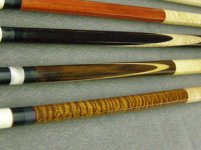
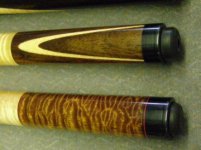
i respect the way you think, but i personally use a lot of flat laminated core material, especially, in burls, koa, saplel. just finished a saplel with a cored forearm and iimo it hits the ball as good as any cue i have ever had in my hands
 

Attachments

  • P5230009.JPG
    P5230009.JPG
    77.6 KB · Views: 168
  • P5230012.JPG
    P5230012.JPG
    70.6 KB · Views: 153
hit in the hand of the be holder


of course that says it all.the "hit" is completely subjective.you are completely right.i also hear great things about your cues.
 
masonh said:
i have been saying this for months.ever since i started studying wood and building cues,i have been trying to figure out why Mpale is the mainstay wood used in cue constuction.it is under weighted,not as strong as other cue woods,and also as you mentioned more prone to warp than many cue woods.

Good question, but it does make pretty shafts.....was very plentiful, too. Still is I suppose, just tougher to find good quality old growth.
 
for shafts it is excellent and basically unbeatable,but i was referring to use in forearms for the most part.
 
cueaddicts said:
Good question, but it does make pretty shafts.....was very plentiful, too. Still is I suppose, just tougher to find good quality old growth.
Imo tight grain hard and pingy maple dowels make for great coring dowels if mated with the right hard wood.
 
Back
Top