
You are using an out of date browser. It may not display this or other websites correctly.
You should upgrade or use an alternative browser.
You should upgrade or use an alternative browser.
Hoppe Sticker Logo Help
- Thread starter atthecat
- Start date

Not exactly what your looking for but this may help - http://www.classicbilliards.net/html/pool_cue_decals.cfm

If it has no sticker then it is a donor for a conversion.... No point in spending money on it as a collector as you can never date it... Unless of course it's still straight and a 9 out of 10 and only missing the sticker.....

Thanks for the help guys. I'm thinking it is from the mid 40's because of the color of the veneers and you can see a tiny bit green where the sticker used to be. Sound right? It plays really nice. The butt comes up a hair at the joint and so does the shaft. Barely anything. When screwed together there is a bigger lift at the joint. The tip and butt stay on the table and I don't notice anything when I shoot. It's one of those things where when you put the cue flat on the table it will roll into place a bit. Shoots great though!!! I'm thinking of putting a little into it to fix up. Suggestions? I don't want to put the sticker on though. Dig it without, the wood is so nice. What should I do with the butt? It came with a long, thin bumper on it that looked added so I took it off. I want to take the shaft down to 12.4 from 13mm. Will I be able to get some of the taper roll out that way? Cue says 21 oz on it but it seems light. Should I add weight?
Here are some pics. Thanks for the help.
Monte


Here are some pics. Thanks for the help.
Monte


Monte,
Thanks for the PM.
To me this cue looks like it was an old conversion from a one piece 26 1/2 from the 1920's or 1930's.
I've scanned some old Brunswick catalogs - compare your cue to the 1928 and 1939 catalog cues in these scans:
http://www.palmercollector.com/Brunswick/BruswickCollectorHomePage.html
Your cue was done along the lines of a 1930's style factory cue, but the joint screw is not standard to any Brunswick I've seen. A conversion would explain the weight difference.
To help me date the cue, is the weight stamped in the butt or burned into the forearm?
You mentioned the joint might be buckhorn? Can you tell if the ferrule is fiber, ivory, or buckhorn?
Depending on your answers, I can give you some restoration or modern conversion ideas.
Chris
Thanks for the PM.
To me this cue looks like it was an old conversion from a one piece 26 1/2 from the 1920's or 1930's.
I've scanned some old Brunswick catalogs - compare your cue to the 1928 and 1939 catalog cues in these scans:
http://www.palmercollector.com/Brunswick/BruswickCollectorHomePage.html
Your cue was done along the lines of a 1930's style factory cue, but the joint screw is not standard to any Brunswick I've seen. A conversion would explain the weight difference.
To help me date the cue, is the weight stamped in the butt or burned into the forearm?
You mentioned the joint might be buckhorn? Can you tell if the ferrule is fiber, ivory, or buckhorn?
Depending on your answers, I can give you some restoration or modern conversion ideas.
Chris
Last edited:
Oh, ok - if it has a signature and forearm weight stamp, it's a converted Titlist. In all likelyhood it is a very early Titlist looking at the veneers.
The signature can help date the cue. Somebody copied the style of the older 2 piece cues used in the 30's with the joint style and screw in the shaft. In those days, however, the shaft was always shorter than the butt by a couple of inches. It wasn't until the late 30's they started making them the same length.
There's lots of things you can do with it. Probably minimally is have the joint changed to a modern screw like a 3/8 X 10 (they can leave the collar as is) - it's not a major operation, and have a new (straight) shaft made, then do a butt treatment like this cue - which is a classic older style Brunswick look.
http://forums.azbilliards.com/showthread.php?t=243866
I like these minimal conversions like the Roger Petit cue above. He did a nice job and was reasonable for Sam.
Chris
The signature can help date the cue. Somebody copied the style of the older 2 piece cues used in the 30's with the joint style and screw in the shaft. In those days, however, the shaft was always shorter than the butt by a couple of inches. It wasn't until the late 30's they started making them the same length.
There's lots of things you can do with it. Probably minimally is have the joint changed to a modern screw like a 3/8 X 10 (they can leave the collar as is) - it's not a major operation, and have a new (straight) shaft made, then do a butt treatment like this cue - which is a classic older style Brunswick look.
http://forums.azbilliards.com/showthread.php?t=243866
I like these minimal conversions like the Roger Petit cue above. He did a nice job and was reasonable for Sam.
Chris
Last edited:
Monte,
Thanks for the PM.
To me this cue looks like it was an old conversion from a one piece 26 1/2 from the 1920's or 1930's.
I've scanned some old Brunswick catalogs - compare your cue to the 1928 and 1939 catalog cues in these scans:
http://www.palmercollector.com/Brunswick/BruswickCollectorHomePage.html
Your cue was done along the lines of a 1930's style factory cue, but the joint screw is not standard to any Brunswick I've seen. A conversion would explain the weight difference.
To help me date the cue, is the weight stamped in the butt or burned into the forearm?
You mentioned the joint might be buckhorn? Can you tell if the ferrule is fiber, ivory, or buckhorn?
Depending on your answers, I can give you some restoration or modern conversion ideas.
Chris
Chris,
I have what I believe to be a Brunswick(no label nor any identifying marks)
2 pc butterfly with 2 veeners, that looks to have that exact same screw.
Dale
Chris,
I have what I believe to be a Brunswick(no label nor any identifying marks)
2 pc butterfly with 2 veeners, that looks to have that exact same screw.
Dale
It's very odd indeed, Dale.
Well, we can assume that since Monte's cue has Titlist markings and since Titlists were one piece cues, this wasn't a factory job. As far as Brunswick joints, the only factory examples screws I've run into are:
- The Willie Hoppe's which are brass 5/14 X 14 piloted, sharp head, scew in the handle side. Brass or rarely a phenolic joint collar.
- 1930's and earlier brass 5/16X18 flat faced or piloted, screw in the shaft, brass, fiber, phenolic, ivory or horn collars.
- 1930's and earlier, a 3/8 X 10 aluminum flat faced or piloted, screw in the shaft, fiber, phenolic, ivory or horn collars.
If you scroll down through the 1928 cues in this link below, it shows a pretty clear picture of each joint type. I pretty much have them all in different cues, so I can tell you the photo is pretty accurate.
http://www.palmercollector.com/Brunswick/BruswickCollectorColorPlates.html
Even though it seems like a stretch, it's possible your cue and this cue of Monte's were converted by the same guy. Does your cue have a weight stamp in the butt area? All old Brunswick's (except the very earliest) will have a weight stamp in the butt. Sometimes it's hard to see it but it's about 2 inches from the bottom.
Generally Brunswicks with butterflys were older cues. If you notice in the 1928 catalog, the butterfly cues with multi colored veneers are gone (except the 360). Those double butterflys with veneers would be a cue from prior to 1920 or so.
Your butterfly could be a Katz or soimething like that converted by the same guy.
I checked my Eddie Laube and Burton Spain joints - 2 cue makers who liked putting screws on the shaft side - and they both used different screws than the one on Monte's cue.Below is a picture of a Katz butterfly.
Chris
Attachments

Last edited:
Chris... You constantly amaze me...... :thumbup:
Chris... You constantly amaze me...... :thumbup:
Thank you - I just hope once in a while I'm right.
I just today received the mother load of cue literature from the estate of a deceased collector/dealer. 3 huge boxes, over 50 pounds worth of old brochures, catalogs, receipts, etc. There are literally thousands of pages of stuff from the last 40 years.
I'm going to do my best to index and publish them one brand at a time. It's going to take months, but it will be useful to cue collectors. Mostly production but quite a bit of custom stuff too.
Chris
That is exactly what I want for my cue. I have an old KU bumber I'd like to put on. Do you have Roger Petit contact info?Oh, ok - if it has a signature and forearm weight stamp, it's a converted Titlist. In all likelyhood it is a very early Titlist looking at the veneers.
The signature can help date the cue. Somebody copied the style of the older 2 piece cues used in the 30's with the joint style and screw in the shaft. In those days, however, the shaft was always shorter than the butt by a couple of inches. It wasn't until the late 30's they started making them the same length.
There's lots of things you can do with it. Probably minimally is have the joint changed to a modern screw like a 3/8 X 10 (they can leave the collar as is) - it's not a major operation, and have a new (straight) shaft made, then do a butt treatment like this cue - which is a classic older style Brunswick look.
http://forums.azbilliards.com/showthread.php?t=243866
I like these minimal conversions like the Roger Petit cue above. He did a nice job and was reasonable for Sam.
Chris
Monte
Here are some more pics Chris that might help. The butt weight is 12.7oz and the shaft is 4.2oz. I knew it felt light. There is one picture of the bumper that came with the cue. You can see some fragments of green from the sticker.
It's hard to tell what the ferrule is, it's so scuffed up. I'd love to add some weight to the butt. It plays good now, but I like the heavy cues. If I could find some old shaft wood I'd have a new shaft made.
Thanks for your help.
Monte


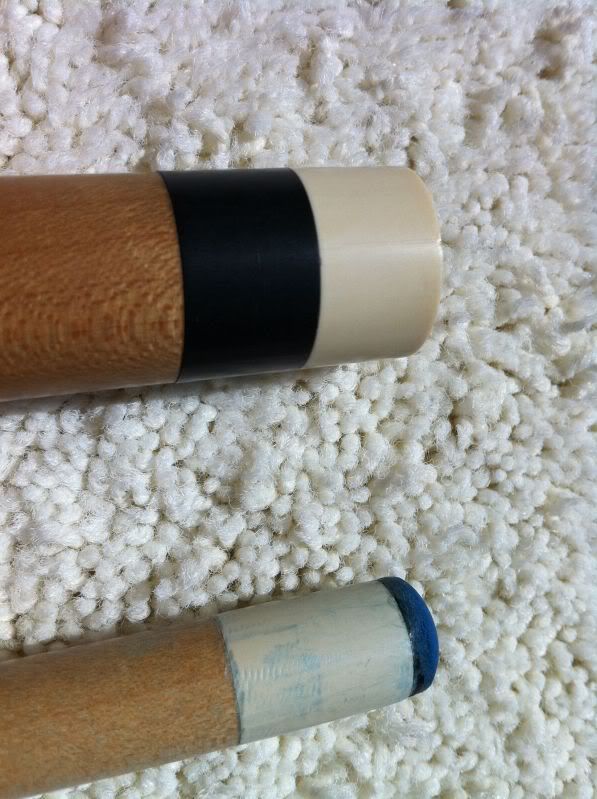


It's hard to tell what the ferrule is, it's so scuffed up. I'd love to add some weight to the butt. It plays good now, but I like the heavy cues. If I could find some old shaft wood I'd have a new shaft made.
Thanks for your help.
Monte
It's very odd indeed, Dale.
Well, we can assume that since Monte's cue has Titlist markings and since Titlists were one piece cues, this wasn't a factory job. As far as Brunswick joints, the only factory examples screws I've run into are:
- The Willie Hoppe's which are brass 5/14 X 14 piloted, sharp head, scew in the handle side. Brass or rarely a phenolic joint collar.
- 1930's and earlier brass 5/16X18 flat faced or piloted, screw in the shaft, brass, fiber, phenolic, ivory or horn collars.
- 1930's and earlier, a 3/8 X 10 aluminum flat faced or piloted, screw in the shaft, fiber, phenolic, ivory or horn collars.
If you scroll down through the 1928 cues in this link below, it shows a pretty clear picture of each joint type. I pretty much have them all in different cues, so I can tell you the photo is pretty accurate.
http://www.palmercollector.com/Brunswick/BruswickCollectorColorPlates.html
Even though it seems like a stretch, it's possible your cue and this cue of Monte's were converted by the same guy. Does your cue have a weight stamp in the butt area? All old Brunswick's (except the very earliest) will have a weight stamp in the butt. Sometimes it's hard to see it but it's about 2 inches from the bottom.
Generally Brunswicks with butterflys were older cues. If you notice in the 1928 catalog, the butterfly cues with multi colored veneers are gone (except the 360). Those double butterflys with veneers would be a cue from prior to 1920 or so.
Your butterfly could be a Katz or soimething like that converted by the same guy.
I checked my Eddie Laube and Burton Spain joints - 2 cue makers who liked putting screws on the shaft side - and they both used different screws than the one on Monte's cue.Below is a picture of a Katz butterfly.
Chris
Curiouser and curiouser, my cue seems to have a 5/16 x12 brass pin with
the typical non-threaded shoulder. I have 2 double butterfly cues with
the same pin.
Rather than hijack this thread, I will put some more info/conjecture/questions in a PM.
Dale