How to Connect our Mind and Body Directly to the Game of Pool.

CJ Wiley

ESPN WORLD OPEN CHAMPION
Gold Member
Silver Member
We experience the game through the cue and tip, the entire body (not just the upper body) is what influences the tip. One thing that is overlooked is a technique to connect the player's "self" synergistically to the tip.

This may sound challenging, and I assure you it does take practice once you understand how it works. The reward is it develops a potential that may otherwise be impossible in just a few weeks. Basically you want to practice a systematic way that allows the tip to work in conjunction with your entire body, opening the door to a whole new dimension of pool. Although this is advanced I believe it's important for anyone to be exposed to.

To bond this connection the tip must act as a reflection of what the back-hand is doing (when the back hand moves up the tip moves down {like a see/saw} for instance).....the back-hand must be a reflection of what the wrist, arm and shoulder are doing......and the wrist, arm and shoulder must operate as a reflection of what the hips, legs, head/eyes, and feet are doing (when the legs and hips move away from the cue ball the head, chest and shoulder/arm moves towards the cue ball).

When this chain is created suddenly the players is connected completely to the tip and therefore to the physical game. Only at this level can one perform at their top mental potential. The cue ball will actually create exactly what we "think" it will do. This is what is sometimes called "The Zone," or "Dead Stroke"....with practice this will become a part of your subconscious mind - we will actually be developing a "6th Sense" of understanding the game and more importantly ourselves.

This is certainly advanced, however, if the player knows how it's done they can learn to do it relatively quickly......actually it's easier for beginning players to learn because they won't have to re-train their bodies to perform this synchronization, they can learn it from the start with clear, concise directions. 'The Game is the Teacher' www.cjwiley.com
 
I was thinking something similar today whilst shopping. Which part of the anatomy is most important for playing pool?

Without being obvious and without oversight I concluded the eyes and how we use them are the most important...
:thumb up:

What u say?
 
I see the idea of moving something to get an equal and opposite "reflection", because this is the way I've been working on dropping down into the shot. It is a very balanced method that lets me employ the larger leg and hip muscles instead of my back. This really helps in the fatigue category and puts my head completely on the shot line from the start of my aiming to when my bridge hand hits the cloth.

With this thought in mind, how do I connect my tip to all that? The closest I come is by chalking and looking at it to see if I did a good job. I've already tried to "be the cue ball", but every time my head ran into an object ball, it hurt! :grin-square:

Seriously though, you mentioned this several times before, but didn't follow up with any further food for thought. I'd like to hear more .Thanks.

Best,
Mike
 
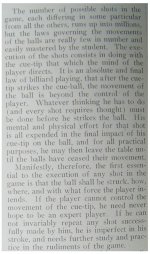
Neil, you'll notice that the first sentence is very similar to something you posted recently...

The rest applies to what CJ said about the tip...

1913 Billiards Mag Prof LW Perkins.JPG

Published by famed instructor L.W. Perkins, formerly of the Wyatt Earp posse.
1913
 
Neil, you'll notice that the first sentence is very similar to something you posted recently...

The rest applies to what CJ said about the tip...

View attachment 345302

Published by famed instructor L.W. Perkins, formerly of the Wyatt Earp posse.
1913

I, and most of the instructors have said the rest of what is in that article also. It is about controlling the tip. Controlling where it hits the cb. Not just what side of the cb you hit.;)
 
I, and most of the instructors have said the rest of what is in that article also. It is about controlling the tip. Controlling where it hits the cb. Not just what side of the cb you hit.;)

Controlling which side it hits takes out half of your misses... I am working very hard to get the contact patch to within 1mm of where I intend but if I am using dead center missing left 1mm may be fraught with peril where missing right would keep me golden.... Aiming half tip left or half tip right gives me a huge margin of error for contact... At half tip going straight thru any cut over 10 degrees will cancel any spin I had on the ball from transfer and I get a centerball tangent....

Won't work all the time but if your shooting 60% of your shots this way while your opponent isn't you'll be way tougher to fade since rote always beats conscious thought over the long run... In the zone is all about autopilot...

Chris
 
Controlling which side it hits takes out half of your misses... I am working very hard to get the contact patch to within 1mm of where I intend but if I am using dead center missing left 1mm may be fraught with peril where missing right would keep me golden.... Aiming half tip left or half tip right gives me a huge margin of error for contact... At half tip going straight thru any cut over 10 degrees will cancel any spin I had on the ball from transfer and I get a centerball tangent....

Won't work all the time but if your shooting 60% of your shots this way while your opponent isn't you'll be way tougher to fade since rote always beats conscious thought over the long run... In the zone is all about autopilot...

Chris

What are you calling a "tip of english"? I, and many other instructors, call a tip as 3mm. Same size as the inner circle of a red circle cb. So, then a half tip would only be 1.5mm.

If you are referring to a tip as 13mm, then a half tip would be 6.5mm. That is quite a bit of english. That would be two tips of english for me. I seldom need that much when wanting to spin the ball.

No offense, but if anyone is hitting that far out on the cb, and killing the spin just from CIS, they really need to work on their stroke. Likewise, if they are referring to just 3mm as a tip, then they are hitting with 1.5mm accuracy on using a half tip of english. Just a hair more accuracy, and you are at the goal of 1mm accuracy and don't need to use toi on every shot. TOI is great when the situation calls for it. And, has been around for many, many years. But, one should always strive for accuracy, and then use what the shot calls for. If you stay within 1mm of center, either side, you will have a "flat" cb coming off the ob for all practical purposes on most angles.
 
1.5mm=half tip

I aim half tip left... 1.5mm and I miss right 1mm I still am .5mm left... I miss left 1mm I am now 2.5mm left....

I aim dead center... I miss left 1mm... I am now 1mm left,, I miss right 1mm I am now 1mm right...

One can cross you over one cannot... The subterfuge about a tip being 13mm was good filler but you know better.....
 
Controlling which side it hits takes out half of your misses... I am working very hard to get the contact patch to within 1mm of where I intend but if I am using dead center missing left 1mm may be fraught with peril where missing right would keep me golden.... Aiming half tip left or half tip right gives me a huge margin of error for contact... At half tip going straight thru any cut over 10 degrees will cancel any spin I had on the ball from transfer and I get a centerball tangent....

Won't work all the time but if your shooting 60% of your shots this way while your opponent isn't you'll be way tougher to fade since rote always beats conscious thought over the long run... In the zone is all about autopilot...

Chris
Can you accurately consciously decide on the 1 mm target and speed needed to send the cue ball exactly where you want it... even if you had a robot to execute your shot perfectly?

I don't know of anyone who consciously decides on a 1 mm target. I think pretty much all the pros just know "a little low outside (or whatever) on this shot" and the calculations from there are subconsciously obtained from the picture of the shot that they hold in their mind along with hrs and hrs of practice. I don't think even the best pros can pinpoint a 1mm target and speed consciously. The 1 mm accuracy makes for a great book but not very practical imo.
 
Last edited:
Mojo?


Lets use in a sentence.

I put a half tip of Top Right Mojo on it and helped it in the hole, then I went two rails around toward the opposite corner pocket.

Top Right Mojo= TRM

Not bad at all any other suggestions?
 
We experience the game through the cue and tip, the entire body (not just the upper body) is what influences the tip. One thing that is overlooked is a technique to connect the player's "self" synergistically to the tip.

This may sound challenging, and I assure you it does take practice once you understand how it works. The reward is it develops a potential that may otherwise be impossible in just a few weeks. Basically you want to practice a systematic way that allows the tip to work in conjunction with your entire body, opening the door to a whole new dimension of pool. Although this is advanced I believe it's important for anyone to be exposed to.

To bond this connection the tip must act as a reflection of what the back-hand is doing (when the back hand moves up the tip moves down {like a see/saw} for instance).....the back-hand must be a reflection of what the wrist, arm and shoulder are doing......and the wrist, arm and shoulder must operate as a reflection of what the hips, legs, head/eyes, and feet are doing (when the legs and hips move away from the cue ball the head, chest and shoulder/arm moves towards the cue ball).

When this chain is created suddenly the players is connected completely to the tip and therefore to the physical game. Only at this level can one perform at their top mental potential. The cue ball will actually create exactly what we "think" it will do. This is what is sometimes called "The Zone," or "Dead Stroke"....with practice this will become a part of your subconscious mind - we will actually be developing a "6th Sense" of understanding the game and more importantly ourselves.

This is certainly advanced, however, if the player knows how it's done they can learn to do it relatively quickly......actually it's easier for beginning players to learn because they won't have to re-train their bodies to perform this synchronization, they can learn it from the start with clear, concise directions. 'The Game is the Teacher' www.cjwiley.com

Oh wow, good thing I read this. From the title it looked like CJ was going to combine pool with yoga.
 
So aiming center, the most you would be off is 1mm on either side.

Aiming off center, you could be off as much as 2.5mm on one side. Explain how that's better.

It's not and if you've been paying attention then you know many people have pointed this out in the past. Heck, I even tried to point this out. I think PJ most clearly pointed out the fallacy of creating a larger "margin for error". This was before he was banned of course. You can't really do it. Plus I think it's a bit counter productive to even try. After all we are humans and for me at least -- it's feels instinctive to aim for the center of the pocket. Why fight against this when you don't have to?
 
familiarize yourself with the deeper levels of pool and they will be revealed asap

Actually I can create a larger margin of error in the same way tennis players do it with topspin and golfers do it with "drawing and fading" the golf ball. We call these "zones" and it's vital to recognize how to create "approach angles" to relate and utilize these advanced techniques.

If you can't grasp what I'm saying, simply put it on a shelf, and make it available for the future. Communication is the beginning of understanding, in person these techniques can be demonstrated, explained and conceptualized rapidly......in writing it takes the willingness to open your mind to accept the new information.

"We can only recognize what we're familiar with - familiarize yourself with the deeper levels of pool and they will be revealed" - CJ Wiley 'The Game is the Teacher'


It's not and if you've been paying attention then you know many people have pointed this out in the past. Heck, I even tried to point this out. I think PJ most clearly pointed out the fallacy of creating a larger "margin for error". This was before he was banned of course. You can't really do it. Plus I think it's a bit counter productive to even try. After all we are humans and for me at least -- it's feels instinctive to aim for the center of the pocket. Why fight against this when you don't have to?
 
this is how zones are created - the knowledge has been around for many years

It's not about distance silly, TOI is about eliminating one side of the cue ball so you always cut the object ball slightly more.....this is how zones are created - the knowledge has been around for many years (not to suckers) ;)......it's just been kept "under wraps" in pocket billiards...until now. 'The Game is now the Teacher'


So aiming center, the most you would be off is 1mm on either side.

Aiming off center, you could be off as much as 2.5mm on one side. Explain how that's better.
 
Back
Top