I have a cue with a SS joint with a brass pilot protruding out of shaft. My main question is if the pilot isn't the same diameter as the recessed part in butt, does it do anything for stability or alignment? The pilot is a solid MM smaller than the pocket and doesn't touch the bottom of pocket either. This just seems like wasted surface area to me. If I am wrong please correct me. If I'm correct, what should I do?, have a custom shaft built?

You are using an out of date browser. It may not display this or other websites correctly.
You should upgrade or use an alternative browser.
You should upgrade or use an alternative browser.
piloted joint question.
- Thread starter BaliFlipper
- Start date

Some makers have specially fitted joints that provide a snug fit, but on most of the standard piloted shafts I've seen, the pilot doesn't touch the joint at all. Most of the aftermarket shafts (Predator, etc) tend to have very small pilots so that they will fit a wider variety of cues.
Nothing to worry about really, imo.
Nothing to worry about really, imo.
I have a cue with a SS joint with a brass pilot protruding out of shaft. My main question is if the pilot isn't the same diameter as the recessed part in butt, does it do anything for stability or alignment? The pilot is a solid MM smaller than the pocket and doesn't touch the bottom of pocket either. This just seems like wasted surface area to me. If I am wrong please correct me. If I'm correct, what should I do?, have a custom shaft built?
Balabushka's shaft tab didn't touch the ID of the joint collar, and some people think he
made a pretty fair cue.
'Wasted surface area' vs 'unnecessary contact' 6 of one...
Dale
Fair point. I guess I'm over thinking , like usual. I have no problem with cue, its hits great. As a craftsman I was curious.
Sent from my Nexus 4 using Tapatalk
Sent from my Nexus 4 using Tapatalk


I have a cue with a SS joint with a brass pilot protruding out of shaft. My main question is if the pilot isn't the same diameter as the recessed part in butt, does it do anything for stability or alignment? The pilot is a solid MM smaller than the pocket and doesn't touch the bottom of pocket either. This just seems like wasted surface area to me. If I am wrong please correct me. If I'm correct, what should I do?, have a custom shaft built?
I think technically if you looking for a reason there is one that applies. I don't know if this is in the minds of the cuemakers but you would get a better and more consistent fit if there is some screw left after the joint has closed. In this kind of connection you don't what the screw to bottom out and maybe not have the rest of the joint completely seated.
This would also be the case even with a piloted joint that had a tight fit on the sides of the extended piece on the shaft going into the butt. You don't want it to bottom out. With a flat faced joint when the joint tightens the area just under the screw has to make contact exactly at the same time with the rest of the facing area.
If it does not, and makes contact first, the rest of the joint will not be equally tightened and you could have a joint that buzzed. In other words, the small center area at and around the screw may be tight and you could in an extreme case have some part of the rest facing area of the joint not even making contact at all.
By having a pilot, or even just a divot on say a flat faced joint you are assured it is the surface of the joint closing and the screw has not bottomed out preventing complete closing. Also leaving a little screw thread unused if additional tightening if necessary.
I think you will find this even in the case of just attaching a leg to a table. In that case though instead of a pilot you usually find the insert is recessed and when the leg is tightened there is some unused threads that allow additional tightening if needed.
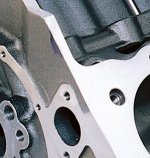
Look at the attached picture of an engine block and you will find the same theory in use.
Like I said, this may not be exactly what is in the minds of a cuemaker but it is what is happening and it's a good thing.
Thats my 2 cents anyway.
Attachments
Last edited:
Why make a piloted joint if it's not gonna fit snugly? That doesn't make all that much sense to me. I have to imagine that an incorrect fit will disturb the playability of the cue. Maybe not all that much but still.
In the days of Rambow and Martin, cues were made on what was essentially a
specialized wood lathe. They were turned by hand with chisels, so it took some
extra elements to produce a 2 piece cue that was straight when screwed together.
Once metal lathes became the norm, these tricks of the trade were no longer needed.
When is the last time you heard someone complain about the playability of his
Balabushka?
FWIW - the cues in YOUR logo have piloted SS joints with tabs that don't touch
the joint collar.
Dale(always the trickey tradester)
Last edited:

I think technically if you looking for a reason there is one that applies. I don't know if this is in the minds of the cuemakers but you would get a better and more consistent fit if there is some screw left after the joint has closed. In this kind of connection you don't what the screw to bottom out and maybe not have the rest of the joint completely seated.
This would also be the case even with a piloted joint that had a tight fit on the sides of the extended piece on the shaft going into the butt. You don't want it to bottom out. With a flat faced joint when the joint tightens the area just under the screw has to make contact exactly at the same time with the rest of the facing area.
If it does not, and makes contact first, the rest of the joint will not be equally tightened and you could have a joint that buzzed. In other words, the small center area at and around the screw may be tight and you could in an extreme case have some part of the rest facing area of the joint not even making contact at all.
By having a pilot, or even just a divot on say a flat faced joint you are assured it is the surface of the joint closing and the screw has not bottomed out preventing complete closing. Also leaving a little screw thread unused if additional tightening if necessary.
I think you will find this even in the case of just attaching a leg to a table. In that case though instead of a pilot you usually find the insert is recessed and when the leg is tightened there is some unused threads that allow additional tightening if needed.
Look at the attached picture of an engine block and you will find the same theory in use.
Like I said, this may not be exactly what is in the minds of a cuemaker but it is what is happening and it's a good thing.
Thats my 2 cents anyway.
Maybe I'm just thick, but I just read your whole post three times and couldn't make heads or tails out of it.
And they tell me I'm supposed to know something about threaded fastening.
Freddie

Maybe I'm just thick, but I just read your whole post three times and couldn't make heads or tails out of it.
And they tell me I'm supposed to know something about threaded fastening.
Freddie
Yea I thought about that when I wrote it. In essence having the screw pull from the center downward and all the contact points more on the perimeter of the shaft is better. makes for a better more consistent connection.
The whole thing is, to not have the screw run out of threads before the connection is fully seated. The nipple on the insert on the shaft is not really required it could be flat, just as long as some space is left after the joint has closed at the screw so it doesn't interfere with a solid connection. maybe someone else can phrase it better.
I thought the engine block was a good visual but I guess not.
Last edited:
I have been told by a good cue maker that all the pilot does is provide more length for the pin to screw into. longer contact area.
Although true that can be accomplished with just a longer screw if that is what you want.
Ok some great info there Mac. Thanks. I'm always trying to learn something new.
Now here's another idea. If the the diameter of the pilot was, say .001 or so smaller than the pocket diameter would this cause a vacuum effect keeping it from seating properly? With that said, could I flute the side of the pilot on shaft to fix this?
And on the bottoming out part. What if I made the pocket .5 inches deep, and the pilot .49 inches long, and added a flexible, gasket type material to bottom of pocket that was slightly thicker than the difference, so that when you hit the gasket i could still get maybe a full turn to seat the faces, but not bottoming out as you said. Would this be pointless or would it make for a solid connection.
I'm always over building what I make. Can't figure out why I do this, but I feel you can't craft something that is "too good".
Sent from my Nexus 4 using Tapatalk
Now here's another idea. If the the diameter of the pilot was, say .001 or so smaller than the pocket diameter would this cause a vacuum effect keeping it from seating properly? With that said, could I flute the side of the pilot on shaft to fix this?
And on the bottoming out part. What if I made the pocket .5 inches deep, and the pilot .49 inches long, and added a flexible, gasket type material to bottom of pocket that was slightly thicker than the difference, so that when you hit the gasket i could still get maybe a full turn to seat the faces, but not bottoming out as you said. Would this be pointless or would it make for a solid connection.
I'm always over building what I make. Can't figure out why I do this, but I feel you can't craft something that is "too good".
Sent from my Nexus 4 using Tapatalk
IMO, a pilot is intended to locate/align the outer diameters of each component. With sloppy v-threads the shaft will settle off to one side or the other as it seats. A pilot prevents this. If the pilot is as sloppy fitting as the threads, then it's a pointless aspect of the joint design. If the joint pin isn't installed on center or straight, a good fitting pilot will still pull the shaft to center. There are many ways a pilot 'could' mask or negate issues associated with sloppy machining and ill fitting parts, but with good machining practices a pilot is unnecessary, IMO.
All that said, some cue makers use piloted joints for nostalgic purposes, with a few even believing a good fitting pilot enhances solidarity of the joint as well as enhancing playability. Kinda like bigfoot, I'm not convinced but then again wouldn't be surprised to find out it's true. At least there's some food for thought with that situation. With sloppy fitting pilots, there's no purpose.
All that said, some cue makers use piloted joints for nostalgic purposes, with a few even believing a good fitting pilot enhances solidarity of the joint as well as enhancing playability. Kinda like bigfoot, I'm not convinced but then again wouldn't be surprised to find out it's true. At least there's some food for thought with that situation. With sloppy fitting pilots, there's no purpose.
Ok some great info there Mac. Thanks. I'm always trying to learn something new.
Now here's another idea. If the the diameter of the pilot was, say .001 or so smaller than the pocket diameter would this cause a vacuum effect keeping it from seating properly? With that said, could I flute the side of the pilot on shaft to fix this?
And on the bottoming out part. What if I made the pocket .5 inches deep, and the pilot .49 inches long, and added a flexible, gasket type material to bottom of pocket that was slightly thicker than the difference, so that when you hit the gasket i could still get maybe a full turn to seat the faces, but not bottoming out as you said. Would this be pointless or would it make for a solid connection.
I'm always over building what I make. Can't figure out why I do this, but I feel you can't craft something that is "too good".
Sent from my Nexus 4 using Tapatalk
:wink:
You got to stop now. A machinist works with closer tolerances than cue makers.
You keep it up and you will confuse some people.
Alrighty. Will do. In my defense, a lathe is a machine. I'm just a creative thinker I guess. I believe these tolerances could be accomplished with a lathe and a good set of calipers and depth gauge.
Sent from my Nexus 4 using Tapatalk
Sent from my Nexus 4 using Tapatalk
Last edited:
Alrighty. Will do. In my defense, a lathe is a machine. I'm just a creative thinker I guess. I believe these tolerances could be accomplished with a lathe and a good set of calipers and depth gauge.
Sent from my Nexus 4 using Tapatalk
The intent of the pilot is to have intimate contact to keep the shaft and butt concentric. From an historical standpoint, today's precision machining and engineering tolerances of screw fits, pilots are not necessary to keep things concentric. However, in days where the fit of the screw to the fit of the female thread was not so precise (please look up Machinist's Handbook for scrw fits), then a pilot that seated into a counterbore was a necessary item.
The Schuler and the Lambros joints were developed to keep that intimate contact over time. Many of the old-school pilot designs seem to wear down to the point of non-contact. But the intent was to have contact, according to those that know (not me).
I think newer pilots that don't have that contact are there for show.
Freddie <~~~ my own background and opinion.

imo, a pilot is intended to locate/align the outer diameters of each component. With sloppy v-threads the shaft will settle off to one side or the other as it seats. A pilot prevents this. If the pilot is as sloppy fitting as the threads, then it's a pointless aspect of the joint design. If the joint pin isn't installed on center or straight, a good fitting pilot will still pull the shaft to center. There are many ways a pilot 'could' mask or negate issues associated with sloppy machining and ill fitting parts, but with good machining practices a pilot is unnecessary, imo.
All that said, some cue makers use piloted joints for nostalgic purposes, with a few even believing a good fitting pilot enhances solidarity of the joint as well as enhancing playability. Kinda like bigfoot, i'm not convinced but then again wouldn't be surprised to find out it's true. At least there's some food for thought with that situation. With sloppy fitting pilots, there's no purpose.
^^^^this^^^^

Tascarella
I have owned my Tascarella for four years, and when assembling the cue, in the last 3/4 turn, you can feel the pilot grab the SS joint. It has not changed or wore down at all since I have owned it, and I believe it is intentional for what some describe as a compression fit.
I also owned a Black Boar and the fit was the same, Tony told me it was supposed to be this way, the last turn the pilot grabs the inside of the joint.
I have also owned other SS jointed cues in which this was not the case.
-dj
I have owned my Tascarella for four years, and when assembling the cue, in the last 3/4 turn, you can feel the pilot grab the SS joint. It has not changed or wore down at all since I have owned it, and I believe it is intentional for what some describe as a compression fit.
I also owned a Black Boar and the fit was the same, Tony told me it was supposed to be this way, the last turn the pilot grabs the inside of the joint.
I have also owned other SS jointed cues in which this was not the case.
-dj
I have a cue with a SS joint with a brass pilot protruding out of shaft. My main question is if the pilot isn't the same diameter as the recessed part in butt, does it do anything for stability or alignment? The pilot is a solid MM smaller than the pocket and doesn't touch the bottom of pocket either. This just seems like wasted surface area to me. If I am wrong please correct me. If I'm correct, what should I do?, have a custom shaft built?
I'm new to pool so I only know what I've read on AZBilliards.
Based on what I've learned, if it's a custom cue you should be happy that you received a cue at all.
If you send the cue to a repair shop you will either 1) never see it again (although your check will be cashed) or 2) after 11 months you'll get it back...warped, nicked and with a broken ferule.
AZBilliards has been a wealth of information!
:wink:
You got to stop now. A machinist works with closer tolerances than cue makers.
You keep it up and you will confuse some people.
In the case of a cue they can be changing tolerances, because you are working with wood. Dennis Searing make a piloted joint (I don't know if he always does) that as you screw the cue together is almost a press fit is is so tight. I had a guy bring me his Searing cue and he could not screw it together.
The wood of the pilot had swollen a tiny bit. I told him that if I took it down then in a different environment it may shrink again and then be loose. I refused to do it and suggested he send it to Dennis. He was kind of annoyed that he could not play with his cue and I got the impression he was going to take some sand paper and do it himself.
Schuler cues have a joint that has in it's design has a tight fit with an aluminum extended piece in the shaft. Some believe this makes for a more stable joint and they may be right. You can take most cues and screw them together and if you hold them up to a light and put some force on one side of the shaft it will open up a gap in the joint a tiny bit on that side.
This may even happen as you play and hit a shot hard with spin. It would be impossible to detect though and maybe not happen at all due to the force being absorbed by the shaft.