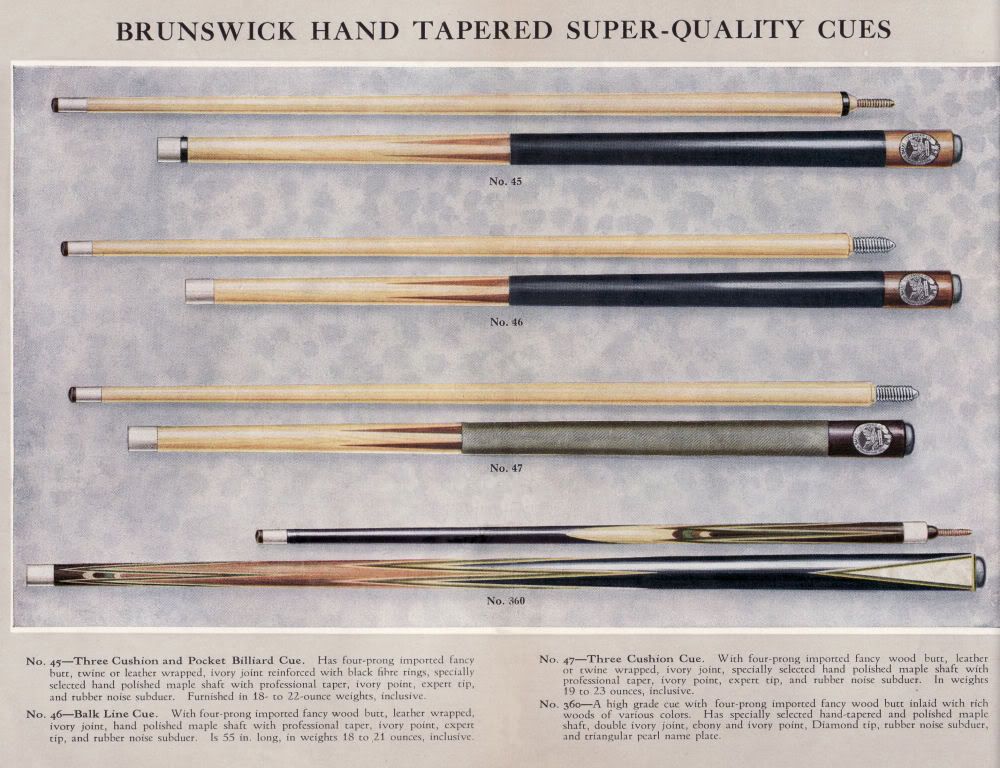
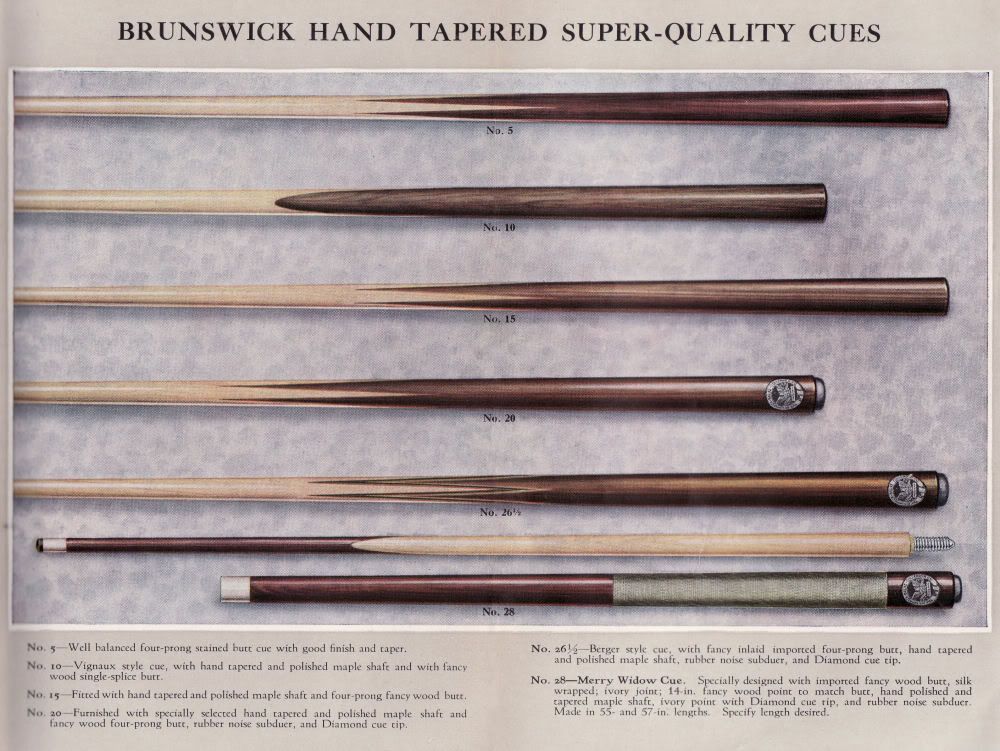
Preview of the Brunswick Collector

TATE

AzB Gold Mensch
Silver Member
I've been gathering information for this for over a year. It will be a web site containing information about older Brunswick cues and other products. I plan on having some of it ready to publish by the end of the year. There will be a lot of antique catalog items, cues, tables, all sorts of things.

Here is a brief sample of some rare color plates from an original 1914 catalog and a 1928 catalog. Once you're on the page, just scroll down.


http://www.palmercollector.com/Brunswick/BruswickCollectorColorPlates.html
 
Chris...i retouched your first two photos and got rid of the crease in the middle of the pages. i just thought you might like that done. if you want, when i get some time, i'll see if i can do the others as well. here are the pics. just right click as "save image as".


Brunswick_1928-2.jpg


Brunswick_1928-1.jpg
 
skins said:
Chris...i retouched your first two photos and got rid of the crease in the middle of the pages. i just thought you might like that done. if you want, when i get some time, i'll see if i can do the others as well. here are the pics. just right click as "save image as".

Great job! Thanks, I will use those.

Chris
 
You're a Funny Guy

jazzn4444 said:
If only I could get a few of those for the original price...


No matter what your girlfriends may say Jazz.....you really do have a sense of humor -- or something :eek: :D :p :rolleyes: :)

I still love that silly hat too :p
 
Last edited:
Excellent Site & Idea!!!

skins said:
Chris...i retouched your first two photos and got rid of the crease in the middle of the pages. i just thought you might like that done. if you want, when i get some time, i'll see if i can do the others as well. here are the pics. just right click as "save image as".


Brunswick_1928-2.jpg


Brunswick_1928-1.jpg


Excellent site idea and the information looks great as always Chris! Best of luck with your new adventure! :)
 
TATE said:
I've been gathering information for this for over a year. It will be a web site containing information about older Brunswick cues and other products. I plan on having some of it ready to publish by the end of the year. There will be a lot of antique catalog items, cues, tables, all sorts of things.

Here is a brief sample of some rare color plates from an original 1914 catalog and a 1928 catalog. Once you're on the page, just scroll down.


http://www.palmercollector.com/Brunswick/BruswickCollectorColorPlates.html

Hello Chris, I have a around 200 antique Brunswick cues, from the 1880's to the 1940's. I would be glad to contribute photo's for your site, if you are interested please let me know.

By the way, I think you have a great idea that will really be a service to collectors world wide, and for that I applaud you!!!!!

Have a good night!!!
 
manwon said:
Hello Chris, I have a around 200 antique Brunswick cues, from the 1880's to the 1940's. I would be glad to contribute photo's for your site, if you are interested please let me know.

By the way, I think you have a great idea that will really be a service to collectors world wide, and for that I applaud you!!!!!

Have a good night!!!

Craig,

Very much interested. I will be needing pics and it will be especially helpful if the cues can be identiified with model number and years. I have some pretty unusual catalogs too, the earliest being 1908.

These color plates, especially of the older cues, are helpful because it makes the cue ID easier and more positive. My e-mail is palmercollector@aol.com .

I've gone about as far as I can on the Palmer's now, so it's time to put some effort into Brunswick. It's one of those kind of things where the information is there, it just needs to be compiled.


Chris

ps. I learned something interesting from the 1908 catalog. Some of the shafts that are ebony or purpleheart spliced on the ends are actually repair jobs. When a shaft got worn out or warped, Brunswick offered the service of splicing a new end onto it. For a one piece cue, that's not a bad idea!
 
Last edited:
The site continues to grow with tons of information.
Great stuff and lots of work.
Appreciate the effort.

Myron
 
Funny story.....about 15 years ago I did a cue repair for a local and when it came time to pick up the cue, he was short about $50. I told him I had to get paid in full before turning over the cue. He said he had an old cue that he would be willing to trade for the balance due. It turned out to be a one piece 360 in very nice condition with a 90% decal. At that time, I had never seen a cue like this and told him I had rather have the money. When it looked like I wasn't going to get paid, I finally took the cue and told him not to contact me for any more cue repair. When the first edition of the Billiard Encyclopedia came out, I then realized I did OK on the trade.
 
Jack Justis said:
Funny story.....about 15 years ago I did a cue repair for a local and when it came time to pick up the cue, he was short about $50. I told him I had to get paid in full before turning over the cue. He said he had an old cue that he would be willing to trade for the balance due. It turned out to be a one piece 360 in very nice condition with a 90% decal. At that time, I had never seen a cue like this and told him I had rather have the money. When it looked like I wasn't going to get paid, I finally took the cue and told him not to contact me for any more cue repair. When the first edition of the Billiard Encyclopedia came out, I then realized I did OK on the trade.

I sure hope you kept that cue, Jack! I still do not have one for an example, but I can keep my hopes up. They have been scarace for many years now, but you never know...maybe if a good deal comes up...Jack, if you still have it, I would appreciate some pictures.

Chris
 
alpine9430 said:
The site continues to grow with tons of information.
Great stuff and lots of work.
Appreciate the effort.

Myron

Myron, Jim S, everybody,

It's only the comments like this that make it worthwhile. It's going to be a very involved site but there's no sense in releasing too much in bits and pieces.


Chris
 
TATE said:
Craig,

Very much interested. I will be needing pics and it will be especially helpful if the cues can be identiified with model number and years. I have some pretty unusual catalogs too, the earliest being 1908.

These color plates, especially of the older cues, are helpful because it makes the cue ID easier and more positive. My e-mail is palmercollector@aol.com .

I've gone about as far as I can on the Palmer's now, so it's time to put some effort into Brunswick. It's one of those kind of things where the information is there, it just needs to be compiled.


Chris


ps. I learned something interesting from the 1908 catalog. Some of the shafts that are ebony or purpleheart spliced on the ends are actually repair jobs. When a shaft got worn out or warped, Brunswick offered the service of splicing a new end onto it. For a one piece cue, that's not a bad idea!

I totally Agree with this the below statement Chris:

ps. I learned something interesting from the 1908 catalog. Some of the shafts that are ebony or purpleheart spliced on the ends are actually repair jobs. When a shaft got worn out or warped, Brunswick offered the service of splicing a new end onto it. For a one piece cue, that's not a bad idea.


I have also done some research on this subject. While Herman Rambow started working for Brunswick as a mail boy sometime in the 1890's it was not long before he had switched to the cue making department of Brunswick. Sometime before 1910 Herman started a cue repair department for Brunswick which became a very profitable department. In this department they would repair cues that were broken for their customers at half the price of a new cue.

Chris, I have found many examples of cues that were sent back to Brunswick for repair, and I am also certain that imported cues were also repaired, which after repair were given a Brunswick label. Now it is common knowledge the older plain cues (Pre or early 1900) without veneering on the points commonly had wedges machined into the bottom of the cues. Throughout the last five years I have begun to notice cues with Brunswick labels from the 20's and 30's with single or even multiple wedges on their bottoms. Another factor are the number punches used for weight identification, on the very early cues these are normally found in the cues wedge at the bottom of the cue. Also on cues made in the 1920's the weight stamp numbers are very neat in most cases and uniform, on the older cues they were hand stamped without care to alignment or even the size of the stamps used. Last of all, I have also found that the weight stamps were not changed after repairs. I have found cues that up too two oz less than the stamped weight.

I hope this helps, and I will start putting together some photo's for you!

Have a good night Chris!
 
Last edited:
manwon said:
I totally Agree with this the below statement Chris:

ps. I learned something interesting from the 1908 catalog. Some of the shafts that are ebony or purpleheart spliced on the ends are actually repair jobs. When a shaft got worn out or warped, Brunswick offered the service of splicing a new end onto it. For a one piece cue, that's not a bad idea.


I have also done some research on this subject. While Herman Rambow started working for Brunswick as a mail boy sometime in the 1890's it was not long before he had switched to the cue making department of Brunswick. Sometime before 1910 Herman started a cue repair department for Brunswick which became a very profitable department. In this department they would repair cues that were broken for their customers at half the price of a new cue.

Chris, I have found many examples of cues that were sent back to Brunswick for repair, and I am also certain that imported cues were also repaired, which after repair were given a Brunswick label. Now it is common knowledge the older plain cues (Pre or early 1900) without veneering on the points commonly had wedges machined into the bottom of the cues. Throughout the last five years I have begun to notice cues with Brunswick labels from the 20's and 30's with single or even multiple wedges on their bottoms. Another factor are the number punches used for weight identification, on the very early cues these are normally found in the cues wedge at the bottom of the cue. Also on cues made in the 1920's the weight stamp numbers are very neat in most cases and uniform, on the older cues they were hand stamped without care to alignment or even the size of the stamps used. Last of all, I have also found that the weight stamps were not changed after repairs. I have found cues that up too two oz less than the stamped weight.

I hope this helps, and I will start putting together some photo's for you!

Have a good night Chris!

Very interesting. Maybe we can put together some of these mystery's. The earliest decent color copies I have so far are in the 1914 catalog. The 1908 shows the various models but they're just drawings.

In the 1908 catalog, I was surprised to see they offered a "screw-on" tip. Actually, they called tips "points". The tip looks like it has a short tapped ivory ferrule that screws into a larger fixed ferrule.

In the book, they also offer that any cue can have a "name plate" (wedge) or an ivory joint added. I figured as much from the cues I've seen.

I'll scan in some of the 1908 book pages for kicks and post them here later.

Chris
 
Last edited:
Back
Top