Question about Veneers

Gmanpoke

Banned
A couple of weeks ago, a friend and I had a healthly conversation about veneer work. The cue we were discussing had a box or window in the butt sleve with veneer work.

Would mitered veneer work represent an elevated level of craftmenship?

Also, if the veneer work is mitered at the corners would you expect to see space between the vertical and horizontal veneers. And, when I say space picture approximately a 1/16 of an inch. In addition, the space is not uniform from corner to corner.

I'm not trying to dog someone's work, I just want to understand the level of detail and craftmenship I should expect in higher end cues.

Thanks in advance

Steven
 
Not so true , old school is offset and solid construction . Mitered looks better , cleaner line . I'm old school , it's all about the wood . Depending on technique how much wood you waste .:eek:
 
Now, I've ever done mitered windows.....but a 1/16" gap in the corners is a big gap. I can't think of an excuse to have gaps like that.....sounds like the veneers were cut b/f the window pocket was created and it came up short.

if i'm understanding your description correctly
 
Now, I've ever done mitered windows.....but a 1/16" gap in the corners is a big gap. I can't think of an excuse to have gaps like that.....sounds like the veneers were cut b/f the window pocket was created and it came up short.

if i'm understanding your description correctly

I'm not a cue maker so I really don't know how/when the veneers are cut. But, your explanation seems very reasonable to me.

I wonder if the cue maker tried to cut miter the veneers after the pocket was created and just could not get them tight against one another? And, since he could not create a tight fit, he decided to create a design with a gap between the vertical and horizontal veneers. Again, the gaps are not uniform from one corner to another. 1/16" maybe an exaggeration, but hey, my wife says I don't know what 10" is anyway (but thats another story).

In any event, there is a very pronounced gap at each corner where the vertical and horizontal veneers do not meet up.

So, in your opinion, I should not necessarly expect mitered veneers on high end cues?

Thanks for input.

Steven
 
If the boxes have a uniform .0675 gap at every corner they might have been designed that way. The miters should be uniform as well, lining up if the gap was not there.
 
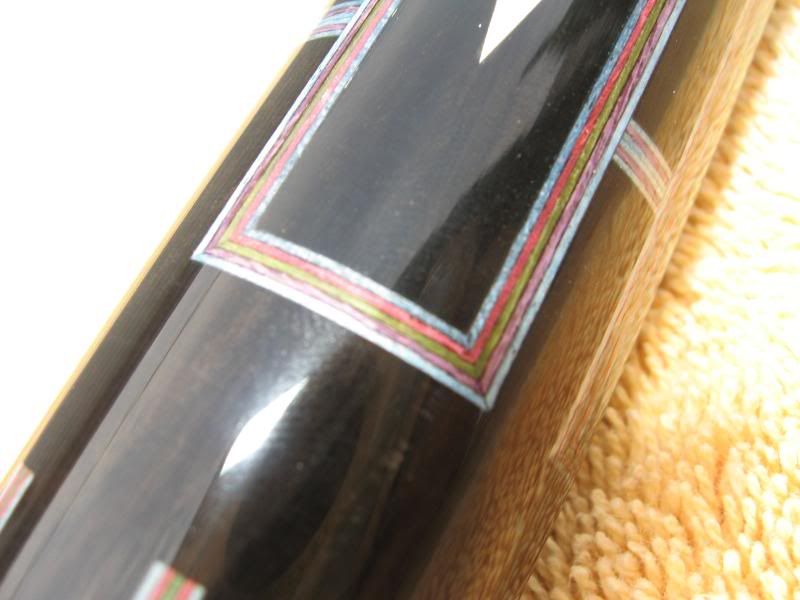
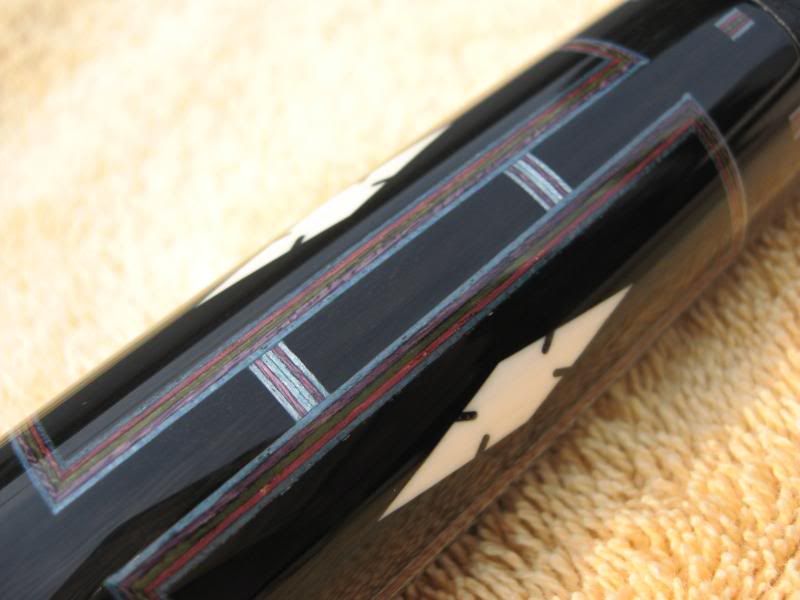
gracio017.jpg

gracio016.jpg


Just got a cue with mitered boxes,not much of a gap
 
I think it was Mike Cochran that did some where there was an intentional gap. I wouldn't call them mitered. There were 4 separate inlays. I'm sure it was designed that way and not an afterthought.
 
ahh carpentry my first love.....

all the pics posted are very good examples of good mitering work, no gap

you can glue your veeners together and measure the distance corner to corner, mark a measurement on the veneer the same as the corner to corner distance, then 45º miter (outside miter longer, inside shorter)

you have to include the KERF* of the blade cutting the miter, or have the inside of your mark be on the inside of the blade edge

*kerf: the thickness of the business end (cutting edge) of the blade, general table/chop saw blades have a kerf thickness of 1/8"


if your building cabinets, picture frames, molding your going to be doing mitering....unless your doing joinery work using dovetail ends.

now that i think of it....thats probably why (unless done purposefully) there were gaps in the OP's described cue......the cuemaker measured correctly and then straddled the line somewhat and made the cut, leaving a 32nd on each a side to add up to that missing 1/16th inch.

Can't forget about the tolerances of the equipment we use.......you can do good work on lower tolerance equipment just as high tolerance, but attention to detail is that much more important. Take abe rich turning cues by hand on the wood lathe compared to the machine lathe....the machine lathe can be bumped to a degree and not too bad ill effects, you bump or jump with a hand tool and BANG ruination.

-Grey Ghost-
 
Last edited:
Ghost:

For the reasons you mention, I do not mark anything for cutting on larger pieces. I measure from the end of the piece (however I'm measuring inside or outside) to the out set blade tooth to accommodate for kerf.

Now, even doing that, if your blade has any run-out, you may or may not hit the 'closest' tooth on the blade, which is the defining cut line.

For small pieces, I always use a hard stop, so even if the pieces are 'off' they are all off exactly the same.

1/64 on a cabinet is invisible. 1/64 on a cue is massive.:wink:

I think a slitting saw is the way to go with cues. No 'set' to the teeth, and exact thickness of cut. You have to cut slower because it does not clean as easily, but an air jet and patience do a pretty good job.
 
Ghost:

For the reasons you mention, I do not mark anything for cutting on larger pieces. I measure from the end of the piece (however I'm measuring inside or outside) to the out set blade tooth to accommodate for kerf.

Now, even doing that, if your blade has any run-out, you may or may not hit the 'closest' tooth on the blade, which is the defining cut line.

For small pieces, I always use a hard stop, so even if the pieces are 'off' they are all off exactly the same.

1/64 on a cabinet is invisible. 1/64 on a cue is massive.:wink:

I think a slitting saw is the way to go with cues. No 'set' to the teeth, and exact thickness of cut. You have to cut slower because it does not clean as easily, but an air jet and patience do a pretty good job.

very true very true......if it didn't then everyone would make an awesome cue :)
 
These mitered windows are hard to do perfectly if you haven't experimented and learned the easy way. The methods described won't get it. You've got to think outside the box and they become very easy. I make them on a CNC.

Dick
 
These mitered windows are hard to do perfectly if you haven't experimented and learned the easy way. The methods described won't get it. You've got to think outside the box and they become very easy. I make them on a CNC.

Dick

and i bet you aint cuttn your mitered corners on a saw with kerf either:grin:
 
Back
Top