DelaWho??? said:
Bouncing eyes will destroy a good shot. Studies have shown increased accuracy with less eye movement.
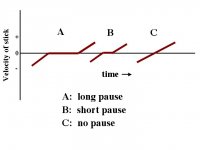
Scott Lee says everyone has a pause in their stroke, some more pronounced than others. I think if you are taking notice of your pause and how long it is, it becomes exagerated because you are focused on it. The pause is nothing more than the transition from backswing to shot. It should be smooth and natural, something thats in the background, like blinking your eyes, you just do it.
Banger
Bouncing eyes? What the heck does that mean anyway?
Your eyes, IMO, should move from the cueball to the object ball during your backstroke, and back down to the cueball as your stroke comes forward. Is this what you mean by bouncing? If so, let me say that this should be perfectly normal.
I must interject here also that I have heard that Randy G adjusts his students' personal eye movement into their stroking. I have heard this from this from one of his instructors and from 3 students. Personally, I would be VERY LEARY of this. Randy, please confirm this or not. Thanks. BTW, I don't mean to bump Randy's classes in a negative way since they are probably one of the very best around.
On your final backstroke, a bigger pause is helpful IMO, at least for me, because of the following reasons:
(1) Tony Robles told me that whatever you do, make sure that where your hand ends up at the back on your final practice stroke should be where your hand goes on your final stroke. The pause really helps you do this.
(2) To answer your question about pausing at the cueball just before you pull the trigger (final stroke), my opinion is that it helps you relax - i.e. not to rush your shot. As a matter of fact, sometimes I can actually feel the tension rushing out of my arm and mind during this pause.
And more importantly, it helps you make damn sure your tip is going exactly where you want it to go.
In case you are doubtful, Nick Varner is a very big proponent of doing this.
(3) Pausing helps you not to rush the shot. Pausing on the final stroke at the back helps following through properly and straighter.
One more thing about rhythm - the late Papa George told me that shooting was just like dancing - it took rhythm to get from one place to another. IMO, if you are going to do something consistently, it is much easier with a rhythm, or cadence.
If you get into a very definite rhythm, then you can immediately (with feel) detect if your stroke is suddenly doing something different. This could be due to a slightly changed stance for example. If you have no ryhthm, you you have no real feel and can't determine anything because there is no consistency.
Good luck.