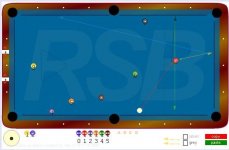
Secrets To Executing This Shot?

DrCue'sProtege

AzB Silver Member
Silver Member
ok, for all of you venerable posters/players out there, what is needed to execute this shot?

your cue ball is about 1/2" to 1" or so off the rail. the shot on the '3' Ball is straight in, and you need to draw it back for the shot on the '4'.

any tricks of the trade on this shot? and please, before someone says follow, assume that is not a possibility, thank you.

DCP

CueTable Help

 
For starters, I am a firm believer in the idea that there is always even the littlest bit of room to cheat the pocket. Granted, with a ball that far out of the pocket, it is very difficult.

So, all I would suggest is to line the shot up. Once you have your angle and are ready to shoot, elevate slightly. You only need to draw back about 6 to 10 inches.

It does NOT look like you need to come back 3 feet. Maybe 1 foot. But you might be able to get away with less. Either way, playing the three and drawing is the only real option. You don't need to hammer the ball as much as you need to stroke it but it should do you just fine.

**If you don't draw back far enough, examine the possibility of playing the rail-first shot on the 4.**
 
Last edited:
thats a tricky shot, you hit it too hard and you just end up doing a modified jump shot and the cue dies where it hits the 3. You just have to strike thru the cueball, give it a little extra punch, visualize that as your cue makes contact with the cueball you whip your wrist just a bit. Ive found on shots where i need alot of cueball action, i will only wrap my middle and forefinger around my cue and leave the rest off. Practice it, smoothness is the key.
 
DrCue'sProtege said:
ok, for all of you venerable posters/players out there, what is needed to execute this shot?

your cue ball is about 1/2" to 1" or so off the rail. the shot on the '3' Ball is straight in, and you need to draw it back for the shot on the '4'.

any tricks of the trade on this shot? and please, before someone says follow, assume that is not a possibility, thank you.

DCP

CueTable Help

Tricks to the trade? Stroke straight, hit off-center (i.e., low, in relation to the stick elevation angle). That's about it.

You need to tell us how you normally miss this shot? If you miss, but get the draw, you need to work on seeing the center of the cueball, and stroking the stick straight. If you make the shot, but don't get draw, you need to work on hitting elevated draw shots.

Other than that, it's pretty much like any other shot.

Now, for the more esoteric, non technical, I like to keep my cue grip very loose, and almost drop the cuestick into the shot.

Fred
 
On a shot like this, you can try experimenting with looking at the cueball last. Take many more strokes than you normally would, and then keep your eye on the cueball as you make your final stroke.

I say "experiment" with it because this isn't for everybody, and even those that like it will find they only like it on certain variations of the shot.

Actually, now that I re-read your post, I see you don't mention what your specific problem is. Are you missing the ball, or are you not getting the draw? My advice above only applies to missing the shot because of the elevation.

Hope it helps...

- Steve
 
Last edited:
Tom,

Jump/draw the CB. Jack up, hit down on the CB with a "jump/draw" stroke. IMO, this shot comes up enough to practice it.


Eric >and scratch in the side pocket :p
 
Last edited:
Assuming that you tend to miss the shot, what Steve said above... plus... during your pre-shot routine, REALLY focus on hitting whitee on the vertical centerline. If you're off slightly, whitee will swerve on ya... and a miss will result.

And if you tend to underdraw... and tend to miss sometimes, hit whitee lower and softer than you normally do. Hitting softer will help a bit with any swerve... and hitting lower will get more draw for the same speed of stroke.

Practice... practice... practice. :)
 
Steve Lipsky said:
On a shot like this, you can try experimenting with looking at the cueball last. Take many more strokes than you normally would, and then keep your eye on the cueball as you stroke.

I say "experiment" with it because this isn't for everybody, and even those that like it will find they only like it on certain variations of the shot.


Steve,

This bit of advice or coaching that you gave to me in the past has helped me greatly. I think of it every time i need to shoot against the rail or over another object ball. Unfortunately, I forgot to tell myself not bump the object ball into the cueball with my finger last night.
 
briandlau said:
Steve,

This bit of advice or coaching that you gave to me in the past has helped me greatly. I think of it every time i need to shoot against the rail or over another object ball. Unfortunately, I forgot to tell myself not bump the object ball into the cueball with my finger last night.

Yes, coaches concerning bumping balls with your finger will come in lesson two, lol.

By the way, Brian, I am simply shocked that you are not working right now.
 
START(
%Cj5N5%DL1Z7%EP9X2%F`4Q5%GX2W3%Hb8D7%IG7O6%Pa4Z6%Ul3E0%Vk0M7
%Wi9P0%Xb1Y9%Yr8Z8%Zl4C9%[r1K2%\j7O2%]k8D3%^s1J8%eA8`2%_T4X7
%`\8P8%aj8C6
)END

Hit it hard enough so that if you miss the cross bank that the three ends up in the middle of the rail and don't miss it fat. You will end out good whether or not you make the ball.
 
NotYou said:

CueTable Help


Hit it hard enough so that if you miss the cross bank that the three ends up in the middle of the rail and don't miss it fat. You will end out good whether or not you make the ball.

Uhh...Sure....that's a lot easier than drawing the cueball back 2'...lol.
 
Last edited:
Move the cue to the right, parallel to the center line.
The cueball will deflect to the left, ball goes in and you don't scratch.
If you use backhand english, you will scratch.
 
Steve Lipsky said:
Yes, coaches concerning bumping balls with your finger will come in lesson two, lol.

By the way, Brian, I am simply shocked that you are not working right now.

haha... oh, but i AM working. sort of...
 
I personally would miss the shot or I would over/under draw the cue ball. Therefore I would play safe.
 

Attachments

  • shot.JPG
    shot.JPG
    23.3 KB · Views: 239
zeeder said:
Uhh...Sure....that's a lot easier than drawing the cueball back 2'...lol.


I think his shot does have merit but I believe the exercise in this post was to ask about how to draw well from this position, not to look for alternatives. There will be situations when no alternatives exist, and he wants to know how to shoot this shot.

But I think the larger problem is that the shot presented above is most probably a kiss if you choose to bank it. A great rule of thumb to know when there is a kiss or not is to see if the cueball, the object ball, and the pocket all line up. If they do, you'll probably get the kiss. There are ways to avoid one, but they usually involve certain strokes and english, which would be tough to do from jacked up on a rail.

- Steve
 
Hey, didn't Tom say that "assume follow was not possible"? That would mean that you were dead straight on the 3 ball. I don't think some of the "cheat the pocket shots" are possible if you are dead straight...


Eric >whaddo I know
 
Steve Lipsky said:
I think his shot does have merit but I believe the exercise in this post was to ask about how to draw well from this position, not to look for alternatives. There will be situations when no alternatives exist, and he wants to know how to shoot this shot.

But I think the larger problem is that the shot presented above is most probably a kiss if you choose to bank it. A great rule of thumb to know when there is a kiss or not is to see if the cueball, the object ball, and the pocket all line up. If they do, you'll probably get the kiss. There are ways to avoid one, but they usually involve certain strokes and english, which would be tough to do from jacked up on a rail.

- Steve

Thanks Steve for pointing that out! I did see the likely double-kiss and I would probably even try the shot if the straight in shot were blocked as it does have two-way potential, as long as you avoid the kiss. I was basically just trying to say that if you weren't comfortable shooting the draw shot that you need to practice it because it's pretty straight forward.

I tend to get lazy and give a smartassed comment instead of taking the time to write out a post on my thoughts...lol.
 
Some months ago there was a thread about putting backspin on the cueball when it is close to the rail. I think it was Hal or Chefjeff (or maybe Jude?) that said you can drive the tip of your cue right through the edge of the rail. I tried this on my el-cheapo Brunswick and it works not too badly. You jack up a bit and stroke through the rail to the lower part of the CB. I found it works better when you are shooting straight away from the rail as the angle does not push the tip in either direction. Based on the Wei, trying this may cause the tip to be pushed a but to the left, away from the rail. It's worth a try, I know I was quite impressed ... with the shot, not the blue streaks it leaves on the rails. It should look OK on your table DCP, it will be blue-on-blue :)

Dave
 
I am assuming you are looking for the secret to a jacked up draw shot.

"The Horizontal Center Axis of the CB is equal to the Angle of the Cue"
 
DrCue'sProtege said:
...
any tricks of the trade on this shot? ...
Sure, three of them:

Form the bridge you are going to use when elevated with the stick horizontal. Aim that way also. Then elevate without moving your bridge and do your best to hit the cue ball without side spin.

Number 2 depends on your shape and stance: Hold the elevated stick against the side of your chest. This is not how you would normally want to play but it can help to keep you from letting the stick wander off line due to going to a sidearm for the elevation.

Practice the shot as a progressive practice drill. Start the cue ball six inches from the rail and move it a little closer to the rail each time you do the shot right and a little farther away each time you mess up. Among other things, this kind of drill will automatically tell you where your 50-50 point is provided that you remember to move the cue ball position each time.
 
Back
Top