show us a picture of it


How can a person have a more "forceful" break? The only variable is cue ball speed. If the cue ball travels faster I suppose you would have more force and slower would be less force but no matter what its all about speed.

If so why? And what is the common oz of break cues that pro players have?
I was gonna say I'll let them worry about that.
Then you got me thinking, why would someone manufacture a cue over spec regs?
Looked it up, it's 25oz, my bad.
It's a Rage break/jump I got from Seyberts. Love that place only being about an hour drive away.
 :thumbup:
On the other hand it is still mystery to me why would anyone want to break with 550-600grams cue when the cue ball weights 120-130grams,the weight advantage of heavy cue doesnt make it up for the much slower swing.
One reason is that some people produce a straighter stroke with a heavier cue.
Another reason is that some people simply like the feel of a heavier cue.
My play cue is nearly 20 oz only because I like the feel of that weight. Not because of physics.
I have cues going down to 17 oz and they simply don't work for me. I greatly dislike the feel and as a result my play isn't as good.
19.5 to 20 is my ideal weight and it's only based on feel.
Not efficiency, straighter stroke, power etc.
 I guess when a player has 20oz playing cue and 25oz break cue then it is really a matter of personal preference. On the other hand I am yet to hear about really good/great player to break with 25oz cue. Maybe Earl comes to mind but he 1) is nuts 2) would break great even with hockey stick :grin::grin::grin:
How can a person have a more "forceful" break? The only variable is cue ball speed. If the cue ball travels faster I suppose you would have more force and slower would be less force but no matter what its all about speed.
The speed that figures into the force equation is a direct result of the mass of the cue stick crashing into the mass of the CB. If stroke speeds are equal, a 24oz cue stick (weighing 4 times the 6oz weight of the CB) would produce more CB acceleration than a 15oz cue that only weighs 2.5 times more than the CB. More acceleration equals more force.

I agree, the cueball weighs the same no matter what you hit it with, so more speed equals more force.
This isnt like the difference in being hit by a car or hit by a truck.
Jason

Seyberts are good people,25oz is ok in terms of rules. On the other hand it is still mystery to me why would anyone want to break with 550-600grams cue when the cue ball weights 120-130grams, the weight advantage of heavy cue doesnt make it up for the much slower swing..but if you like it then all good to you
Yeah, fair enough
I agree, the cueball weighs the same no matter what you hit it with, so more speed equals more force.
This isnt like the difference in being hit by a car or hit by a truck.
Jason
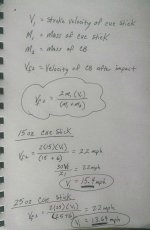
For kicks, I calculated the cue stick speed needed to create a 22 mph CB break speed. With a 15 oz cue the player's stroke would need to be 15.4 mph. With a 25 oz cue the stroke speed would need to be 13.6 mph. These are extremes, meaning lightest and heaviest break cue weights were used, and any extra force exerted by the grip hand/arm us ignored. Only the weight of the cue sticks was figured in. The difference in mass between the cues is much greater than the difference in the required speeds needed to create a 22 mph CB speed. But none of this really matters....just found it interesting. :grin-square:
I believe it is the same as being hit by a car or a truck. For fun, imagine a small car stopped at a red light, a convertible Volkswagen Bug, top down, standard shift, blonde lady behind the wheel doing her makeup in the mirror with the car out of gear and her foot off the brake. The traffic light turned green 20 seconds ago and she doesn't realize it. Coming up quickly on the car is a Ford F350 Super Duty pickup truck with a full load of firewood. The truck is going 40 mph, the driver eating a biscuit and glancing down to change the radio station. BAM!!! He rear-ends the Volkswagen! The truck is 7,500 lbs, 2.5 times as heavy as the 3000 lb Bug, so the extra weight forces the bug to roll away into the intersection at a slow rate of speed. Let's call the speed "X" mph.
Now, instead of an F350, let's say it was a UPS truck going 40 mph, weighing close to 12,000 lbs. BAM!!!!!!!! The UPS truck, 4 times heavier than the car, would force the car away at a faster rate of speed, almost "2X".
It's exactly the same as using a 15oz cue stick vs a 24oz stick on a 6oz CB, only without the smeared lipstick and insurance claims. If the stroke speeds are the same, the CB will accelerate faster from the impact of the heavier cue stick. So you can use a light cue and break with more speed, or use a heavy cue and break with slightly less speed. You'll get the same break results, as far as the actual force when the CB smashes into the racked balls. But speed has been shown to be more crucial because we can get a lighter cue to move much faster than a heavier cue. Still, it's a matter of what feels right and works best for you.
It is against the official rules to use a cue weighing more than 25oz. Phenolic tips allow more cue weight and speed to transfer to the CB on impact (a softer tip absorbs the impact). If we could use a 40oz cue with a granite tip we'd be breaking balls like crazy. Unfortunately, we'd really be breaking the balls, literally.

~ ~ ~ ~ ~ ~ ~ ~but you're not hitting the rack with the "truck" you are hitting it with the "car" and the car is hitting "me" because i'm crossing the street against the "light" of reason.
Jason

For those interested, lots of calculations and interesting related conclusions can be found on the optimal cue weight resource page (especially in the linked TP A.30 document).At last....someone did the calculations.
This is awesome dude!!!!!!!!
At last....someone did the calculations.
Thanks a lot for your work and the time you spent on this.

Too much smart...Not much time at all. Here is the work....