
Super Low Deflection Cue Idea - Thoughts?

Colin Colenso

AzB Silver Member
Silver Member
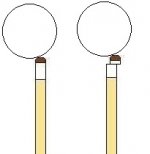
I'd appreciate thoughts from physics savvy and fabrication savvy people on this idea for a super low deflection articulated ferrule.

I'm imagining it would be spring loaded, so it bounces back to an original position after each hit.

Assuming it could reduce the effective tip end mass by 50%, what effects might we expect?

I haven't seen this idea presented before. If this is the first example of it, I hereby state my intention that it be available for use and development by all under creative commons license, such that anyone may produce and market it, but no one may obtain sole rights to the idea.
 

Attachments

  • Low Squirt Articulated Ferrule.jpg
    Low Squirt Articulated Ferrule.jpg
    7.8 KB · Views: 745
I'd appreciate thoughts from physics savvy and fabrication savvy people on this idea for a super low deflection articulated ferrule.

I'm imagining it would be spring loaded, so it bounces back to an original position after each hit.

Assuming it could reduce the effective tip end mass by 50%, what effects might we expect?

I haven't seen this idea presented before. If this is the first example of it, I hereby state my intention that it be available for use and development by all under creative commons license, such that anyone may produce and market it, but no one may obtain sole rights to the idea.


The materials would have to be machined
The machined moving parts will need to be extremely strong and then all those extremely strong parts are going to have to fit in a extremely small area ( the ferrule ).

I do not know of any materials that small that will hold up to the pressures or forces that are going to be applied to it................................................
 
The materials would have to be machined
The machined moving parts will need to be extremely strong and then all those extremely strong parts are going to have to fit in a extremely small area ( the ferrule ).

I do not know of any materials that small that will hold up to the pressures or forces that are going to be applied to it................................................
No easy engineering feat for sure MM. I'm thinking of a slight conical taper of the tip end piece, perhaps 3 degrees and 3 or 4 spring attachments, which pull the tip end piece back into place after the squirt pushes it to the side.

I'm sure there are more ingenious ways of creating a spring type mechanism, but the first step would be proving the concept with a functioning prototype. I'll diagram another idea that I just had shortly.
 
I'd appreciate thoughts from physics savvy and fabrication savvy people on this idea for a super low deflection articulated ferrule.

I'm imagining it would be spring loaded, so it bounces back to an original position after each hit.

Assuming it could reduce the effective tip end mass by 50%, what effects might we expect?

I haven't seen this idea presented before. If this is the first example of it, I hereby state my intention that it be available for use and development by all under creative commons license, such that anyone may produce and market it, but no one may obtain sole rights to the idea.

How about instead of moving parts a ferrule made of a flexible material instead of being rigid.
 
It seems like the simplest way to implement this would be to find a core material with just the right properties. Stiff enough for energy transfer to the cue ball, but elastic enough to allow a free floating tip to move aside.

Whether something like that exists, or is even possible, I have no idea.
 
Last edited:
Spring back tip end concept

Here's one possibility. A conically shaped tip endpiece that is pulled into place by a center attached spring or equivalent elastic material that has excellent shape memory.
 

Attachments

  • Spring tip cone.jpg
    Spring tip cone.jpg
    5.8 KB · Views: 656
How about instead of moving parts a ferrule made of a flexible material instead of being rigid.
Seems plausible. I suspect the challenge though is in creating an anisotropic effect, such that the material could deform elastically sideways, but not along the line of the cue (compressively).

Having done some experiments with a rubber tip, it seemed to compress then push back at the CB in the line of tip contact point to CCB. This led to huge deflection.
 
Here's one possibility. A conically shaped tip endpiece that is pulled into place by a center attached spring or equivalent elastic material that has excellent shape memory.

To withstand the forces involved, I think the spring material would need to have a bigger diameter, and extend further into the ferrule/shaft than in your illustration. A strong enough way to attach it to the tip piece would be another issue.
 
Last edited:
To withstand the forces involved, I think the spring material would need to have a bigger diameter, and extend further into the ferrule/shaft than in your illustration. A strong enough way to attach it to the tip piece would be another issue.
Interesting thoughts. I'd imagine the tip end pieces would be manufactured with the elastic component hanging out of the base.

The lower connector might have a screw ring component that grabs the elastic chord and stretches it enough such that the tip is held in position with a little tension.

The surface of the conical interface may need occasional lubrication.

I wouldn't go LONG on the elastic chord, as the tip only needs to deflect perhaps a mm before contact is lost with the CB. If it were long, it might be shot past the edge of the cone.

The important part is the sideways resistance for the distance the cue tip and CB are in contact, which may necessitate only a couple of mm movement on power side english shots.

I wouldn't be surprised if prototype models required slight finger pushing to get the tip end piece to perfect center on occasion. Chalk and dust getting into the gap could be troublesome.

Colin
 
Last edited:
I'd appreciate thoughts from physics savvy and fabrication savvy people on this idea for a super low deflection articulated ferrule.

I'm imagining it would be spring loaded, so it bounces back to an original position after each hit.

Assuming it could reduce the effective tip end mass by 50%, what effects might we expect?

I haven't seen this idea presented before. If this is the first example of it, I hereby state my intention that it be available for use and development by all under creative commons license, such that anyone may produce and market it, but no one may obtain sole rights to the idea.
Cool idea, but it's not the first time presented. This is the "de-coupled ferrule" concept. I want to say that PJ, Mike Page, or Tony Mathews drew up something similar after discussions on the Meucci air-gapped ferrule which effectively decouples the ferrule from the shaft for some but not all of the tip-to-ball contact time.

Freddie <~~~ RSB
 
Cool idea, but it's not the first time presented. This is the "de-coupled ferrule" concept. I want to say that PJ, Mike Page, or Tony Mathews drew up something similar after discussions on the Meucci air-gapped ferrule which effectively decouples the ferrule from the shaft for some but not all of the tip-to-ball contact time.

Freddie <~~~ RSB
You sure have BEEN AROUND Freddie!

Just the other day I came across some of your early discussions on BHE here:http://billiardsdigest.com/forums/showthread.php?18625-Origin-of-back-hand-english/page2

Any more insights on where I might read that thread mate (google turned up dry)?

Cheers,
Colin
 
Last edited:
You sure have BEEN AROUND Freddie!

Just the other day I came across some of your early discussions on BHE here:http://billiardsdigest.com/forums/showthread.php?18625-Origin-of-back-hand-english/page2

Any more insights on where I might read that thread mate (google turned up dry)?

Cheers,
Colin
Most of the rec.sport.billiard posts are now in Google groups ( groups.google.com ), but it's become very difficult to search. I would start with searching for "decoupled ferrule design."

I could be "misremembering," but several ideas had come up including a thick elastomer pad, a spring-loaded self-aligning head (compliant press head in my industry), and even mini linear roller bearings (which would require orientation and a few other impossibilities).

Freddie <~~~ needs a remember-all pill
 
Weight

I'd appreciate thoughts from physics savvy and fabrication savvy people on this idea for a super low deflection articulated ferrule.

I'm imagining it would be spring loaded, so it bounces back to an original position after each hit.

Assuming it could reduce the effective tip end mass by 50%, what effects might we expect?

I haven't seen this idea presented before. If this is the first example of it, I hereby state my intention that it be available for use and development by all under creative commons license, such that anyone may produce and market it, but no one may obtain sole rights to the idea.

Well it seems that your design it not designed to be less mass.........
Instead of a spring why don't you mount the tip on a magnet and another magnet in the ferrule, thus getting rid of all mechanical devises.
Making the tip free floating.
 
Most of the rec.sport.billiard posts are now in Google groups ( groups.google.com ), but it's become very difficult to search. I would start with searching for "decoupled ferrule design."

I could be "misremembering," but several ideas had come up including a thick elastomer pad, a spring-loaded self-aligning head (compliant press head in my industry), and even mini linear roller bearings (which would require orientation and a few other impossibilities).

Freddie <~~~ needs a remember-all pill
Thanks Freddie,
Sometimes I think I'd like such a pill, but one of life's pleasures is being able to forget a lot of crap that has entered my ears over the years.

Colin <~~~ tries to remember the good things.
 
Well it seems that your design it not designed to be less mass.........
Instead of a spring why don't you mount the tip on a magnet and another magnet in the ferrule, thus getting rid of all mechanical devises.
Making the tip free floating.

The magnet is an interesting concept, but my first thought is that I'd like the tip to offer less resistance in the primary stage, then greater resistance as it is thrown to the side. A magnet would do the opposite and the tip may go flying.

Why would this design not be less tip end mass btw? Tip end mass is pretty much the what contributes the end 6 inches of the cue, probably the closer to the tip end, the greater contribution the parts of the mass contribute.

If the tip slides away relatively easily, in the early stage while in contact, it would seem to me that the tip end mass is greatly reduced.
 
Well it seems that your design it not designed to be less mass.........
Instead of a spring why don't you mount the tip on a magnet and another magnet in the ferrule, thus getting rid of all mechanical devises.
Making the tip free floating.

That's a good idea. I can't remember if magnts were previously discussed. I can't see why not.

Warning on physics-speak to follow. Ignore now, if you want.

In case others haven't gotten it yet, reducing tip mass to reduce cueball squirt is only an abbreviated saying in the overall understanding of what causes squirt. Reducing the mass that's in effect during the the tip-ball contact time is what reduces squirt. That's been said a million times, but I think maybe people don't read it correctly or hear what they want to hear only.

The easiest way to reduce the effective mass is to remove mass by removing material and/or using lower density materials in the first 3-6". But decoupling or reducing the coupling of the ferrule/tip from the shaft has been also one of the concepts for years and years to reduce squirt. Bob Meucci's ferrule is one such example. Jaden's reduced deflection tip had a similar theory. And this post by Colin is another. De-coupling the tip would reduce the amount of shaft mass in effect during tip-ball contact.

It's not only about reducing tip end mass, but more correctly it's about reducing the mass that's in effect during the tip-ball collision.

Freddie <~~~ one million and one
 
Back
Top