tip time

driven

AzB Silver Member
Silver Member
I don’t think there’s many people that replace a tip quite the same as me, so
I made a video
I call it:

Tip replacement featuring a Poor Mans Lathe.

I have refined my technique over the years…

The method of scraping the razor over the top of the ferrule leaves a very flat surface,
I figured this out by myself. I used to use a file or sandpaper but had to get lucky to get it flat.
Sorry, bad camera angle for this part.

The use of the razor to trim the excess tip I learned from a video I saw here.
I would use a very sharp chisel if I had one.

Using the razor to shape the tip I learned in las vegas, during an apa event.
Upstairs, in a private room next to the az room, The Cue Guy, aka Mark Davidson, I think
Showed me this little trick. Quick and easy…

It is nice to have an assistant work the drill, but they can be hard to come by.

If you notice some wobble while I am shaping the tip it is because I under tightened the bolt in the chuck and it got loose. That could have been disaster.
First time for that screw up.
Enjoy.
Steven

https://vimeo.com/122678607#


209 views. thx for looking
I took the video down as it has served its purpose.
steven
 
Last edited:
Post

There is nine about hundred and ninety nine ways possible to install a tip.
Personal use install for you it looks like it works good for you.
The cue lathe and tooling use to install tips on a professional set up makes the job much easier.


Rob.M
 
Easy job made hard

I don’t think there’s many people that replace a tip quite the same as me, so
I made a video
I call it:

Tip replacement featuring a Poor Mans Lathe.

I have refined my technique over the years…

The method of scraping the razor over the top of the ferrule leaves a very flat surface,
I figured this out by myself. I used to use a file or sandpaper but had to get lucky to get it flat.
Sorry, bad camera angle for this part.

The use of the razor to trim the excess tip I learned from a video I saw here.
I would use a very sharp chisel if I had one.

Using the razor to shape the tip I learned in las vegas, during an apa event.
Upstairs, in a private room next to the az room, The Cue Guy, aka Mark Davidson, I think
Showed me this little trick. Quick and easy…

It is nice to have an assistant work the drill, but they can be hard to come by.

If you notice some wobble while I am shaping the tip it is because I under tightened the bolt in the chuck and it got loose. That could have been disaster.
First time for that screw up.
Enjoy.
Steven

https://vimeo.com/122678607#


Hi Steve
Straight up looks like it was some what of a struggle or way to much work....
The standard is not to touch the ferrule with anything coarser then 1500 grit , and that still might get you fired because most people don't want there ferrule and shaft sanded on ................................................................ at all.

Frame or time on the video 4.41 you cut into the ferrule with your razor blade knife.
Big time no no. Little hint those blades are dull.... they are dull from the factory.
( I sharpen mine on a stone )

You also got into the ferrule with the coarse sand paper you where using, another big no no.

You sanded on the shaft :eek:

Your shaft cleaning technic lightly sanding didn't clean the shaft............
lemon pledge is not going to seal the wood grain from chalk and dirt and grim from getting into the wood pours...
Denatured alcohol helps clean the shaft and Carnauba car wax dries harder then any known natural wax in the world, it also has the highest melting point...................
It will also help keep your shaft clean if you clean and wax your shaft often enough.

I hope you can be open minded enough to look at what you are doing from a professionals point of view.
With that said I can only say poor F______G ferrule and possibly the shaft.
Nothing abrasive like sand paper or and metal cutting objects or tools should ever touch the ferrule..................
At most a scotch bright pad, micro mesh or polishing creams or leather should be the only thing to touch the ferrule........... Everything else is a no no ................

Before the tip was ever replaced I noticed the ferule had blue chalk in the scratches in the ferrule.
Almost a dead give away that who ever put that tip on did it by hand and had used coarse sand paper on the ferrule.

Safety, at times when watching your video I thought there was a high risk of you cutting yourself and I am surprised to didn't get friction burns.

If I cut you loose on one of my lathes, you would quickly understand that your not doing the ferrule and shaft on your cue any favors by the technic you are using now.


Nothing works as good and as easy as a lathe...

 
Last edited:
Thanks for the replies.

It was worth the time making the video just to find out about carnauba wax
I had some mothers wax in basement....

I have been using the lemon pledge for so many years I kind of got used to it.
The mothers wax is much better. thx.

The only thing I disagree with Mike, is what you said about being to much work. I know a little about the subject.
I a person enjoys what he is doing it is not really work at all.

I hope everyone else who watched the video at least got a chuckle or two..
steven

btw Mike, nice work on the last picture there. I can't do that.
but if anyone wants to send me their 2 piece custom made pool cue I'll give it a try for no charge...
just kidding of course.
 
Tips

Thanks for the replies.

It was worth the time making the video just to find out about carnauba wax
I had some mothers wax in basement....

I have been using the lemon pledge for so many years I kind of got used to it.
The mothers wax is much better. thx.

The only thing I disagree with Mike, is what you said about being to much work. I know a little about the subject.
I a person enjoys what he is doing it is not really work at all.

I hope everyone else who watched the video at least got a chuckle or two..
steven

btw Mike, nice work on the last picture there. I can't do that.
but if anyone wants to send me their 2 piece custom made pool cue I'll give it a try for no charge...
just kidding of course.

Hi
For shaft cleaning this is how I do it and your drill will also work.
Use denatured alcohol to clean the grit dirt chalk and grim out of the pours of the shaft.
That may take several times to get the shaft half way clean, its not the end of the world if you cant the shaft looking like new, a little blue tint to it is 100% normal.
I would be very careful doing this but then use a green scotch pad and LIGHTLY buff the shaft while its spinning and clean again with the alcohol.
The alcohol will raise the grain of the maple shaft and it will have almost a fuzzy feel to it, don't worry about that because when your done it will feel like the bottom of a babies butt.
Then take bug shit ( Clear shellac ) and denatured alcohol and mix 50/50 and mix up about a shot glass of it....
This is your shaft sealer wipe it on with a paper towel and put on 10 coats if you want.
It dries extremely fast or in seconds and your going to buff off 95% of all the shellac you put on.
Remember its just to seal the pours in the shaft and to feed the wood.
In case you didn't know this but bug shit is good for the wood.
If the pours in the wood is sealed with shellac then dirt and grim cannot get into the wood pours or grain.

Take the green scotch brite pad and LIGHTLY buff the shellac smooth,
the shellac will be smooth but some what sticky to run your fingers over.

Now apply several coats of the hard Carnauba car wax, remember to allow enough time for the wax to harden up again and then buff off the excess.

If I was shooting 8 hrs a day then I would strip and re wax once a week.
the oils in your hands will break down both the shellac and the carnauba wax........


Having a lathe makes changing a tip effort less , having a lathe with a digital read out is even that much better.
Right now I am making mounts for the lathe in the picture for a fowler dial indicator to be mounted to measure the cross slide movements.
Which works great on tip replacement jobs...............
I can zero to the ferrule and do my cuts to zero and I don't have to worry about getting into the ferrule.

I suggest that you buy a cue repair lathe, because I can see you enjoy replacing your tips yourself, and a lathe is the best tool for the job..
 
As i do have a lathe to do tip changes, I have been experimenting with different ways of doing it fast, simple and to make the result the best I can. A short list of steps that I have found to work the best:

- Cut off the old tip, about 0.5mm from the ferrule to make sure you dont touch it with a box cutter.
- Wrap some packaging plastic around the shaft, leave 10cm from the ferrule exposed.
- Pick an approperiate plastic bushing to match the size of your ferrule. I have found that the best way to make sure no dings or "ghosts" of the chuck jaws is to use an exactly right sized bushing, I have them machined every 0.2mm or so, since I am a machinist myself. I don't like to cut them, instead I leave them round and in 1 piece. About 2-2.5mm wall thickness works well.
- Make sure that the shaft is securely attached, and that the end of the shaft fits snuggly to the spindles backend. (dont know the right english word for this :frown:)
- Check that the ferrule is spinning straight and is not wobbling.
- Cut the old tip away, and take about a 0.1mm from the ferrule to make it straight.
- Take a piece of 600 sandpaper, and very gently swipe the end of the spinning ferrule, this seems to help with glue sticking securely on it.
- Wrap some tape around the ferrule if you are not 100% sure how much glue to use. If you haven't done many tip replacement, it's easy to use a lot more than needed.
- Prepare the new tip, I like to use a 320-400grit sandpaper for this, it seems to do the job fine. Slide the tips glue side on the paper placed on a flat surface, untill it's ready. Many tips have the word GLUE on them, and usually they are ready to be installed when the word is sanded away evenly. If installing a Kamui Clear, or other tips with plastic pad, I usually very gently sand them on 600grit, to make something for the glue to take a grip on.
- Make sure that the ferrule and tip are free from dirt and dust of any kind, I use a common household paper towel for this, just wipe away all dirt from them.
- Apply the right glue (I use Loctite Super Gel for leather, and Loctite 401 for Kamui Clear tips) You dont need that much, but always make sure that the glue gets all around the tip, and that a small amount of it comes out from all around the tips edges. Any spot without glue on it will give the cue a bad sound when hit, and it greatly increases the chance of popping a tip off.
- Center the tip to your ferrule, and apply some pressure on it. Using 14mm tips is the easy way here, as they are not that exact on centering the tip. Keep the pressure on for a minute or two when using fast setting super glues like the loctites.
- Turn the tip down near the diameter of your ferrule. The best way seems to be that you leave the tip a tad bit larger (about 0.1mm) in diameter than the ferrule, this makes sure that the ferrule is left untouched by your cutting tool. Having digitals is the easy way, if you dont have them, it's also pretty straight forward to just go down near the right diameter with about 0.2mm cuts, and then move closer to the ferrule in smaller cuts. For me it's pretty easy to see when the correct diameter is achieved, as I have a trained eye for this kind of stuff due to my day job :wink:
- After cutting the correct diameter, it's best to use a razor blade to cut the dime onthe tip. I turn my cutting tool 90 degrees, and use its backend as a backing plate to rest the blade on securely. This seems to be the way that puts the minimum amount of stress on the tip. I have tried all kinds of diamond sharpened tools ground to a dime, but they seem to apply excessive cutting force on the tip, compromising its structure. The sharp razor blade still works, atleast for me.
- Use a grit 600 - 1000 sandpaper to gently sand the tip to the exact diameter of the ferrule. Make sure not to touch the ferrule with sandpaper, it is too coarse for it and will leave chalk marks all over it very easily if scratched.
- If needed, you can use a microfilm, Nick's Edge for example, to very gently flatten the line between the tip and ferrule. I often come from the end of the ferrule towards the tip, making sure that the transition from ferrule to tip is flawless. The finest microfilms dont seem to hurt the ferrules, but go easy on it.
- Burnish the leather with whatever suits you the best. I use a small amount of spit on a dennish bill I found somewhere, it seems to do the job pretty well :) Dont heat the tip with friction, it softens the glue usen on laminated tips. Some like to use leather creams and leather to burnish it's a matter of personal preferration I think.
- To finish a new tip, the last thing I like to do is to very gently swipe the dime with a 400-600grit sandpaper to flatten the surface of the tip and make a very small rounding to the edges of the dime, this seems to make them a bit more durable. For single layered tips a coarser paper can be used.
- Take your shaft out and wipe it down to remove any dust and dirt from it.
- Laminated tips seems to come out the best if they are given a bit of Gator Grip treatment, it really brings the fibres up and make the tip hold chalk pretty well. I just spin the shaft squeezing the tip gently on the Gator Grip, till it seems to be ready.

Cleaning the shaft is pretty straight forward IMO. I use Magic shaft cleaner, a Q-Wiz pad and Nick's Edge microfilms to buff out all dirt and chalk on the shaft and to polish it. Cue silk to finish 'em up. My shafts are always clean though, I cant stand the idea on playing with a blue or tacky shaft. They just must be clean and slick for me :cool:


The process takes about 10-20 minutes for me to do, and I am sure that there are more efficient ways and some other opinions on how it's done, but this is the way I do my own tips and a few others too, and it works well for me :embarrassed2:

 
great video and I think I may have to try this way since I need to put a new tip on the break cue. Idk bout sandin tht much on the ferule but I like the drill idea.
 
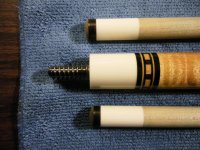
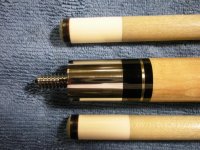
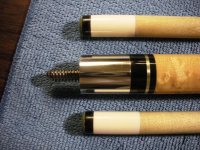
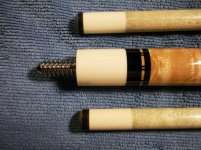
That was a pretty painful video to watch with all that struggling. Overall, I agree with Mike. The ferrule started out in pretty bad condition, and all that sanding on it indicates it won't last too long before it's too thin. I would say the better alternative is a cue repairman with a lathe. That is, unless you have the patience to do it with tape over the ferrule, and sandpaper with the tip, until you get it right. Some examples, you say? All by hand:
 

Attachments

  • DSCN0378.jpg
    DSCN0378.jpg
    99.2 KB · Views: 511
  • DSCN0346.jpg
    DSCN0346.jpg
    97.3 KB · Views: 461
  • DSCN0332.jpg
    DSCN0332.jpg
    100.9 KB · Views: 515
  • DSCN0312.jpg
    DSCN0312.jpg
    99.4 KB · Views: 559
Very nice

That was a pretty painful video to watch with all that struggling. Overall, I agree with Mike. The ferrule started out in pretty bad condition, and all that sanding on it indicates it won't last too long before it's too thin. I would say the better alternative is a cue repairman with a lathe. That is, unless you have the patience to do it with tape over the ferrule, and sandpaper with the tip, until you get it right. Some examples, you say? All by hand:

Very nice,

Prime example of setting the standard of appearance of what the tip and ferrule should look like after tip installation and even during the life of the tip....

I have invested into a couple nice wood chisels and I have them razor sharp.
If I had to do a tip by hand I think I would use one of my chisels to trim the tip to the ferrule while the cue was upside down and the tip rested on a block of wood.

very impressive work .


.
 
nope...

You may not get the tip as perfect, doing it yourself without a lathe, but you can get it to a nice and acceptable level, not perfect but very good. I didn't like the drill idea, especially since it appeared you took quite a bit off the ferrule there...I'd rather do it all by hand, at least then I'm in control and won't ruin the ferrule.

Buying a lathe for this kind of work will set you back thousands of dollars, at the very least 1500 or so. You'll need to do A LOT of tip repairs to break even. If you just want to do your own tips there's no point. If you wan't to be a professional it's a must of course.

If you JUST want to do tips, you can get a 7x10 metal lathe from harbour freight for $400 with one of their super coupons and do a couple of rigged addons and get some collets for it and only be into it for a total of ~500.

The pass through on the spindle is more than big enough for shafts.

If you aren't willing to do that, then just have a professional install your tips with the right equipment.

Jaden
 
Lathes

You may not get the tip as perfect, doing it yourself without a lathe, but you can get it to a nice and acceptable level, not perfect but very good. I didn't like the drill idea, especially since it appeared you took quite a bit off the ferrule there...I'd rather do it all by hand, at least then I'm in control and won't ruin the ferrule.

Buying a lathe for this kind of work will set you back thousands of dollars, at the very least 1500 or so. You'll need to do A LOT of tip repairs to break even. If you just want to do your own tips there's no point. If you want to be a professional it's a must of course.

My first repair lathe paid for its self in the first month of owning it...................
I hit up every bar in town and told the owners I would retip 25 to 50 pool cues for a set price.
Almost every bar went for the deal and I did a 165 bar cues in the first three weeks of owning it...
.
 
Drill

great video and I think I may have to try this way since I need to put a new tip on the break cue. Idk bout sandin tht much on the ferule but I like the drill idea.

Ya I really liked the part where the drill was kind of flopping around as he was operating the drill with his toe's pinching the cue with one hand with a dull razor knife in the other hand and his upper leg as a steady rest.
And you can see the white ferrule shaving rolling off the edge of the dull razor knife
as the ferrule screams bloody murder. ( Dramatized of coarse )

The only way to make this job harder would be to turn the lights off.
 
I need to say to anyone thinking about adopting any of my methods..
re read post number 3.
any number of things could go wrong at any given moment.
and don't wear loose clothing, my shirt sleeve could have got spun around there.

anyway, I have been sanding on the ferrule and shaft since day one.
the only reason I sand today is to remove the glue that gets on the ferrule.
I have tried blue tape but the glue gets under there and still makes a mess.

Is there a way to get the glue off without sanding, or better yet, to keep it off in the first place?
thx
me
 
That was a pretty painful video to watch with all that struggling. Overall, I agree with Mike. The ferrule started out in pretty bad condition, and all that sanding on it indicates it won't last too long before it's too thin. I would say the better alternative is a cue repairman with a lathe. That is, unless you have the patience to do it with tape over the ferrule, and sandpaper with the tip, until you get it right. Some examples, you say? All by hand:

real nice work, WW
 
Back
Top