What makes a break cue different?

JBB2388

Banger Extraordinaire
Silver Member
What specifically in the construction of a BC makes it different from a playing cue? Are the shafts built differently or made with specialized materials? Is the shaft taper unique? Is there a special type joint that performs better or is stronger? I know they tend to have special break tips on them but I am more interested in the actual construction techniques and materials used.
 
I'm not a cue maker, but I believe different ferrells are used and the weight distribution is different from a playing cue
 
I think they're balanced so that the weight's in the back. The BK2 has a lot of verbiage about the construction. The taper is "stronger" whatever that means (more conical?) to withstand the force of breaking. There's a pad behind the tip. There's a phenolic joint, and the grip is made to be extra-grippy (rubber sport grip) which I think is important. You want to grip it loosely and you don't want the thing to go flying out of your back hand. I think the BK2 also extends the wrap all the way to the back for those who like to move their hand far back.

Also, just a personal observation, but I feel like break cues are easier to swing hard and handle better when they're shorter than standard length. I don't know the science behind that or if it's just my imagination.
 
don't use one

i'v only been playing for 65 years, but i still use my playing cue to break, its worked good enough so far, so i don't think i will change. i do believe a lot of people use a break cue, so they don't screw up the tip on their playing cue, but i think thats about the only advantage.
 
I read online about the Mezz Power Break II one time and how it was specifically engineered for the break shot. There may be some degree of that in a lot of break cues, but since I hit some breaks with my buddy's Mezz I can tell you that for them I absolutely believe it. It's quite remarkable. I suggest googling.
 
The purpose of a break cue is to deliver as much of the force, generated by your body, into the cue ball a possible.

Specs of the cue that will help to do this include:

Lighter weight.

Stiffer shaft.

Harder tip.

Shorter ferrule.

Harder ferrule.

Dime radius.

Lower deflection.

Rear weight bias.

A good break cue, like any good cue, is a useful tool in the hands of a skilled player, but but if one is a banger with a bad stroke and poor aim ... not saying that you are ... fold your money over and put it back in your pocket.
 
Here are a few ideas for break cue selection, design and/or construction.

The break cue is like any other specialized “tool”. The break cue is made for doing a specific job. A good break cue is made for accurately striking a 6 ounce cue ball, at 29.33 feet per second (20 mph) or even faster.

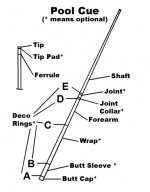
The cue diagram above shows the nomenclature (names of the parts) of the pool cue. Some of these parts are optional and not found on house cues or inexpensive production cues. The “options” are referenced with an asterisk (*). Cue length is a major factor in design, because cue length does affect the overall weight and balance of the pool cue.

The “Crescent Wrench, Monkey Wrench or House Cue” will do the job of substituting for a specific tool, if that is all you have to use. Please remember this, a good tool & the correct tool always does the job better and faster. Having good equipment is a necessity. Having very nice equipment is plus, but not a necessity. To say that any cue can be used for breaking is a broad statement and a vague statement too. Some cues have splintered at impact. The spine of some cues, actually allow impact with the cue ball, to buckle the cue’s spine, and thereby lose power and direction in the stroke.

Some good break cues have the wrong kind of leather tip, or a bad leather tip, which can allow too much compression. The tip on any cue is very important, it is where the “rubber meets the road”, as Mr. Firestone used to say.

 

Attachments

  • Break Cue Info.jpg
    Break Cue Info.jpg
    37 KB · Views: 526
Last edited:
The Mezz break cue's butt is 4" shorter than standard. Wish I could try one out.
 
We had one in our BreakRAK booth when they first came out.... they are nice Break Cues. I liked the lesser amount of mass behind my grip hand.
 
The Pechauer Break Cues are forward weighted... they hit very well.

We have Pechauer Break Cues, OB Break Cues, Predator Break Cues & Auerbach Break Cues in our booth at the big tournaments.
 
Back
Top