What's the lowest cut shot angle possible??

Jude Rosenstock said:
Look, the amount of spin that would be necessary to throw an object-ball backwards is going to be significantly greater than the speed of the cue-ball. It's gotta be spinning like a top in order to do it. You can't do that, at least, not with a cue alone.
What exactly makes you think that it's impossible to obtain a spin vs. speed ratio greater than 1? As Jal pointed out, if your tip offset is greater than 2/5th the radius of the CB, then the CB surface velocity speed will actually be greater than the linear speed. Of course, you'd have to keep your cue from miscuing, but 2R/5 isn't that huge of an offset.
 
Last edited:
jsp said:
What exactly makes you think that it's impossible to obtain a spin vs. speed ratio greater than 1? As Jal pointed out, if your tip offset is greater than 2/5ths the radius of the CB, then the CB surface velocity speed will actually be greater than the speed. Of course, you'd have to keep your cue from miscuing, but 2R/5 isn't that huge of an offset.


Because then, I could actually have the cue-ball accelerate when rebounding off of a rail. That only happens when the cue-ball comes in contact with another ball first.
 
Jude Rosenstock said:
Because then, I could actually have the cue-ball accelerate when rebounding off of a rail. That only happens when the cue-ball comes in contact with another ball first.

I don't find that to be true; the cue ball does accelerate off the rail with a lot of running english. Try hitting extreme running english shots into a rail and gradually decreasing the pace of each shot. When I do it, the hard shots don't have noticeable speed gain off the rail, but as they get softer, I start to see the spin really adding to the ball speed off the rail.

-Andrew
 
jsp said:
What exactly makes you think that it's impossible to obtain a spin vs. speed ratio greater than 1? As Jal pointed out, if your tip offset is greater than 2/5th the radius of the CB, then the CB surface velocity speed will actually be greater than the linear speed. Of course, you'd have to keep your cue from miscuing, but 2R/5 isn't that huge of an offset.


Wait, are you suggesting that the further you hit the ball away from center, the less mass you're catching, hence the energy is transferred to spin, rather than forward motion? If that's the case, in order to achieve this, you would have to look at total volume minus half the total volume, get the radius from its difference and there is your contact point. If I'm right, you would have to hit approximately .9" away from center in order to achieve more spin than speed. That's a miscue.
 
PROG8R said:
I won some $$ from a few rail birds with this one once.

CueTable Help


I tried shooting this shot about a hundred times and just can't seem to make it with a center ball hit. ;-)
JoeyA
 
Jude Rosenstock said:
Wait, are you suggesting that the further you hit the ball away from center, the less mass you're catching, hence the energy is transferred to spin, rather than forward motion? If that's the case, in order to achieve this, you would have to look at total volume minus half the total volume, get the radius from its difference and there is your contact point. If I'm right, you would have to hit approximately .9" away from center in order to achieve more spin than speed. That's a miscue.
Hmm, I'm curious as to exactly how you arrived at 0.9''.

The conventional proof of (2/5)R offset to obtain a unity spin vs. speed ratio can be found in Ron Shepard's Amateur Physics for the the Amateur Pool Player, pp 24-25. Unfortunately, I don't remember the link to this paper.

He actually solves for the vertical tip offset you need to immediately obtain a natural running CB. The problem and answer is virtually the same, we're just looking at a different axis.

The magic 2/5th number comes from the moment inertia of a sphere, which is (2/5)MR^2.

So (2/5) * 2.25'' * (1/2) = 0.45''. I believe you can safely cue half an inch without miscuing, assuming your cue is properly chalked.

EDIT: I found the link... http://www.physics.ohio-state.edu/~penningt/262/ps/apapp.pdf
 
Last edited:
Jude Rosenstock said:
... I have to ask: WHAT IS THE JACKSONVILLE PROJECT??? You're referencing something as the basis of your proof yet you provide no links. Does this project apply to pool? I want to see this exact report.
It was a high-speed pool video project done in 1998 using a camera that worked at up to 12,000 frames per second. Much of the shooting was by Predator's Iron Wille. The tests went on for a week at about 12 hours per day. A two-hour DVD of some of the sequences is available for $10. Articles about the project are available on the sfbilliards web site. There has been extensive discussion of the project in rec.sport.billiard, which is available through google groups.

Among other things learned during the project is that it is possible to get what I call "retrograde" spin if you hit far enough off center. That is, with left english, you can make the right side of the cue ball move backwards relative to the table. This means that it is possible to throw a near-90-degree cut backwards some with outside english. (But please also see my remarks above about the thinnest cut angle I found to be "reasonable".)
 
jsp said:
... The conventional proof of (2/5)R offset to obtain a unity spin vs. speed ratio can be found in Ron Shepard's Amateur Physics for the the Amateur Pool Player, pp 24-25. Unfortunately, I don't remember the link to this paper...

Among other places, his paper is on www.sfbilliards.com under the misc files list: http://www.sfbilliards.com/misc.htm Also there are Ron's article on squirt and some articles on the Jacksonville Project.

As for the 2/5R offset, that was covered by Robert Byrne a long time ago along with George Onoda's use of a striped ball to get the correct offset. See Byrne's "Advanced" book. Onoda's articles from Billiards Digest are also available on the misc page listed above.
 
jsp said:
...I wouldn't try to mock Jal if I were you, he probably knows more physics on this board than anyone.
Thanks Jsp, I owe you! Usually what I say about the physics are regurgitations of what Bob Jewett, Mike Page, Ron Shepard and Dr. Dave Alciatore (and some others) have described. But I fancy that sometimes I might look at some detail in a different way and see something which they haven't already elaborated on.

I've remarked before that your descriptions of problems are particularly clear headed and I know that you've been delving into Ron Shepard's work. His can be a little intimidating since he goes into tensors and throws in a little Lagrangian mechanics to boot. His is a great resource but I would also recommend Dr. Alciatore's technical articles. They are, in my opinion, a little more straighforward and less formal. It won't take much for you to understand this stuff better than my lazy head. There are really only about a handful of core equations that describe just about everything to a first approximation.

Jim
 
Jal said:
Thanks Jsp, I owe you! Usually what I say about the physics are regurgitations of what Bob Jewett, Mike Page, Ron Shepard and Dr. Dave Alciatore (and some others) have described. But I fancy that sometimes I might look at some detail in a different way and see something which they haven't already elaborated on.

I've remarked before that your descriptions of problems are particularly clear headed and I know that you've been delving into Ron Shepard's work. His can be a little intimidating since he goes into tensors and throws in a little Lagrangian mechanics to boot. His is a great resource but I would also recommend Dr. Alciatore's technical articles. They are, in my opinion, a little more straighforward and less formal. It won't take much for you to understand this stuff better than my lazy head. There are really only about a handful of core equations that describe just about everything to a first approximation.

Jim

I'm thinking this can be proven mathematically but I want some time to go over it. My line of thinking is this: in order to have spin that is greater than 1:1 ratio of speed, you would need to hit a portion of the cue-ball that would represent less than half its mass. From there, you would find what the radius of the half would be and that would represent the strike-point on the cue-ball.
 
bomber said:
I have seen balls cut off the spot into the corner pocket when the cue ball is in the jaws of the opposite corner pocket on the same end of the table. This is STRONG!!!!!!!!!!!!!!!!!!!!!! Obviously, I cant do this but it can be done.

this sounds like a shot i could give anyone 10 tries at and i'd end up with the cash every time. as long as the cue ball doesn't leave the table this shot on a level 9 foot table in my book is enough to consider not even worth trying. your pretty lucky to have witnessed this more than once. :rolleyes:
 
I'll admit, there is a lot to learn from Ron Shepard's paper and unfortunately, I will also admit, it would take me some time to comprehend it. However, with that said, there were a few things that should also be considered in our scenario: The path of the cue-ball.

After this collision whether the friction be collision-enduced-throw or spin-enduced-throw and assuming there is no draw or follow, the cue-ball will travel in a 90 degree path from the path of the object-ball. That is to say, if you could cut a ball 90 degrees, the cue-ball would not change course (see figure 4.2). To cut a ball sharper than 90 degrees would mean that the cue-ball would deflect on the same side of its original path as the object-ball it is colliding with.

I can't say I understand this stuff. I wish I did but it's apparent to me that with this particular scenario, we are forgetting quite a few steps. We can't say: since we can get a rotation speed greater than the cue-ball's velocity we therefore can cut a ball sharper than 90 degrees. It's obviously not that simple. Figure 4.2 has a formula that I cannot even begin to decipher but it illustrates the principal that the collision will result in a right-angle between the object-ball's path and the cue-ball's new path. Any referee will tell you that if the cue-ball does not deflect to the right, a collision on its left did not occur.


I would be fascinated if someone took the time to plug-in our scenario into all of the equations that apply. However, I'm reserved to believe that the results will only convey my conviction that a cut sharper than 90 degrees, even with maximum side-spin is impossible. If anything, even if mathematics could prove the possibility existed, it's practicality would justify this debate moot.
 
Jude Rosenstock said:
I'm thinking this can be proven mathematically but I want some time to go over it. My line of thinking is this: in order to have spin that is greater than 1:1 ratio of speed, you would need to hit a portion of the cue-ball that would represent less than half its mass. From there, you would find what the radius of the half would be and that would represent the strike-point on the cue-ball.
While this may sound plausible, getting angular momentum in collisions right is not obvious or intuitive -- at least not to me. The 2/5 R number has pretty much everybody in physics on its side, including Coriolis. This used to be a standard problem in physics text books 100 years ago. If you can disprove it, there will be quite a stir, and maybe a Nobel prize.
 
Jude Rosenstock said:
I'm thinking this can be proven mathematically but I want some time to go over it. My line of thinking is this: in order to have spin that is greater than 1:1 ratio of speed, you would need to hit a portion of the cue-ball that would represent less than half its mass. From there, you would find what the radius of the half would be and that would represent the strike-point on the cue-ball.
I think the following is a simpler way to look at it.

If you apply a constant force F to an object for a time T, the object will undergo a change in momentum equal to the impulse FT (product of F and T). If the force varies during the time T, as it does in collisions, then all we need do is substitute the average force. Let's just use F to stand for this. The change in momentum is md_V (product of m and d_V) where m is its mass and d_V is its change in velocity. If the object was at rest to begin with, then d_V is simply its final velocity V. So we have:

FT = mV

If the object is hit off center by an amount b (tip offset for instance), then a torque equal to bF is exerted. This causes a change in angular momentum equal to Id_W, where I is its moment of inertia and d_W is its change in angular velocity. If the object was not initially spinning, d_W is its final angular velocity W and we have:

bFT = IW

Dividing the second equation by the first:

IW/(mV) = bFT/FT

and with a little algebra,

W = mbV/I

As Jsp pointed out, for a sphere I = (2/5)m R^2. Substituting in the above:

W = (5/2)bV/(R^2)

and bringing one of the R divisors over to the left side,

RW = (5/2)(b/R)V

or

RW/V = (5/2)(b/R)

This relation describes much that takes place with pool balls. RW is the surface speed at the equator of the spinning ball. If b/R = 2/5, then you get RW/V = 1. If b/R is greater than 2/5, then RW/V > 1 and you get the retrograde surface speed at the equator on one side of the ball.

The relation also applies to a pure friction force acting at the surface. In this case b = R, so:

RW/V = (5/2)

or

RW = (5/2)V

If a ball is moving and spinning prior to impact, or just moving along the surface of the table, then the more appropriate form of this equation is:

Rd_W = (5/2)d_V

Its surface speed due to the spin changes 2.5 units for every unit change in linear speed. This is true even as a ball travels its swerving parabolic path. Here you have to add these changes vectorally to its initial speed and spin.

I'm bringing this friction part up in anticipation of my next post.

Jim

 
Last edited:
Jude Rosenstock said:
However, there is MUCH LESS force getting transferred as you increase the cut (which is something I think you just fail to realize). Look, the amount of spin that would be necessary to throw an object-ball backwards is going to be significantly greater than the speed of the cue-ball. It's gotta be spinning like a top in order to do it. You can't do that, at least, not with a cue alone....
I fully agree that there is less force as you increase cut angle. And near 90 degrees there's hardly any force at all, relatively speaking. But the maximum throw you can get with the right spin still should increase. Here's why, in factoid form:

1)The object ball is propelled forward by the compression impulse FT, which gets smaller at larger cut angles given the same cueball speed.

2)The object ball gets propelled sideways by the friction impulse uFT, where FT is the compression impulse and u is the coefficient of friction (by definition of u). At least this is true if the cueball slides across the object ball during the entire contact period. If it ends up rolling across the object ball before the completion of impact, it will be thrown less.

3)The throw angle (actually tangent of) is the ratio of these two component speeds, which are themselves in the ratio uFT/FT (see earlier post). This is just equal to u since the FT's cancel out in the division. This applies when the cueball slides during the entire impact period, otherwise it will be less.

4)The coefficient u decreases as the relative surface speed between the balls increases, and increases as the relative surface speed decreases. This is an empirical result gleaned from tests. The relative surface speed is a combination of the cueball's linear speed and equatorial spin speed (english).

5)Maximum throw occurs when the cueball slides across the object ball during the entire contact period and just reaches the rolling state at the very end. This is because the coefficient of friction is at its largest possible value (lowest relative surface speed) consistent with the cueball sliding the entire time. This can be firmed up with another argument.

6)As you increase cut angle, the compression and friction impulses decrease, given the same cueball speed. As a consequence, the relative surface speed which results in maximum throw must also decrease. This is because the reduced friction impulse can only bring the balls to a rolling state if the relative surface speed is reduced accordingly.

7)The appropriately reduced relative surface speed yields a higher coefficient of friction (factoid 4) which results in more throw (factoid 3).

Well, I hope that makes some sense. It is a surprising result and one of those things intuition is not very good at ferreting out. I've learned quite a bit from your posts on how to play the game, but when it comes to physics trivia......

Jim
 
Last edited:
xidica said:
I think I'm just gonna stick to hitting the balls in pockets.

Me too, but I'm glad I still started this thread. I have learned a great deal from reading some of these posts. Mostly, I'm finding out why I graduated from high-school in the lower percentile of my class :eek: . It's getting way too complicated for me and my pea-brain :o . I'm going to stick with this personal assessment: An object ball can be cut in at a 90 degree angle, give or take a few degrees ;) !!!

Maniac
 
Sorry ...

But I can't stand it - The thread title should read 'Highest cut shot angle' not lowest.
 
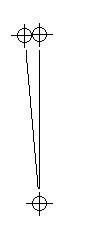
Due to the size of the balls in play, there is no 90* cut for any practical shot on the table (non-frozen). The shallowest cut angle occurs where the cue ball would be 9' (108") away. Even so, the maximum cut angle allowed by geometry is: 88.8*. This is found from arctan(108/2.25).

cut.jpg
 
Snapshot9 said:
But I can't stand it - The thread title should read 'Highest cut shot angle' not lowest.

I know, I know, I've already been severely chastised :o on this in a previous post. My thinking on this, and wrongly so, was that a straight-in shot would be propelling the ball in a 180 degree angle and a most severe cut-shot would be about a 90 degree angle (give or take) and that any object ball being propelled in between straight and a 90 degree angle would be in between 91 degrees and 179 degrees. So, as I saw it, if a ball COULD be cut somewhat backwards (and I believe the jury's still out on this one), the ball would have been cut at a LOWER angle, thus the use of the word "lowest" in my OP. Geez, when I explain it this way, it still sounds like I had it right the first time. At least to me it does. But then, I ain't exactly the sharpest tool in the shed :D :D :D !!!

Maniac
 
Back
Top