why are full splice points always short?

spliced said:
How come points on a full splice cue are always so short? On titlists, as well as current full splices made by prather, davis, and others, the points always end up only being 6-7" long from wrap to tip, as opposed to most short splices with points around 9/10". Is it difficult to get them longer on a full splice or something?

So where do you see short splices with 10 inch points?

Szams are considered quite long - they run aprox 8 inches.

Dificulty is not an issue - length is determined by the
angle the stock is cut.

As for the cue in your link:
that is just where the builder chose to put the wrap.
IF the butt hasn't been cut, the points will extend back
aprox another 3 inches under the wrap

I have a Titlist that has points 9 1/2 inches in length
from top to bottom. An old 26 1/2 has points over 11 inches long.

Dale
 
spliced said:
How come points on a full splice cue are always so short? On titlists, as well as current full splices made by prather, davis, and others, the points always end up only being 6-7" long from wrap to tip, as opposed to most short splices with points around 9/10". Is it difficult to get them longer on a full splice or something?

titlist example:

http://forums.azbilliards.com//attachment.php?attachmentid=87127&d=1233423311

I don't know who built this cue, however, there is no way to tell from the Photo that the cue is Full Splice. Many times Titlist cues are to short for conversion, this is because the points / butt section of the Titlist are in mant cases from a one piece cue and are not long enough (29 inches) for a conversion cue butt. So to correct this problem a section of the wood from the original cue below the points is cut for the cues butt, and a handle is added where the forearm and butt are attached to give the needed length. So if a Titlist Conversion is wraped, and you do not have access to the builder, you don't know if the cue is still full spliced.

Full splice cues can be made with points any length that the cue maker desires, it all depends upon what a cue maker prefers. In most cases once their machinery is set up to build things a certain way they leave it that way. The set up and making the Jigs needed for building that type of cue is the hardest part of making them.

Take Care
 
My Short splice points with veneers are 9 to 10 inches long when finished. I made several of my recent full splice non-veneered butts to have points that are 9 to 10 inches long. They are hanging there waiting for inlays. But to answer your questions as to why very few of us make them longer. It is harder to do and takes more material. I have to start with a 30" butt wood blank to make the points long. Most start with a 24" blank. It takes longer veneers if adding long points with veneers. They are harder to hold even when longer because the angle is less severe and the least amount of run out will throw the points off alot.
 
Last edited:
Im sorry if I confused anyone. I understand that the points extend back under the wrap, where the veneers come together in the splice. I'm not talking about that, just from the beginning of the maple forearm after the wrap to the tip of the point. On most full splice cues, the length only extends about 6", unless the splice is moved forward after the wrap, but I don't like the look.

Hercek is the only cuemaker that makes full spliced cues with long points that come within 3" of the joint, without the bottom of the splice protruding past the wrap. I was just wondering why.
 
cueman said:
My Short splice points with veneers are 9 to 10 inches long when finished. I made several of my recent full splice non-veneered butts to have points that are 9 to 10 inches long. They are hanging there waiting for inlays. But to answer your questions as to why very few of us make them longer. It is harder to do and takes more material. I have to start with a 30" butt wood blank to make the points long. Most start with a 24" blank. It takes longer veneers if adding long points with veneers. They are harder to hold even when longer because the angle is less severe and the least amount of run out will throw the points off alot.


Thanks Chris this is exactly the info I was looking for.
 
spliced said:
Im sorry if I confused anyone. I understand that the points extend back under the wrap, where the veneers come together in the splice. I'm not talking about that, just from the beginning of the maple forearm after the wrap to the tip of the point. On most full splice cues, the length only extends about 6", unless the splice is moved forward after the wrap, but I don't like the look.

Hercek is the only cuemaker that makes full spliced cues with long points that come within 3" of the joint, without the bottom of the splice protruding past the wrap. I was just wondering why.


Hercek is the only cuemaker that makes full spliced cues with long points that come within 3" of the joint, without the bottom of the splice protruding past the wrap. I was just wondering why.[/QUOTE]

Herceks Cues are not a traditional Full Splice, his cues consist of a Short Spliced forearm that is spliced to the cues handle. The best available example of a True Traditional Full Splice with Veneers is a Willie Hoppe Titlist one piece cue. Where the wood used for the cues Butt and the wood used for the cues forearm are joined at the Splice, along with the Veneers for the cue points. There are no additional splices used in the butt so the handle wood and the wood for the point is a solid piece.

Many cue makers today do not want to take the time to use this method of construction any longer. It requires a great deal of work to set up, build the necessary Jigs for, and then to perfect the technique. This technique is accomplished on a Table Saw, and some have also used a large Band Saw. Another consideration is that it takes much more work than current methods, which attempt to copy this technique, and much more material is wasted during the building process.

Here are some examples of a similar technique to that used by Joel Hercek.

v_SPLICE.jpg
 
Or maybe you were looking for a traditional Ebony pointed full splice or an Ebony on Ebony one.....


020.jpg
 
manwon said:
Herceks Cues are not a traditional Full Splice, his cues consist of a Short Spliced forearm that is spliced to the cues handle. The best available example of a True Traditional Full Splice with Veneers is a Willie Hoppe Titlist one piece cue.

Are all Herceks like that or just the heavier wood cues? (Cocobolo, and Ebony) I thought he did the additional splice for balancing purposes and it wasn't necessary for the Rosewood or Purpleheart. Honestly just curious, I'll never try to take apart a Hercek to find out myself. :D
 
shakes said:
Are all Herceks like that or just the heavier wood cues? (Cocobolo, and Ebony) I thought he did the additional splice for balancing purposes and it wasn't necessary for the Rosewood or Purpleheart. Honestly just curious, I'll never try to take apart a Hercek to find out myself. :D

I am uncertain if all Herceks are made like this, however, this the technique Burton Spain was using for the last few years of his life. It is also very similar to .the technique that John Davis who worked with Burton in the 1970's uses. Joel may make full splice cues in a traditional manner also, however, there are only two ways to tell find a wrapless cue or remove the wrap off a Hercek, and like you said that's the wrong answer.

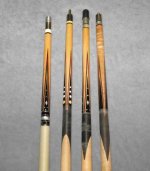
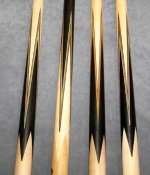
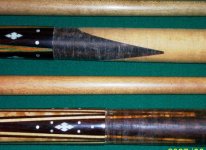
Below are some John Davis full splice butts compare them to the butts abve and you will see how similar they. In addition Palmer was also using this technique in the 1960's, and Adam / Helmstetter was using it in the Early 1970's. So, all I can say is it is not new or unquie and who actually invented it is certainly up in the air, maybe some day we will find out.

John Davis Blanks

John__Davis_Points_op_517x600.jpg

Helmstetter / Adam

Splice.jpg

Helmstetter / Adam

Use.jpg

Paradise and Palmer

v_SPLICE.jpg

Hope this helps
 
Some great information here. John Davis does "true" full splices as well. I have seen 2 Ebony and several other woods as well. It depends on what you order. Your points will be 10" + regardless of what splice he does for you.
 
Here are a few full spliced cues. The first one in an Ebony Titlist Hoppe.


PB290155.jpg


This second pic is an old Brunswick model 26 1/2 full spliced cue with a wedge.


P7090054.jpg


This 3rd shot is a titlist conversion done by Timmy Scruggs.


P6240008.jpg


And this last shot is a very early Palmer similar to Spain and Davis blanks. The jury is still out on who made this one.


P1250063.jpg


The Titlist points have been lengthened by moving them foreward and adding a small butt sleeve addition. They appear very long from point to point. So, IMHO it's a matter of perspective for full spliced point length.
John
 
manwon said:
I am uncertain if all Herceks are made like this, however, this the technique Burton Spain was using for the last few years of his life. It is also very similar to .the technique that John Davis who worked with Burton in the 1970's uses. Joel may make full splice cues in a traditional manner also, however, there are only two ways to tell find a wrapless cue or remove the wrap off a Hercek, and like you said that's the wrong answer.

Below are some John Davis full splice butts compare them to the butts abve and you will see how similar they. In addition Palmer was also using this technique in the 1960's, and Adam / Helmstetter was using it in the Early 1970's. So, all I can say is it is not new or unquie and who actually invented it is certainly up in the air, maybe some day we will find out.

John Davis Blanks

View attachment 87449

Helmstetter / Adam

View attachment 87453

Helmstetter / Adam

View attachment 87454

Paradise and Palmer

View attachment 87455

Hope this helps
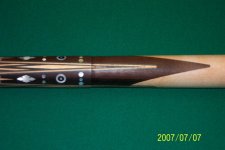
The one dated 2007/07/07 is almost identical to what Burton Spain did in his last days. The v-points go right over the top of the butterfly splice instead of up in front of it. Thanks for posting the great pictures.
 
The top blank's points (10" from top to bottom), look way short (6") once the wrap is installed. So, with a longer splice (15" from top to bottom), when the wrap is installed you still get the nice long points that v-groove inlayed point cues often have, while maintaining the structural integrity of the full splice.

longsplice.jpg
 
Last edited:
anyone capable of making a full splice with 15" points from bottom to top?
 
spliced said:
anyone capable of making a full splice with 15" points from bottom to top?
I am capable of doing it in my shop, but would probably decline doing it unless I was making about 10 of them as all angles have to be changed on the jigs and it would be a lot of trouble. Also it would require different forearm wood lengths.
 
spliced said:
I dont think anyone has quite understood my point. I am just talking about having a blank made like the bottom one. If the cue is going to have a wrap, this is how i would like it done. Now we gets it?

longsplice.jpg
In this picture it appears that you just want the points moved up to the normal forearm/wrap position instead of starting at roughly the half way point. I sell some imported blanks with veneers that are made just like that at www.cuesmith.com on the point blanks and cue parts page.
 
I don't normally make comments however when it comes to full splices I'm somewhat passionate.
I don't make short splices, never have. I make a full splice that has an extra splice under the wrap.
This allows me to control the weight and the balance. Simply put, a true full splice consists of the prongs
being cut from the handle wood. The length has nothing to do with the term full splice, whether you run the wood
all the way to the butt or end it in the handle, the technique is still the same. Hope to see some of you guys at VF.

Joel Hercek
 
Back
Top