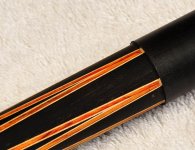
Recut points

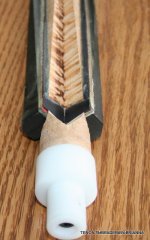
Recut points are when you cut your "v" groove in the forearm, inlay a piece of wood for the point, cut a "v" groove into the point you just inlaid, glue in your next piece of point wood, etc. It gives you the different wood variations like veneers but it is done with solid pieces of wood instead.

With veneers you usually see a miter at the tip of each point.

Check out this thread...http://forums.azbilliards.com/showthread.php?t=107062&highlight=recut
 
Last edited:
> Recuts work like this. A 90 degree groove is cut down the length of the forearm,like you would normally do for a short-spliced point,where a square of wood is glued into the groove,then the excess is cut off and the whole piece is turned back round.

Where this differs is instead of using a stack of colored or different woods,you glue a solid piece back in,turn it back round,and cut another 90 degree groove,and repeat.

The end result is a forearm with what looks like a colored/contrasted veneer,but with no seam at the tip.

It's a LOT more work to make it look right,and a potential hazard as there are a LOT more chances to have something go wrong like cutting a groove to deep or it running out while turning and having the points come out funny.

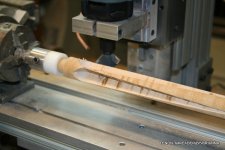
There are jigs and fixtures that some use to overcome this,but there are not that many cuemakers that have a "talent" for them. It's still a fairly new technique as far as I know,thus there aren't that many that do them regularly. A cuemaker that does them well,however,should be considered at least middle-elite. Having them come out really close or perfect is a sure sign of world-class craftsmanship. Correspondingly,they are more expensive to the buyer as well. Hope this helps,Tommy D.
 
Recut V points are not for the "hobbyist"! It requires some very accurate equipment.
A large mill is almost a requirement....

Pretty much anyone that does these is going to be a very well equipped and very accomplished and talented cuemaker.
 
Here is one that I just finished after 3 tries. 6 pointer, 4 recuts per point, last veneer was boxed. Real pain in the butt. This was built using the glue point in, turn round and recut next point in method. Wishing I could learn Dave's method!
 

Attachments

  • DSC_1188.jpg
    DSC_1188.jpg
    83.9 KB · Views: 494
  • DSC_1189.jpg
    DSC_1189.jpg
    94.8 KB · Views: 496
Here is one that I just finished after 3 tries. 6 pointer, 4 recuts per point, last veneer was boxed. Real pain in the butt. This was built using the glue point in, turn round and recut next point in method. Wishing I could learn Dave's method!
Wow, that looks really nice!
 
Thanks Sheldon,
Third time cutting the points into the same forearm, not something I want to do anytime soon again.

Kenny Murrell
 
:yes:
Here is one that I just finished after 3 tries. 6 pointer, 4 recuts per point, last veneer was boxed. Real pain in the butt. This was built using the glue point in, turn round and recut next point in method. Wishing I could learn Dave's method!
That is GEORGEOUS, thanks for the comments and the pic!
 
@Kenny
this is a very nice clean work.

@Jason
Take a look on my cue (link in my signature). This a six points recuts full splice. DBK makes up to 6 recuts afaik.
 
What are some of the ways to remove and replace the cue with exact accuracy?
MAx
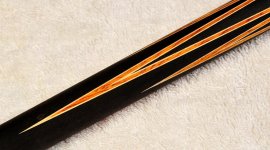
A recut fixture allowing you to remove it 100 times if wanted with acuracy
its the white delrin plastic on the end of the forearm
 

Attachments

  • SZAM 008-1.JPG
    SZAM 008-1.JPG
    75.1 KB · Views: 217
I will ascertain that the re-mount or re-cut jig that Lee sells is the nut. Absolute perfect re-indexing every time. I've got two of them, one for my mill for V-cuts and one for my CNC for inlays.

Dick
 
Back
Top