Inexpensive coring wood for weight

kiinstructor

AzB Silver Member
Silver Member
I have a number of Birdseye maple forearms that I would like to use for cues. Problem is their very light and even with inlays not much heavier. I know maple has a wonderful hit and feel so I want to use them as some are striking in their figure. Anyway I need suggestions for a coring material thats not expensive. I don't think longer pins on the handle will help much and I really don't favor that technique. Thanks guys.

Mark
 
Purpleheart is an option, but any core wood will change the hit somewhat. I find purpleheart to be a little pingy compared to maple.

Alan
 
Last edited:
I have used full length purple heart core in a CM and cocobolo cue and the person that owns the cue says it hits nice.

My PH core weighed a little more than an oz more than a maple core.

It has a maple shaft, juma ferrule, lepro tip and weighs 21 oz.

Kim
 
I'm a fan of BEM and in recent times have been considering that hi-fig BEM would benefit from a core.
While the Maple can have a lively enough hit, there could be a stability issue with some of the more
highly figured pcs. It comes down to a 'roll of the dice' in the decision process of which pcs will move
and which will remain straight over the life of the cue. Coring can provide a level of insurance for both
the buyer & the builder. My new motto: when in doubt, core.

Coring can also be done to add or lessen wght.
In this particular case, you want to add some wght without using metal. Coring is a viable option.
It may be your only option.
As to what wood you should use as a core, there are many sites devoted to the scientific approach to various
woods based on the numbers: specific gravity, lbs/cu.ft, density, fiber/grain structure, etc.
Research in this area can be fruitful. No one wood will cover all the bases for the perfect core.
Learn as much as you can and you'll be better prepared to make the decision as to which wood will best suit your needs.
Purpleheart may be a good starting point for you here. It has both wght. & density and it's inexpensive.
Some hands-on experimentation will be to your advantage. No better way to learn than by doing.

I'm by no means a coring expert and have put-off the practice for many yrs while contemplating; is it really necessary?
I've come to the conclusion that in some cases it is.

KJ
 
Using Specific Gravity

I'm a fan of BEM and in recent times have been considering that hi-fig BEM would benefit from a core.
While the Maple can have a lively enough hit, there could be a stability issue with some of the more
highly figured pcs. It comes down to a 'roll of the dice' in the decision process of which pcs will move
and which will remain straight over the life of the cue. Coring can provide a level of insurance for both
the buyer & the builder. My new motto: when in doubt, core.

Coring can also be done to add or lessen wght.
In this particular case, you want to add some wght without using metal. Coring is a viable option.
It may be your only option.
As to what wood you should use as a core, there are many sites devoted to the scientific approach to various
woods based on the numbers: specific gravity, lbs/cu.ft, density, fiber/grain structure, etc.
Research in this area can be fruitful. No one wood will cover all the bases for the perfect core.
Learn as much as you can and you'll be better prepared to make the decision as to which wood will best suit your needs.
Purpleheart may be a good starting point for you here. It has both wght. & density and it's inexpensive.
Some hands-on experimentation will be to your advantage. No better way to learn than by doing.

I'm by no means a coring expert and have put-off the practice for many yrs while contemplating; is it really necessary?
I've come to the conclusion that in some cases it is.

KJ

When I was doing Engineering work for plastics I have used specific gravity to calculate the weight of a certain volume. It worked very well and got me within 1% accuracy on a complex shape. With a simple cylinder you should be able to get pretty much dead nuts.
 
When I was doing Engineering work for plastics I have used specific gravity to calculate the weight of a certain volume. It worked very well and got me within 1% accuracy on a complex shape. With a simple cylinder you should be able to get pretty much dead nuts.

That does work with good accuracy. The only problem is that wood specific gravity varies with humidity, mineral content and just because it is a plant and not a man made product.

There are specific gravity charts on the internet listing most all woods.

Kim
 
That does work with good accuracy. The only problem is that wood specific gravity varies with humidity, mineral content and just because it is a plant and not a man made product.

There are specific gravity charts on the internet listing most all woods.

Kim

I think the best way , is to turn your wood to dowels, weigh and measure them.Then you know the density of the product you are working with.
At some point they most likely need to be dowels anyway.
 
I'm a fan of BEM and in recent times have been considering that hi-fig BEM would benefit from a core.
While the Maple can have a lively enough hit, there could be a stability issue with some of the more
highly figured pcs. It comes down to a 'roll of the dice' in the decision process of which pcs will move
and which will remain straight over the life of the cue. Coring can provide a level of insurance for both
the buyer & the builder. My new motto: when in doubt, core.

Coring can also be done to add or lessen wght.
In this particular case, you want to add some wght without using metal. Coring is a viable option.
It may be your only option.
As to what wood you should use as a core, there are many sites devoted to the scientific approach to various
woods based on the numbers: specific gravity, lbs/cu.ft, density, fiber/grain structure, etc.
Research in this area can be fruitful. No one wood will cover all the bases for the perfect core.
Learn as much as you can and you'll be better prepared to make the decision as to which wood will best suit your needs.
Purpleheart may be a good starting point for you here. It has both wght. & density and it's inexpensive.
Some hands-on experimentation will be to your advantage. No better way to learn than by doing.

I'm by no means a coring expert and have put-off the practice for many yrs while contemplating; is it really necessary?
I've come to the conclusion that in some cases it is.

KJ
I've turned down maple dowels for core. Some were tight grain ugly yellow birdseye maple. I stored them where temperature can get up 100* sometimes and humidity down to 10% sometimes. Some of the hard figured bem's checked and some cracked totally.

To the TS.
If the cue will have a wrap, I suggest using a purpleheart or straight grain bocote for handle.
If it will have an exposed handle and the handle will be light as maple, I suggest using a rosewood core. Purpleheart is nice but it does not glue the best among rosewoods.
 
I don't know how much weight you're looking to add, but Oak is a tad heavier than maple and should give adequate gluing performance. It's also pretty cheap.
 
I think the best way , is to turn your wood to dowels, weigh and measure them.Then you know the density of the product you are working with.
At some point they most likely need to be dowels anyway.

You are right.. a real measurement is the best.

I weigh almost all the pieces that I turn, butt sleeves, forearms, shafts , handles, core dowels..... and I note the species of wood. I keep a 5X7 card with this info handy.

Kim
 
don't go cheap

using cheap wood for coring, is like putting a pinto engine into a porsche. i am by no means an expert on such matters, but i have been building cues for almost 10 years. i do core some of my highly figured wood. i like the flat laminated maple dowels sold by hightower and atlas, they are very solid and the laminated wood will not warp as bad as some woods.
i do not think you can build a high quality cue using cheap materials. i believe it takes, quality materials, quality equipment, and quality labor.
 
using cheap wood for coring, is like putting a pinto engine into a porsche. i am by no means an expert on such matters, but i have been building cues for almost 10 years. i do core some of my highly figured wood. i like the flat laminated maple dowels sold by hightower and atlas, they are very solid and the laminated wood will not warp as bad as some woods.
i do not think you can build a high quality cue using cheap materials. i believe it takes, quality materials, quality equipment, and quality labor.
I don't like those flat lams . It might be just me.
I've had some from Shcmelke and Dufferin.
They have too much glue to have a good tone for me.
They're weren't that stable either .
When I cull my shaft dowels, I will find a bunch that can be cut down to 15-18 inches long and the grains will be straight at those lengths. A lot of times I will find dowels that run-out beyond those mark ( both ends sometimes ), so I just whack them.
I re-center them and turn them and season them.
At final size, I store them for months, unsealed.
The survivors become cores.
Old chopped house cues make for good handle cores too ( 7/8 diameter ) .
 
not exclusive

those are not all i use joey, i have about 200 old one piece cues and use quite a lot of them for coring because they are older cured wood, but i have got some of the laminated dowels that were very dense, heavier pieces that i really liked. never got any from schmelke or duffrin so i have no idea what those are like, but as with all woods some are better and some are badder
 
those are not all i use joey, i have about 200 old one piece cues and use quite a lot of them for coring because they are older cured wood, but i have got some of the laminated dowels that were very dense, heavier pieces that i really liked. never got any from schmelke or duffrin so i have no idea what those are like, but as with all woods some are better and some are badder
Those are useless.
Send all with purpleheart bottoms to me.:D

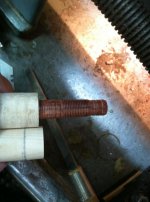
Sometimes I do this.
 

Attachments

  • IMG_7001.jpg
    IMG_7001.jpg
    82.6 KB · Views: 331
Last edited:
I use jatoba. Strong, hard, heavy, pingy, stable. A plus to that is that it's inexpensive. But never worry about cost. Your cue will only be as good as what you put into it. Use the very best of everything, no matter cost, and if you do a good job then your cues will be great cues. Cheap out & do an awesome job & your cues will only be as good as your budget.

To drive that point home, one of my go to core woods is koa. I choose it because it's relative to maple in weight & hardness, but has a strong smoky tone that brings burls & high figured woods to life. Last board I bought was $550, just to use as cores.

A lot of guys would think that's stupid, crazy, whatever. That's fine. It's not their name going on my cues. It's mine. Coring can be as easy as plugging holes with reject shafts to increase stability, keep consistent weight, and keep a relatively consistent hit. Or it can be a complex science where you factor weight, balance, tonal qualities, and wood compatibility dynamics to tune the cue to play & feel a particular way. Does all the extra actually pay off? In short term, no, the well tuned cue may only hit & feel slightly better than the cookie cutter cue. But in the long run, every cue is better and it won't be long before everybody notices the extra little edge. Once that happens, your cues are worth more, far more. It's not the fact that you cored with different woods. It's the character quality that wanted even the unseen details to be your absolute best. The devil is in the details. Detail is what makes the difference between your cue & the cues of other builders.

I core with koa, use african blackwood for my thin black rings, and only use shafts that were submerged in virgin's urine. I build cues of lauro preto and inlay fleur de lis' with turquoise. Ok maybe not all of that, but you get the idea. Don't skimp....or it'll show in your cues.

 
I use jatoba. Strong, hard, heavy, pingy, stable. A plus to that is that it's inexpensive. But never worry about cost. Your cue will only be as good as what you put into it. Use the very best of everything, no matter cost, and if you do a good job then your cues will be great cues. Cheap out & do an awesome job & your cues will only be as good as your budget.
.

Cheap core woods are plentiful.
Granadillo, bolivian, honduran and jatoba.
Their hit do not care about their price.
 
using cheap wood for coring, is like putting a pinto engine into a porsche. i am by no means an expert on such matters, but i have been building cues for almost 10 years. i do core some of my highly figured wood. i like the flat laminated maple dowels sold by hightower and atlas, they are very solid and the laminated wood will not warp as bad as some woods.
i do not think you can build a high quality cue using cheap materials. i believe it takes, quality materials, quality equipment, and quality labor.

Using expensive wood for coring is silly if there is an equally suitable wood available that costs less. I think that is what the OP was asking about.
 
if there is an equally suitable wood available

Not such an easy task, regardless of price. The moment you begin incorporating cost into the decision making, you have already begun to compromise. What follows is a trail of other decisions. How much difference will it make? Will it be good enough? Etc. Not compromising in the first place leaves no room to doubt, and you can press on with other critical facets such as construction & dimension. That's not philosophy. It's experience.
 
Back
Top