LED Flat Panels - the next generation in lighting

Maybe Pops. They aren't as good as they used to be. Neither is my hearing. Don't even get me talking about the prostate.

Just sayin that the pics don't do it justice and I couldn't see any dark spots.

Hey, look at it this way. That light for a 4x8 is a great price. 40 to 60 thou hrs and it costs
you a penny a day. Maybe less. I was joking with a friend. I said that if he bought it, he would be dead long before the light was. Me too.

Much better than most lights that are available today with either 100 or 60 watt bulbs.

I'm used to playing in halls that if one light burnt out, you went and robbed one from another table. We had a mis match of 100s and 60s. If we had 3 lights, we were happy.

What happens when we are forced to buy those high efficiency low watt bulbs. These LEDs are gonna work better than those.

I remember playing a tourney during a storm. Power went out and people stood around the table with lighters until we got the power back. It was fun.
Talk about shadows tho.

It might have come off like I was being an ass by posting pictures of dark spots but I do like the lights.

I was merely suggesting or asking if it would be better to even purchase two sets to balance out the lighting.

I think it's great and i apologize if I was raining on someone's parade.

It could be just my old eyes too. :grin:
 
Can these lights handle a whack from a cue tip? Sooner or later someone will hit one pretty hard.
 
My question still stands for the OP, hope he visits us again.

Color Temperature = ???
How is power fed to the fixture?
 
Last edited:
Almost no heat to speak of, which is standard for LED lighting.

The pictures are distorting the look because the camera picks up the light differently than the eye. Believe me the light is very even over the entire table. Two panels on a 9' table are, as Darcy said, overkill quite frankly. Two 2x4 panels would light up a snooker table.

I'll get some more pictures tomorrow.
You're right, pictures can be misleading. Get a light meter and measure the light levels at the corner pockets and at the center spot. I think a meter will show that you have at least a 2:1 variation in illumination, which is measured in lux.

I think a better arrangement would be to have two smaller panels each centered over a spot -- one over the foot spot and one over the head spot. This would allow you to mount a camera centered over the middle of the table. I think those fixtures basically cost so much per square foot, so two separate half-sized fixtures would not cost much more.
 
You're right, pictures can be misleading. Get a light meter and measure the light levels at the corner pockets and at the center spot. I think a meter will show that you have at least a 2:1 variation in illumination, which is measured in lux.

I think a better arrangement would be to have two smaller panels each centered over a spot -- one over the foot spot and one over the head spot. This would allow you to mount a camera centered over the middle of the table. I think those fixtures basically cost so much per square foot, so two separate half-sized fixtures would not cost much more.

I agree with this arrangement. Although I know how much a digital image can exaggerate lighting glare compared to how the eye perceives it in real life, there will always be a noticeable "hotspot" when only one light source is used. Distance can reduce the effect, but light levels drop off significantly with increased distance. A light that provides "X" lumens at 36" above the table surface will only provide about one half that number of lumens to the same surface at 48".
 
led light

in the photo where it's floating over the table, i don't see a power cord. How does it get power?

And again, how much does it cost?
 
My question still stands for the OP, hope he visits us again.

Color Temperature = ???
How is power fed to the fixture?

I'm curious as well. I'm currently using three G.E. Reveal CFL floods in my traditional fixture. They use less power and are very cool to play under, but they make my Centennials look a little funny colored because of the light temp. Of course, they also leave three noticeable hot spots, so these new LED panels may be the answer as long as the color temp is good.

Another thing is that they look like they may have more overhead glare than the Diamond light. I have a major problem with glare in my right eye causing cloudy vision and I love the Diamond because it's the most glare-free light I've played under.
 
Power is fed with low voltage wire along one of the support wires.
I think it's been posted at 6000k
 
I agree with this arrangement. Although I know how much a digital image can exaggerate lighting glare compared to how the eye perceives it in real life, there will always be a noticeable "hotspot" when only one light source is used. Distance can reduce the effect, but light levels drop off significantly with increased distance. A light that provides "X" lumens at 36" above the table surface will only provide about one half that number of lumens to the same surface at 48".

I was thinking the same thing. If the light were lowered we would see more even coverage in the photo.

Usually its hard to get a perfect 5000k white in an LED. Sometimes its not too obvious, but many have distinct red or blue-ish spectrum.
I have used many LED's over the last 5 years or so, and they get better every year.
 
LED lights are the way to go. They are so flexible you can put them in about any arrangement imaginable. They're low voltage so all you need is a small transformer (like the ones used to charge your laptop computer) and give off no heat.

You can order LED "strips" in just about any color output. The strips are usually 16-foot lengths (cut-able every 3 inches, so you can customize your strips to exact sizes you want).

Yes, you can build these yourself...but at this price it's really not worth your time. If they were asking DiamondLight-like prices, I'd make my own.
 
My question still stands for the OP, hope he visits us again.

Color Temperature = ???
How is power fed to the fixture?

Color temperature is 6000K

Light is fed through a small power line, which in this setup is attached to one of the cables. That line is going into a transformer (the lights only draw 24V) and then into the main power line.

Someone asked can they be whacked by a cue? The frame is aluminum and the light covering itself is a real hard plastic, so they're pretty durable. Besides, if they're hung up at eight or nine feet, they're going to be pretty much out of harm's way.
 
I was thinking the same thing. If the light were lowered we would see more even coverage in the photo.

Usually its hard to get a perfect 5000k white in an LED. Sometimes its not too obvious, but many have distinct red or blue-ish spectrum.
I have used many LED's over the last 5 years or so, and they get better every year.

Actually, I meant that by raising them you would get a more even coverage, but you would get less illumination of the table surface.

I just went down and swapped out the Reveal floods for three 6500K regular CFLs I had kicking around. Boy, do I feel stupid. I've been making excuses to myself for spending $45 on three lousy light bulbs, and suffering for over a year with the same poor color light but was too stubborn to try something else.

Well, the Reveals are now sitting on a shelf I the pool room and I'm going with the regular CFLs for now. The Cents actually look normal now. Bye-bye brown 7-ball and orange 3-ball. Better definition of the balls now as well. Even though the apparent light level seems a tad less, the quality of the light made seeing the balls easier. I started hitting them real good, too, just because the light was so much nicer to play under. Strange how these little things can have such a big effect on our game.
 
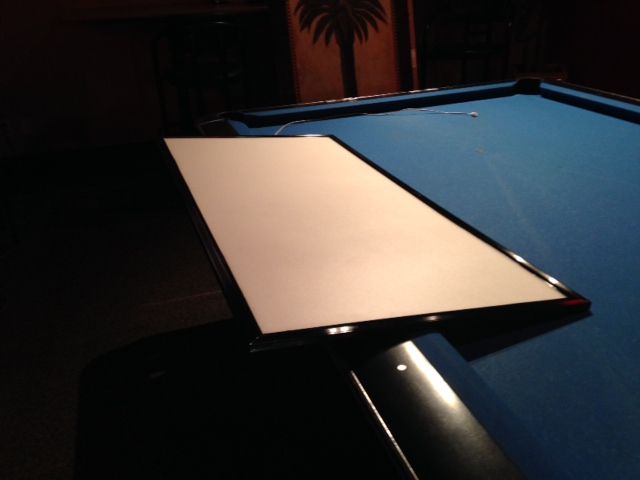
This is the newest thing in pool lighting, it looks like a whiteboard or something, but really it's a light...

LEDpanel.jpg


It's only 1/2" thick, weighs about 18lbs, and only draws 84W of power, but it gives off 4500 Lumen of pure, white light...

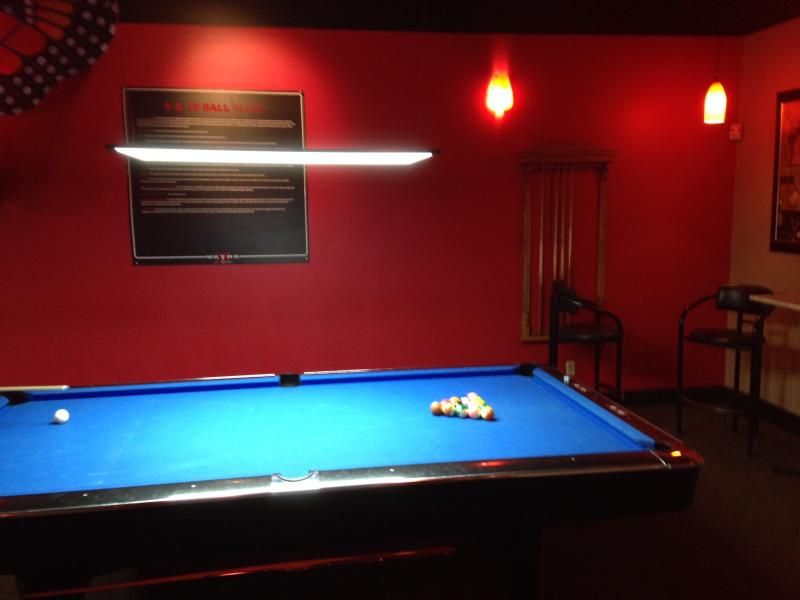
image1.jpeg


The room owner has hung them using thin aircraft cable, which gives them the appearance of just floating in mid air (very cool), but they can be hung in a variety of ways. They can also be hung way higher than standard lights, because they give off so much light.


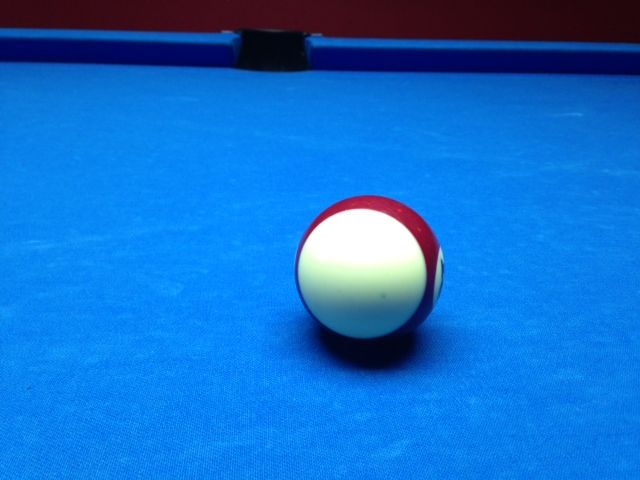
Here's a ball sitting at the centre of the table, very clear edges, very soft shadow...

centertable.jpg


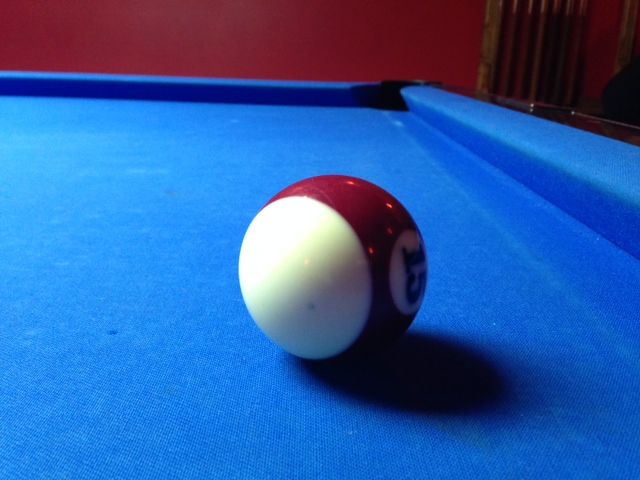
Here's one at the edge. Again soft shadow, no darkness under the rail, and very clear view of the edge of the ball...

edgeoftable.jpg


Personally I was so impressed by their light output that I started repping them for the company (I posted a thread here, in the Wanted/ForSale forum, if you want more info, or you can PM me, don't want to tard up the main forum with sales talk).

I think, though, that the future of pool lighting is in these panels. They draw so little power, last so long, and give off such excellent light that they're going to be a game changer. What do all you pool nuts think?

Discuss...

It looks to cause harsh shadows around the balls. That type of light does not seem to defuse. I think I would feel sick playing under that light for any length or time.
 
Actually, I meant that by raising them you would get a more even coverage, but you would get less illumination of the table surface.

Exactly. In fact I can remember having conversations with Greg Sullivan about Diamond lights, and he was striving to have them hung at 96" from the ground, but the obvious tradeoff is that the farther the light is from the surface of the cloth the less total light you'll get. I still think that 96" is an ideal level, but in this particular pool hall the owner went with ~86" because he liked the look. Plus he felt that if he wanted to go higher he could always shorten the cables, but he couldn't do the reverse, so in a few months he may re-evaluate.

I actually think you could go as high as 120" with these panels and not lose overall total illumination by very much at all.
 
It looks to cause harsh shadows around the balls. That type of light does not seem to defuse. I think I would feel sick playing under that light for any length or time.

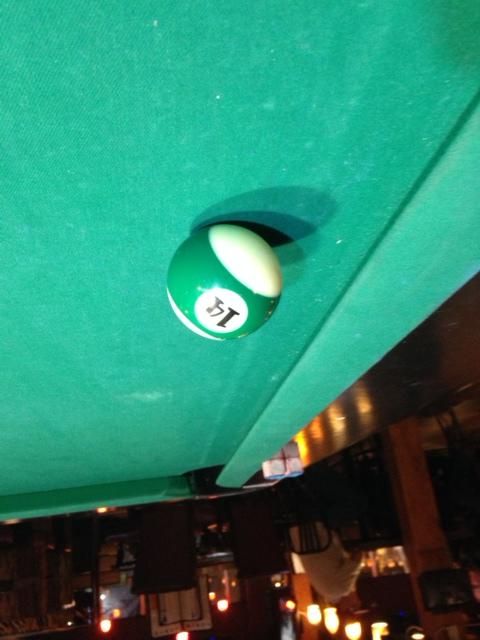
Well, here is a picture of another table in the room, but this one is lit by a standard three light fixture with fluorescent bulbs...

oldlight14.jpg


Notice here that you have three shadows, one from each light, and they're much darker than under the LED. You've also got a lot more glare on the inside portion of the ball. These are both things that we've just gotten used to over the years as pool players, but I guess it's amazing what you can get used to.

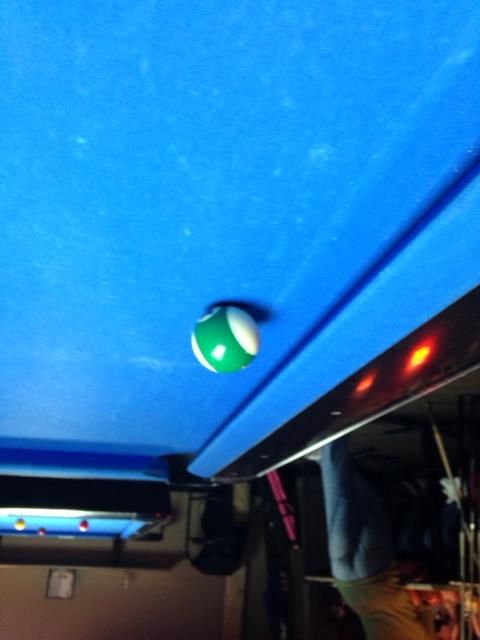
Now compare to the LED...

newlight14.jpg


Much softer shadow, and greatly reduced glare (no UV in the light), so both the inside and outside portion of the ball appear very sharp. Much sharper than with the other fixture.
 
Last edited:
I actually think you could go as high as 120" with these panels and not lose overall total illumination by very much at all.

Just like in pool, there's no cheating the basic rules of physics. Light falls off as the inverse square of the distance from the source. You won't notice this outdoors because no matter how high the mountain is that you climb you are still 93 million miles from the sun. Indoors is a whole other ball of wax.

What matters in not how high the light is, but how far it is away from the table surface. In the case in the photo, the light is 86" high, which is 56" above the table surface. At a 120" height the light is now 90" above the surface. This will result in light loss at the table surface of over 60%. Not an acceptable compromise IMO, and one that would require an entire extra light fixture to even get close to what you get at 86". I think 96" would be fine and would give much better coverage than at 86" with only a 20% reduction in light at the bed.
 
One possible improvement would be a trapezoidal cloth shade that hangs down from the light. It would reduce the glare to the side and protect the light from wild cues. I'm thinking a truncated rectangular pyramid shape that would not reduce the illumination on the table's surface. I suppose the inside could be white.
 
It looks to cause harsh shadows around the balls. That type of light does not seem to defuse. I think I would feel sick playing under that light for any length or time.

I notice that too. The shadows are a blur while the conventional lighting may give off multiple shadows, depending on setup, some are just fine like the ones in a grid system.

Some lights are easy on the eyes while some are not. My buddy got those bulbs for his room that are suppose to represent daylight. Can't play hours on it without feeling nausea.

Lighting is very important depending on duration of play. You need something comforting.
 
Back
Top